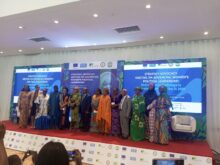
As the National Conference reconvenes on August 4, Tony Uranta, a member of the Presidential Advisory Committee on National Conference, in this interview with OWEDE AGBAJILEKE, harps on the need for true federalism and laments the degradation suffered by the people of Niger Delta.
Do you think the National Conference has overcome the initial skepticism and uncertainty that greeted its convocation few months ago?
The Conference will reconvene August 4 to look at the reports and ascertain that resolutions are reflected in the reports as they were arrived at, without any smuggled items, or items taken out.
I can say hopefully that when they reconvene it shall not be only the reports they shall look into. There shall be issues concerning how to get the National Assembly to do the needful by amending the Constitution speedily so as to allow for a referendum to be held as soon as possible. And thus, empower Nigerians to ratify or dismiss the resolutions of the Conference.
I also anticipate that the Conference Delegates will be interested in looking at whatever fallout there might be between now and August 4. And I think fallouts have already begin to manifest. The Northern youths under the aegis of Arewa Youths have gone to the new Emir of Kano, His Royal Majesty, Sanusi Lamido Sanusi, to demand that there must be a Northern Republic and that they want to secede from Nigeria. In like manner, we are also aware that the three Southern zones plus the Middle Belt zone gave their irreducible minimum position, right from the beginning, as being that federalism be enshrined properly in the Constitution and the regions/zones by the federating units.
Since apparently, the regions did not at the end become the federating units, we are still going to be faced with the problem of the fact that these desires of over 50 percent of Nigerians were opposed vehemently by less than 40 percent of Nigerians. This latter group, as the whole world saw, introduced a threat-and-nuisance element into proceedings right from jump. This abrasive stance inadvertently encouraged by the Conference leadership was not firm on equitable discipline. If, for example, Justice Kutigi had called the Lamido of Adamawa to order when the esteemed royal father threatened secession, that would have set a tone in line with Mr. President’s caveat as to the unity of Nigeria being sacrosanct and all delegates would have been more circumspect in allowing others’ positions to be better accommodated.
Now that issues like Federalism, Regionalism and Confederalism seem to have been temporarily placed on ice, it may force otherwise nationalistic people, who went in there with these as their minimum irreducible positions, to seek alternative routes to attaining those positions. Those alternative routes, I believe, will be a dangerous trend because they could may lead to mass and diverse separatist calls, such as that by the Northern youths, evolving in Nigeria, with many groups crying out that they want to be free of the putative encumbrance of this contraption called Nigeria.
I personally prefer today’s big and growing Nigeria to any smaller units but I am a pragmatist. It’s not about what I prefer or what I would like; what I am scared of is what may really happen. And what may happen, going by what we are seeing is that the nation may be plunged into a crisis of disunity and more insecurity.
What do you think was responsible for the stalemate on the discourse over derivation?
Partly, one of the problems about the whole process was the fact that derivation was even brought up at all. Derivation presupposes that the Federal Government still controls resources and shares out what it wants to share to different sectors/zones/states including the sector from which the revenue is derived. That is not Federalism.
Federalism is not about a central government sharing out resources to units. Federalism means each unit/zone/state owning its resource and paying an agreed-upon tax to the centre. And we have said repeatedly that the first Nigerian Republic was the last one where everybody felt at ease with one another. Regrettably, that was truncated by the January 1966 coup. It was a Nigeria where every region owned its resources.
By the way, we have heard so much revisionism in the recent past from people that we would have considered very enlightened, especially from the Northern part of Nigeria, claiming that one region sustained the whole of Nigeria. That is an outright lie and a revision of truth because every region used its own resources to develop itself and paid 50 per cent of the value of those resources to the Federal Government.
It was autonomy that may have influenced the late Sardauna of Sokoto, Alhaji Ahmadu Bello to decide that he would remain as the head of his region and not be bothered about the centre, and decided to send Tafawa Balewa to the centre to represent the North as the leader of Nigeria. This is because there wasn’t too much attraction in the centre and this was based on the reality of what Federalism should be which is ownership of resources.
We are of the opinion that delegates should not have even accepted to deliberate on derivation. The focus should have been one one word: federalism. Discussing derivation per se was a departure from the Return-to-Federalism concept we had in mind when we, as the Nigerian National Summit Group, started canvassing for this Conference.
NNSG’s desire for Federalism is important because as records show, NNSG was the prime canvasser for this 2014 National Conference. We brought people together on different dates and at different fora and it was agreed that the issue of derivation and resource control were not the nation’s problem and that the issue was Federalism.
What is federalism? We have heard many word definitions that are invariably similar, and have had the slight differences in how, for example, the United States of America and Switzerland practice Federalism. The point remains that with Federalism, the federating units are the real control centres, and not so much the central government. With Federalism we would be able to devolve powers to the extent that we would, for example, have part-time legislators at the National Assembly, and we won’t be wasting up to 75 per cent of our revenues on recurrent expenditures, much of which are going to the legislators and executive members who really can’t operate without all the trappings of power and authority that they have around them.
So, you have a man that has a large perks list and a retinue of aides that consume tens of millions of Naira in a month. If we could have gone properly into the issue of Federalism, we would have found out that we had no need to discuss derivation.
All would have recognised that it is in the interest of every zone and sector to have the derivation principle raised; or, better still, erased, which means let us go to true federalism and decide how much tax we want to pay to the centre.
I know that the southern zones are ready to pay up to even 60 percent as tax to the centre. But because people have got a misconception of what the issue of Federalism, derivation and resource control is all about, they are opposed to it because they see it as a solely Niger Delta-driven issue; and that was based on selective ignorance or intentional mischief.
Don’t you think the aim of the National Conference has been defeated?
It depends on the perspective you are looking at it from. From the perspective of separatists, they have a reason to urge harder for separation. From the perspective of true nationalists, we were able to bring to the front burner certain truths that were swept under the carpet. We had a Lamido of Adamawa revealing at the start of the Conference that he and his people would move over to Cameroun, that is secession. They are not going to move by walking away to Cameroun, they are going to say this landmass of ours has to go to Cameroun, which means they secede from Nigeria and get annexed by Cameroun.
All these things they can achieve through the United Nations self-determination principle. So also the people in Enugu who went and criminally shot people dead and attacked Government House, that is secession. COSEG, the militant arm of OPC is strongly advocating Oduduwa self-determination and they have said in statements in the media they won’t accept the resolutions if they do not give autonomy to regions and allow for holistic devolution of powers.
All these are issues we have known about for 10 years at a minimum, but nobody wanted to address them. We all pretended that it’s not happening. Well, the National Conference has let Nigerians to watch it come to the fore, live on global television that we are different peoples with different objectives and challenges and we can only survive by addressing our different challenges in our unique ways.
For example, there is a very strong likelihood that sometime within the next few weeks Niger Deltans will shut down oil production. It is not so much because they are fighting for resource control or derivation, but because there have been over five earth tremors in Bayelsa, Rivers and Delta in the last one month. And seismologists have identified the cause as being the irresponsible exploration of oil without reinjection of gas into those places to which the oil is taken. So, there is an imbalance created in this extraction. If these imbalances continue, it could lead to major earthquakes.

Join BusinessDay whatsapp Channel, to stay up to date
Open In Whatsapp