

The world’s most industrialised nations who are also the planet’s biggest polluters, barely met or even missed their unambitious renewable energy targets, a new report by REN21, a global renewable energy advocacy group has said.
REN21’s Renewables 2021 Global Status Report published Tuesday shows that the world is nowhere near the necessary paradigm shift towards a clean, healthier, and more equitable energy future.
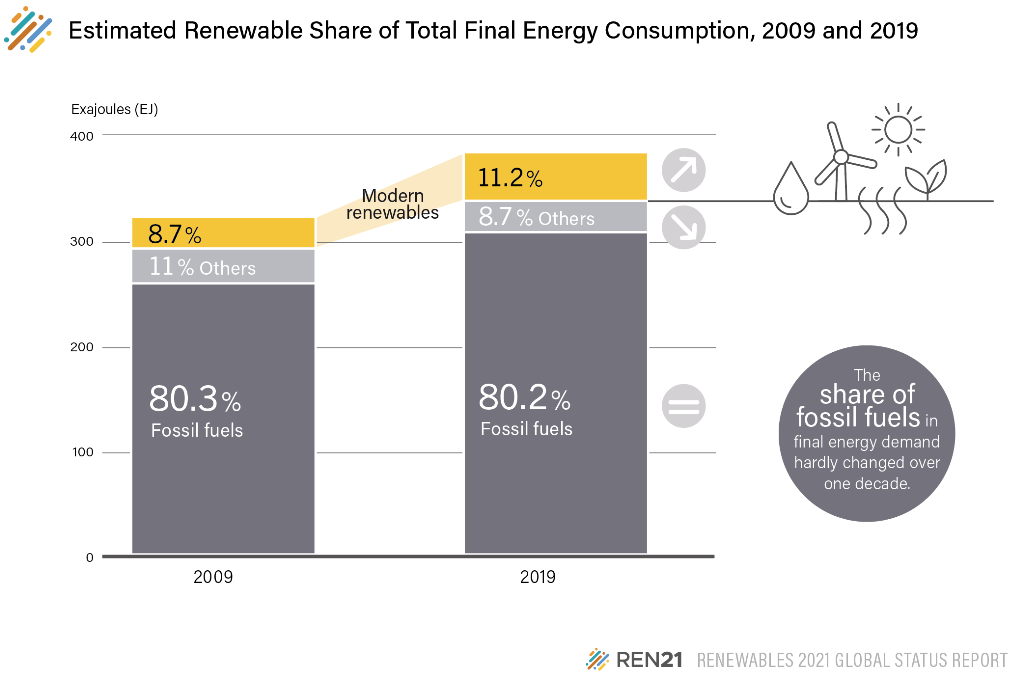
It found that the share of fossil fuels in the total energy mix is as high as a decade ago (80.3 percent vs. 80.2 percent today) and the renewable energy share only increased slightly.
The G20 countries lack targets for renewable energy in total final energy consumption (TFEC), which includes all end-use sectors (power, transport, heating, cooling, industry), it said.
Even with the historic decline in energy consumption last year, the five G20 countries with 2020 renewable energy targets struggled toward their goals. The other 15 did not even have one, the group said in a release.
“We are waking up to the bitter reality that the climate policy promises over the past ten years have mostly been empty words. The share of fossil fuels in final energy consumption has not moved by an inch,” said Rana Adib, REN21’s executive director.
“Phasing them out and making renewables the new norm are the strongest actions we can take.”
Fossil fuels are responsible for climate change, and also heavily contribute to biodiversity loss and pollution. Shifting from fossil fuels to renewable energy is a necessary step to take and making renewables the norm is not a question of technology or costs the researchers found.
However, renewable energy is on the rise accounting for 83 percent of net power capacity additions in 2020. More than 256 GW were added globally in 2020 – surpassing the previous record by nearly 30 percent. This progress could and should be replicated in all other sectors, the researchers said.
In more and more regions, including parts of China, the EU, India and the United States, it is now cheaper to build new wind or solar PV plants than to operate existing coal-fired power plants.
Since 2020, there has been much dialogue about tackling the climate crises. Countries like China, Japan, and South Korea have set net-zero carbon emissions targets.
“This should have made 2020 the year when the world pushed the reset button for the global climate economy and renewables. But instead of driving transformation, recovery packages provide six times more investment to fossil fuels than to renewable energy,” the release said.
REN21’s 2021 report clearly shows that governments need to give a much harder push to renewables in all sectors. The window of opportunity is closing unless efforts are significantly ramped up, and it will not be easy to do.
The report called for taking public spending to levels higher than the Marshall Plan after World War II to really make an impact.
“We do not have another choice for climate reasons, for sustainable development reasons than to move out of fossil fuels,” Adib said in an interview with BusinessDay.
Ren21 is a community of players from industry, government, academia, NGOs that work together to advance the shift to renewable energy.
The multi-sector group’s knowledge activities come from crowd-sourced information through a decentralised network of 200 professionals providing insight into different countries they operate in to put together a coherent narrative.
“Afterwards, the data we collected is shared for peer-review to inform and influence decision-makers as well influence debates,” said Adib.


Join BusinessDay whatsapp Channel, to stay up to date
Open In Whatsapp


