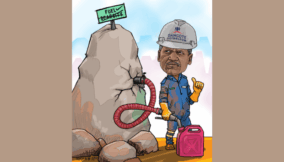
The Nigerian government in the past six years has initiated programmes to deepen energy access in communities living off the national grid.
Much of this progress has been spurred by the need for AN alternative to the creaking national grid which frequently collapses under the weight of too much supply or in the vacuity of too little supply. In an economy racing to develop, renewable energy sources are filling the gap.
While the Buhari administration has demonstrated a clear desire to assist communities living outside the grid to enjoy electricity, the laggard pace of execution, an absence of a clear strategy, and limited participation from the private sector have dulled the impact.
Some of the policies initiated by this administration like the Minigrid policy have the potential to revolutionalise the industry. But shortly after this policy was introduced the government raised tariffs on solar panels worsening the challenge at the ports to clear goods.
Read Also: How Are State Governments Contributing to Electricity Access?
Yet there are currently some programmes underway that could yet achieve good results.
Energising education programme
The objective of the programme is to take clean and reliable energy (Solar and Gas) to Federal Universities and Teaching Hospitals across the country.
So far, four Universities completed and commissioned already: BUK ( Kano), FUNAI ( Ebonyi), ATBU (Bauchi) and FUPRE (Delta); others ongoing.
Energising economies
The goal of this programme is to take clean and reliable energy (Solar and Gas) to markets across the country. Some of the completed projects include Sabon Gari Market in Kano, Ariaria Market in Aba, and Sura Shopping Complex in Lagos.
Solar Naija programme
Launched in April 2021 to deliver 5 million off-grid solar connections to Nigerian households. The program is expected to generate an additional N7 billion increase in tax revenues per annum and $ 10 million in annual import substitution.
Many were excited when this programme was announced but the concern has always been execution.
“On paper, it sounds very good because they are making it compulsory that every project under the scheme will be produced in the country and, a lot of companies are talking to us to provide them solar modules so they can qualify, I can tell you the industry is excited,” said Chuks Umezolora, a co-founder of Auxano Solar
In May 2021, the Rural Electrification Agency announced the planned deployment of solarpowered grids to 200 Primary Health Centres (PHC) and 104 Unity Schools nationwide.
Nigerian Electrification Project
Under this programme, the government is providing grants for the deployment of 200,000 Solar Home Systems, impacting one million Nigerians. The NEP is also delivering mini-grids across the country.
While these programmes are seeing some impact analysts say there is still much work to be done in building an enabling environment and in promoting the ease of doing business.
These projects are drawing us closer to meeting the Federal Government’s target of 90% electrification by 2030 said Ifeoma Malo, co-founder of Clean Technology Hub, renewable energy research and advocacy outfit, but the enabling environment is still a concern.
According to analysts at CleaTechnology Hub, including Lotanna Nwana, advocate that policy should match intentions. For example, in Nigeria, the import duty paid for solar products is 5 percent, and 7.5 percent on VAT which discourages the adoption of solar products in the country.
This compares poorly with Kenya which does not charge import duty for solar products. As a result, Kenya also has been able to set a target of 100 percent renewable energy electrification by 2030 and is on course to meet it, It has reached 85 percent of its target so far.
Mali has eliminated duty and taxes on all solar PV technologies and equipment.
Nigeria on the other hand targets only 30 percent electrification from renewable energy sources whilst there is still no clear data on the amount of installed capacity of solar towards our electrification projects, analysts at Clean Tech said.

Join BusinessDay whatsapp Channel, to stay up to date
Open In Whatsapp