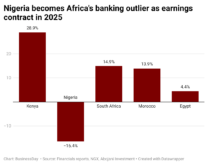
Nigeria’s financial institution in nominal terms recorded 9.6 percent growth in the third quarter (Q3) 2020 from 30.94 percent in the second quarter of the same year, according to the latest report on Gross Domestic Product (GDP) by the National Bureau of Statistics (NBS).
Although the sector is still in a positive territory, the numbers show a -21.34 percentage point decline compare to the last quarter numbers.
Olalekan Aworinde, senior lecturer, department of economics, Pan-atlantic University, Lagos, attributed the decline to some of the issues going on globally, particularly, the Covid-19.
More importantly, he said the #ENDSARS protest affected economic activities. “Basically economy is closed, meaning that a lot of activities are not taking place,” he said.
It is because the intermediation process are not taking place, and if this does not happen, it will definitely affect the flow in terms of the capital and profit that these financial institutions are likely going to get, he said.
Read Also: Nigeria’s educational system should spark creativity and innovation
According to the NBS, the finance and insurance sector consists of the two subsectors, financial institutions and insurance, which accounted for 88.89% and 11.11% of the sector in real terms in Q3 2020.
As a whole, the sector grew at 5.91% in nominal terms (year on year), with the growth rate of financial institutions at 9.60% and –16.54% growth rate recorded for insurance. The overall rate was higher than that in Q3 2019 by 2.20% points, but –14.91% points lower than the preceding quarter. Quarter on quarter, growth was -24.76%.
The sector’s contribution to the overall nominal GDP was 2.46% in Q3 2020, higher than the 2.40% it represented a year prior, but lower than the contribution of 3.76 % it made in the preceding quarter. In real terms, growth in this sector was estimated at 3.21% during Q3 2020, or 2.14% points from the rate recorded in the third quarter, though down by –15.29% points from the rate recorded in the preceding quarter.
Quarter on quarter growth in real terms stood at –25.24%. The contribution of finance and insurance to real GDP reached 2.67%, higher than the contribution of 2.49% recorded in the third quarter of 2019, but 1.33% points lower than 4.00% recorded in Q2 2020.
Aisha Ahmad, deputy governor in charge of financial system stability said six months into the pandemic, the financial system continued to show resilience with soundness indicators retaining their robustness, amidst regular stress testing by the CBN. Non-performing loans ratio declined to 6.1 per cent in August 2020, from 6.4 per cent in the previous month, capital adequacy improved to 15.3 per cent from 14.6 per cent over the same period even as net interest margin remained robust.
Focused implementation of the Loans to Deposit (LDR) policy over the last year continues to promote credit growth to the real sector and lower deposit and lending rates, – which supported banks’ net interest margins.
For instance, credit to the economy increased by N3,766.08 billion from N15,567.66 billion at endMay 2019 to N19,333.74 billion at end-august 2020, with significant growth recorded in manufacturing, consumer credit, general commerce and agriculture.

Join BusinessDay whatsapp Channel, to stay up to date
Open In Whatsapp