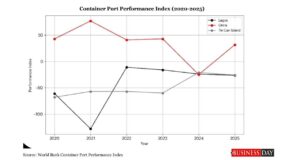
Road congestion, which made it near impossible for cargo owners to take delivery of their consignments and diversion of transit cargoes, owned by importers from landlocked countries to more efficient ports in the West African region, have been blamed for the slight dropped in the volume of business activities recorded at the nation’s seaports in the first half of 2019.
According to terminal operators, expansion of other ports especially those in the Eastern parts of country was also responsible for some importers’ refusal to route their consignment through ports in Lagos, thus, the drop in volume.
Speaking to newsmen in Lagos on Tuesday during the SIFAX Group mid-year press parley, Adekunle Oyinloye, group general manager of SIFAX Group, said their terminal recorded a slower number of volumes in the period under review due to expansion of other ports and diversion of transit cargo to more efficient ports by cargo owners from landlocked countries.
He identified the bad state of the access roads to the Tin-Can Island Port especially Apapa-Oshodi Expressway, as a major challenge as consignment spend more days at the port than necessary.
“The bad state of the port access roads has played a major role in slowing down activities at port, and that the port industry also experienced 3-day strike by dockworkers within the period under review,” he said.
Oyinloye called on the government to consider linking Tin-Can Port by rail to make evacuation of cargo a lot easier. “It has become saddening that some ports in West Africa have taken the shine off Nigeria despite the size of Nigerian economy in the region. For instance, Lome Port has now become a hub.”
John Jenkins, managing director of Ports and Cargo Handling Services Limited, who confirmed the slight drop in number of volumes, said the terminal handled about 130,000 Twenty-foot Equivalent Units of containers (TEUs), which is 275 TEUS less than 130,275 TEUs of volume handled in 2018.
“We are on track to do better than we did in 2018, but as at the first half of the year the volume of business on our terminal dropped slightly due to the congestion Nigerian ports had earlier in the year,” he said.
According to him, “We expect the volume for the year to close at 290,000 to 300,000 TEUs. We also handled about 100,000 metric tonnes of general cargo. We experienced growth in the volume of export cargo received as about 400 TEUs of laden export container come to the port weekly.”
AMAKA ANAGOR-EWUZIE

Join BusinessDay whatsapp Channel, to stay up to date
Open In Whatsapp