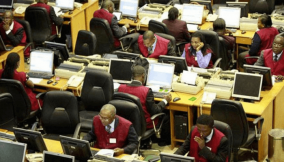
In the wake of limited flow of funds into the Nigerian equities market as investors continue to sight possible near-term risks, the market still provides access to competitive returns.
Increasing menace from the insurgent group – Boko Haram – is hampering foreign investor confidence in the country, coupled with upcoming elections that create ‘wait and see’ sentiment among investors.
Amid all these, the current decline in stock prices no doubt presents an opportunity for entry into stocks of companies with strong earnings and earning potential, strategy, operations and corporate governance.
“Uneven growth and recovery dynamics, divergent monetary policy direction, among high-income countries, bullish trends in global equity securities markets, a strengthening tone in emerging-market currencies and heightened socio-political instability in Thailand and Ukraine were the primary factors influencing capital flows in global financial markets,” research analysts at CBO Capital said.
Drivers of the market will include: Consistent GDP growth which is expected to be sustained, government reforms and policies, SEC and NSE key initiatives, growing consumer demand, firm and stable financial services sector, increasing interest by foreign investors, and attractive pricing and cheap valuation.
Possible draggers in the market are: possible recovery in advanced markets, political risk, security threats, and exchange rate risk.
According to Edward Kingston Associates, “another year of gains will be supported by stronger economic and corporate underpinnings, and just as important, improving sentiment among investors. We expect the third quarter to beat the performances of the first and second quarters of 2014. The positive momentum in the oil and gas space likely to continue into Q3, with the industrial manufacturing companies also expected to post positive returns in Q3.”
Financial Derivatives Company expects to see continued growth in Q3, which should be driven by the consumer and finance sectors, adding that politics is expected to limit deals, “however, the direct effect on the market is negligible; while the disconnect between the equities market and the economy persists.”
Accordingly, CBO Capital analysts said that in the interim, the equities market will depend on positive earnings releases while local investors look for bargains on cheaper prices and cheaply priced stocks. “Earnings will provide guidance, and we also expect FPI inflows, if sustained, to have a positive impact on the market. We expect some gains in Market Capitalisation and ASI over the Q3.
“We expect to see an increase in the participation of foreign investors in the Nigerian exchange as their share of transactions had fallen to 45.25 percent in May from 75.25 percent in April. The rise in foreign participation might be driven by the increased weighting of the Nigeria exchange in the MSCI Frontier Index in June,” according to researchers at CBO Capital.
In the fixed income segment, it is expected that yields will continue to moderate as inflows pick up. “We also expect the shorter end of the yield curve to continue to enjoy the better part of interest due to election jitters. Outcomes from the next MPC meeting will provide guidance on the direction of rates,” they said.
Reviewing Q2, the analysts noted that the equities market in Q2 was characterised by moderate profit- taking and bargain-hunting activities. “Overall, market performance picked up pace late in the quarter.” The market performance measures, the NSE-ASI and Market Capitalisation rose by 9.6 percent and 10.03 percent in Q2 to 42,482.49 points and N14.03 trillion, respectively.
The NSE has recovered significantly from the parlous investor sentiment that overwhelmed it in Q1, which was due to US QE tapering and the subsequent outflows from emerging markets. The NSE-ASI rose by 9.6 percent in Q2 while the NSE-30 index rose by 9.37 percent to 1,896.46 points. The NSE Insurance -10 rose by 6.65 percent to 144.33 points, the NSE Consumer goods gained 6.7 percent to close at 1031.79 points, the NSE Oil and Gas Index, led by Forte Oil, also gained 34.26 percent to close at 386.96 points and the NSE Banking rose by 18 percent to 443.06 points. The market turned over 6.71 billion shares worth N11.87 billion exchanged in 5,869 deals, representing an increase of 69.31 percent and 213 percent in volume and value traded, respectively, while number of deals expanded by 41.29 percent.
Bond yields moderated across all tenor buckets in Q1 for FGN Treasury Bills and Bond yields. Average 3 month treasury yields fell to 10.56 percent in Q2 from 11.95 percent in Q1 and 10-year bond yields also dropped from 13.65 percent to 12.89 percent in the same period as activity increased. The value of bonds (Bond Market Capitalisation), which stood at N4.8 trillion at the end of Q1, increased to N5.35 trillion in June. The Nigerian Inter-Bank Offered Rates (NIBOR) rose across all tenors. The overnight rate, 7 days, 30 days and 60 days rose from 11 percent, 11.38 percent, 11.71 percent in Q1 to 11.25 percent, 11.50 percent and 11.83 percent in Q2, respectively.
Market analysts at UBA Capital said: “H1-2014 was very challenging for emerging markets (EM); though market sentiment appears to have turned positive, albeit cautiously. It is clear that the EM economies remain shaky though outlook seems positive. Major risks to the EM are centred on socio-political uncertainty – an increase in political corruption scandals in Turkey; significant labour market unrest in South Africa; Ukrainian-Russian tensions; and so on.
“As the 2015 general election draws closer, with uncertainty looming in the market and risk adverse investors moving funds out, we expect a moderate uptick in yields in H2:2014. The CBN governor, Godwin Emefiele, hinted of the CBN’s intention to reduce interest rates in an attempt to stimulate the economy in the near term. Taking a cue from the positive relationship between MPR and Fixed income yields, the effect of an interest rate reduction will likely be a decline in yields. Expectation for the market at the beginning of the year was somewhat bearish given a number of anticipated downside risks such as change in the leadership of the CBN; tight monetary policy; further QE Tapering by the US Fed, as well as heightened insecurity situation and domestic political uncertainty.”
They said further that “domestic participation will cushion the effect of capital outflow. Political uncertainty will limit activities in the market. However, no major shock is expected. Security issues will hamper the outlook on some companies. Our outlook for the market in H2:2014 is quite modest. We expect the market to close the year with a return within 5 percent – 10 percent band.”
Looking at the performance of the African market’s index, market analysts at Financial Derivatives Companies noted that, NSE had recovered most of the initial losses in Q2. “It has outperformed the Nairobi Stock Exchange. It is underperforming the Ghana and Johannesburg stock exchanges. In dollar terms, the NSE is higher because of the stable currency. YTD returns on Nairobi Stock Exchange index is -0.4 percent.”
Accordingly, the noted that: “Weak corporate earnings is affecting investor sentiment. Companies with appropriate strategies are outperforming competitors. Corporate results show increasing decline in finance costs. Stock market shows a shift in bargaining power in favour of corporates relative to the banks. The banking stocks are coming under pressure. The cumulative impact of CRR is taking its toll.”
In the month of July, market sentiment favoured firms with positive H1’14 results as their stock prices appreciate; while market sentiment did not favour firms with negative H1’14 results as stock price depreciated in July.
Looking into this quarter, the analysts said: “Weak corporate earnings will constrain stock prices increase, leading to a correction in overpriced stocks. Increased mopping up activities by the CBN will push up interest rates. Investors will rotate their portfolios away from FMCG’s and downstream petroleum companies. Market sentiment expected to be negative in the month.”
Iheanyi Nwachukwu

Join BusinessDay whatsapp Channel, to stay up to date
Open In Whatsapp