The National Bureau of Statistics (NBS) has just released its job creation report for Q2 – Q4 2014, for Nigeria. According to the report, Nigeria’s economy generated 222,163 jobs in the Q2 2013, 246,138 jobs in the Q3, and 267,740 jobs in the Q4 2013.
A breakdown of jobs created in the Q2 indicates that 80,412 jobs were created in the formal sector, 112, 567 jobs were generated in the informal sector, and 29,184 in the public sector. The formal sector contributed 76,385 jobs to the total jobs generated in the Q3 2013, while the informal and public sectors generated 140,673 and 29,080 jobs, respectively.
In the final quarter of 2013, of the total 267,740 jobs created, the formal sector contributed 101,597, while the informal and public sectors created 143,278 and 22,865 jobs, respectively.
This shows a total of 1,167,062 jobs for the full year 2013, made up of 432,720 jobs (0.37%) in the formal sector, 628,845 jobs (53.6%) in the informal sector, and 105,497 (9.4%) jobs in the public sector.
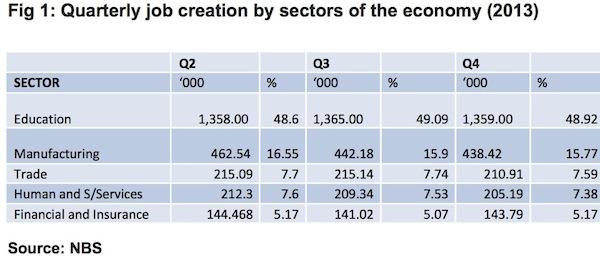
Education contributed the highest number of jobs created in Nigeria in the Q4 2013, with 1.36 million jobs, representing 48.92 percent of the 2.78 million total jobs created. This was followed by manufacturing with 0.4384 million, which is 15.77 percent of the total 2.78 million jobs created. The lowest sector was mining and quarrying with 0.135 million jobs (0.48%) of the 2.78 million total jobs created.
The Nigerian economy is experiencing growth with minimal job creation as the growth rate of the labour force exceeds the employment opportunities. Moreover, the large chunks of the unemployed are secondary school leavers and graduate of tertiary institution.
The NBS data show a need to accelerate reforms in areas that have the potential of creating lots of jobs.
Diversification of the economy through the agriculture sector, which is the largest employer of labour will improve the economy and lives and incomes of the millions of farmers residing in the countryside.
Stability in the power sector will enhance the ease of transformation of farm input into finished goods.
Additionally, this will boost the manufacturing sector whose capacities have been hampered by epileptic power supply.
Passing the long stalled Petroleum Industry Bill (PIB) would help boost investments and job creation in the oil and gas sector.
Additionally, the reduction in red tape and corruption, improving the business climate and lowering the clearing times at the ports, will also help to create employment.
PATRICK ATUANYA & BALA AUGIE

Join BusinessDay whatsapp Channel, to stay up to date
Open In Whatsapp