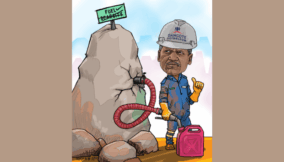
Ibe Kachikwu, minister of state for Petroleum Resources, has signed a landmark Gas Sales & Aggregation Agreement with Greenville LNG for 74MMscf gas delivery to a $500 million LNG facility located in Rumuji, River State.
Greenville will build small scale LNG plants that will deliver liquefied natural gas by through adapted trucks to states not connected by pipeline. The trucks would have the capacity to travel about 1,000 km on liquefied natural gas before needing to refuel.
The impact of mini LNG plants are massive with capacity to feed gas to half a dozen power plants currently lying fallow as well several embedded generation projects in industrial clusters in Lagos, render gas pipeline sabotage impotent to strangulate the economy and create new jobs and enterprise.
Total Nigeria and Gas Aggregation Company Nigeria Ltd (GACN) would deliver gas to the 5250 Tons per Day LNG plant, located on a 97 hectare land in Rumuji. The project will be delivered in two phases.
Three trains will be developed in the first phase with each train having 750MT per day capacity while the second phase will see the construction of two trains of 1500MT per day capacity.
“We have just decided to invest in the first three mini LNG plants in Africa, but the big challenge today is that no bank is available to finance this investment because of the temporary problems that Nigeria is going through,” said Eddy Van Den Broeke, chairman of Greenville LNG.
The Belgian entrepreneur also said that sourcing gas locally through Total Gas from the Obite- Ubeta- Rumugi 42.5 kilometre 42″ Gas Pipeline Project in Rivers State will remove the need for foreign exchange. The second phase of the project is billed to gulp $850 million. So far the company has funded the project without any bank financing.
Nigeria has a thriving LNG plant in Bonny which has a capacity of 22 million tonnes per annum, but it is often shipped to markets in Europe, North America and parts of Asia including Japan.
The huge cost involved in building gas pipelines and persistent sabotage by vandals and militants act as major disincentive for investment. Hence LNG plants, even though they reduce gas volumes by a factor of 600, have become attractive to move gas by ship, rail or truck.
However, local consumption of LNG is still a mirage because, “first of all, you need to move the gas in a liquid form, and then regassify it for consumption for power plants and large scale industries, and this comes with huge cost,” said Chijioke Mama, an energy analyst, based in Lagos.
But small scale LNG may change this. “The term Small Scale LNG refers to the direct use of liquefied natural gas in its liquid form, as opposed to the traditional model of regasification and subsequent introduction into the gas transmission grid. Small Scale LNG is cheaper, better and faster,” said Olufola Wusu, oil and gas lawyer in a blogpost.
Broeke is counting on more government support to drive the sector. “We hope that in the second phase, as the minister has said, more assistance will be given once the people see the investment and once the product come to the market, automatically there will be confidence and we have to build on the confidence.”
While assuring support, Kachikwu said government will move quickly to turn areas in the Niger Delta from being oil-focused to a gas-focused zone.
“Our first step was to set up the Nigerian Gas Management Company and Nigerian Gas Pipeline Transportation Company. I am happy that a few months after we launched the gas policy we are seeing this happen. We want to ensure that the payment issues are dealt with and made on time so there is a good financing for the project.”
Morgan Okwoche, managing director of GACN, said the plant will boost embedded power generation in the country.
“Additionally, areas that are not easily accessible by the traditional pipelines, can now be reached through virtual pipelines for embedded power generation, which will further aid government’s resolve to ensure an efficient energy mix in the nation’s power sector.
“The project when commissioned will give a boost to the development of Compressed Natural Gas (CNG) as a vehicular fuel. Similarly, LNG fueling stations for LNG trucks will spring up, giving rise to a combined UCNG stations to be built along the Nigerian highways, to ensure trucks can re-fuel when required,” said Okwoche.

Join BusinessDay whatsapp Channel, to stay up to date
Open In Whatsapp