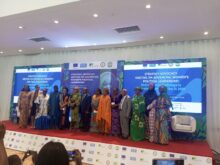
Dr. Marvin Dekil is project coordinator, Hydrocarbon Pollution Remediation Project (HYPREP), which is responsible for the implementation of the United Nations Environmental Programme (UNEP) report on the clean-up of Ogoniland. Dekil, in this interview in his office in Port Harcourt, assures MABEL DIMMA of the Federal Government’s commitment to the implementation of the report. He also speaks on the extent of the project, efforts to carry the communities along, among other issues. Excerpts:
There are insinuations in some quarters that the whole talk about Ogoni clean-up is a scam used by the APC-led government to score cheap points. What is the reality?
The implementation of the UNEP report is something the Federal Government takes seriously and has shown total commitment to right from the beginning. Both the former minister of environment, Amina Mohammed, and the minister of state for environment, Ibrahim Usman Jibril, have shown commitment. As a matter of fact, before the former minister was appointed into the United Nations, she did quite a few significant activities. One was the flag-off of the programme itself; two was the groundbreaking event for the Integrated Contaminated Soil Management Centre in Bori; and three was the workshop for the training of women, which she did and interacted directly with the women in Bori too. Before that was the constitution of the governing institutions of HYPREP, which is the board of trustees responsible for managing the funds meant for the project as well as the governing council with the mandate for approval of the activities of the project; and lastly was project coordination office. I was appointed the project coordinator. And even before the project coordination office came alive, there had been plenty of activities and these were done to ensure that the project is given a sound footing, that it is immune and protected from political transitions and violations. So it is important for people to understand that the project is intended to succeed with the total commitment of the government. Now, the project again is a scientific and technical project, which means that the performance indicators are not the obvious things you know. A lot of desk work and planning are going on because we have to get all these right before we proceed to the field. So it is far from political, rather it is a very technical and detailed scientific project.
That means it is a project that will continue when the present administration leaves office?
The project, as I have explained, is constituted in a way that it is immune to political transitions, and so it will outlive any political transition.
The clean-up has started. What are the various stages and at what stage is HYPREP now?
The first thing is to sensitise the people. Just as you have said, people think nothing is happening. The way to let them know something is happening is to engage with them and we are doing that right now with the communities in the four LGAs. We have recently, a few weeks ago actually, held meetings with the stakeholders, opinion leaders across the LGAs; we interacted with them and solicited their support for the success of the project. So having completed that, we proceeded to each of the communities in the LGAs. These activities are targeted at the people so they understand that they need to take ownership of the project and understand every activity and procedure that we follow. The project is the people’s project and we intend to leave it that way, that’s why we are pursuing the sensitisation of the people about the project very vigorously; it is a vital part that we cannot miss.
What has your interaction with the communities been like, and what’s their response and perception of HYPREP?
The communities have so far been very receptive. As a matter of fact they are eager for us to come and do the things we need to do; there has been maximum cooperation from them. Also, you can understand that we need to engage with them and update them on activities. Obviously, they wish this had happened earlier. You know the UNEP report was submitted to the Federal Government in 2011 and this is 2017, but the important thing is that this government has started; the office of the project coordinator is active.
I came in as project coordinator in March, the office became functional around April/May, we held our first governing council meeting after the appointment in May; so within that period till now, sensitisation has been happening. We are also looking at emergency measures, where we intend to provide water to the communities and for that we have set up a committee, they have done their report which identifies all the communities in Ogoniland with functional and non-functional water facilities. We are using that report to do an assessment and costing for immediate rehabilitation of these water facilities, we intend to follow that up by activating those ones short term; long term is to come up with a comprehensive water scheme for the affected areas.
Most recently we have advertised for project experts in environmental assessment, so we are asking environmental consultants to come in so they can do the scoping of all the sites that have been previously assessed by UNEP. We are also advertising for health impact experts so they can also follow up with the recommendations of UNEP on health impact studies on the Ogoni population in specific areas. We are also advertising for water consultants and engineers. It is also important to note that we have so far opened three sites for the demonstration of technology – these sites are intended to accumulate companies with technology for remediation who would want to showcase such technology; we are happy to provide them with site for them to do such. The companies involved in these are not contractors, they are volunteers and doing it at their cost, and it will not in any way give them an advantage going forward. We would encourage companies who believe they have something by way of technology and are willing to do this at their own cost to come forward. That is what we have been doing. That project is on. At present there are two sites on, with more sites to be opened up shortly.
What is HYPREP doing in terms of restoration of the people’s livelihood?
Restoration of livelihood has to do with giving alternative training and skills for people who otherwise will not have any occupation as a result of the impact of oil spill on their activities, and that is something the project is delivering. It is important for me at this point to explain that the project has two major deliverables: one is the environmental restoration/remediation and the other is restoration of livelihood.
On the livelihood aspect, we are designing training programmes with UNITA, which is the training arm of the United Nations. They are developing the contents for training women as well as the youth and other categories of individuals, including those involved in artisanal refining whom we are actively encouraging to discontinue the illegal act for reasons of the adverse results on their own health as well as the impact it has on the environment and the very sad possibility of re-polluting the environment after the clean-up. We are engaging with them so we can provide new trainings for them, give them new skills and engage them in other useful and beneficial activities or occupation. We have also done technical assistant training for people who studied technical degrees in environment, up to Master’s degree and above; all of them from the local population of Ogoni are being trained to have the skill and expertise in remediation. We have done that training here, but we intend to bring UNEP to do more of the training so as to improve their skills and allow for active participation of the local population in the remediation of Ogoniland.
Most young men in these areas believe oil is the fastest way to make money, how do you re-orientate them to be part of this project?
It’s important for them to get the right orientation and the Office of the Vice President is working on a scheme to allow for ownership of modular refineries in the region by these people who otherwise were doing illegal things. We believe that is another way of engaging them, but the more important thing is the psychology and understanding of the youth which we all need to work on. There is no quick way to success – you need to work hard. And those of them with some rudimental skill in that sector, with the Office of the Vice President working on these modular refineries, we believe that will find another avenue for their skills to be trained for refining in a regulated sector.
What structures or measures is HYPREP putting in place to ensure this project is fraud-proof?
By the very design of the project into governing institutions, that has been taken care of because no one of these institutions has a monopoly of the approval or contracting process, so one depends on the other. There are checks and balances in the institutions so the project is designed to benefit from it.
Considering the level of clean-up to be done, do you think the locals will be enough?
We are starting, we are not restricting it to the locals, and it is just for now. Don’t forget that HYPREP is a national project; it is a project that is accorded to part of the Niger Delta and even beyond but it is important that starting in Ogoni, the people are carried along in a way that they take ownership of the project. So while we are looking at bringing on people – and, of course, most of the expertise is coming from across the country – we actively encourage the local population to participate in that process.
Have you been able to meet with the general leadership of the Ogoni people?
We recently had a stakeholders meeting with the Ogoni leadership; we interacted and sought their cooperation and we had a very good response. They are prepared to give us support; they understand the challenges of the project, that it is a scientific one, it is one that will take some time. We have interacted with them and will continue to do so because it wasn’t a one-off meeting we had. It is a meeting that is designed to hold periodically so that we can interact and also modify our position where there is need.

Join BusinessDay whatsapp Channel, to stay up to date
Open In Whatsapp