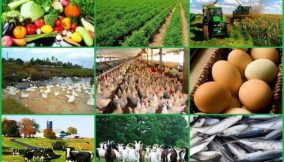
The need for Nigeria to reinvent herself and emerge as a self-sustaining nation in food production is a theme, which though increasingly repeated, is yet to gain traction sufficiently.
However, the government continues to reiterate that the country is on course towards achieving global standards in food production.
As the reality that the era of oil and gas as the mainstay of Nigeria’s economy continues to sink in, analysts continue to express the view that more strategic planning need to done to back up government’s ideas to rejuvenate the economy through agriculture.
Audu Ogbeh, minister of agriculture and rural development, has predicated the attainment of a competitive advantage in food production and international trade on meeting up to global standards.
“We can’t continue to think that there is a Nigerian standard and other standards. There is one standard, and it has to be worldwide. It isn’t just about exports. It is about our own health and our nutrition security. Moving away from just eating much to eating well, there is a big difference between both. There was a Greek doctor who lived during 4th Century BC. He made a comment in 390 BC, saying, “let food be your medicine. And let your medicine be food,” Ogbeh said.
The importance on quality and standard cannot be overemphasised, as Ogbeh further explained that “It is not just about what we export. It is also about the health of the larger society. In that regard, I would like to mention that we need to educate the farmers very intensively, beginning right from the farms. That is what is called traceability. If there is a problem with the crop, where was it grown and how? What kind of water are you using to irrigate your crops? What is the pH level of the water? What is the source of the water? It goes on and on.”
It would be recalled that in mid-2015 some Nigerian agricultural produce such as beans, sesame seeds, melon seeds, dried fish and meat, peanut chips were banned from entering countries in the European Union.
While the ban on other commodities was lifted by the EU, that of dried beans was retained, citing that the rejected beans were found to contain between 0.03mg per kilogramme to 4.6mg/kg of dichlorvos pesticide, when the acceptable maximum residue limit is 0.01mg/kg.
Dichlorvos is considered to be highly toxic, which can cause difficulty in breathing, diarrhoea, vomiting, convulsions, and dizziness, among others. Like many organophosphate (OP) insecticides, it also inhibits the enzyme cholinesterase, which results in disruption to the nervous and muscular system.
CALEB OJEWALE

Join BusinessDay whatsapp Channel, to stay up to date
Open In Whatsapp