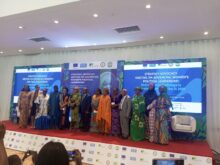
Between June 13 and 14, 2017, The Now Collectives (TNC) photography conference gathered internationally-acclaimed photographers from around the world in Lagos to connect with, inspire and motivate African photographers. Segun Olotu, UK-based multiple award-winning photographer and convener of the conference, spoke with CHUKS OLUIGBO, assistant editor, on the impact of the conference, photography as a profession, and future plans. Excerpts:
Tell us about the just concluded The Now Collectives photography conference?
The Now Collectives was inspired by other such conferences I have attended in the United States and elsewhere, such as Fearless Photographers, which have proved to birth skills, define careers and produce some of the industry’s icons. It was born out of a need to bring photographers together to inspire, motivate and empower them. It was more of an effort to cause some kind of change in the way we view photography and how people take their photos in Nigeria. I noticed that even on social media many Nigerians follow a lot of Western photographers, dropping comments and sharing a lot of their work. Since I have the privilege of knowing most of these Western photographers, I thought it would be nice to bring them to Africa to educate, inspire and also motivate our photographers. The market in Nigeria in terms of photography is really very low and we want to change that; we want to take it up to a standard where instead of us looking at the western people, they look at Africa. That is why I brought that into Nigeria.
The Now Collectives is not just a conference to do and go away, it is a conference to come back and make impact in people’s lives. It is also to build a community, which is very important and that’s where we are going. We pray it will move to the next level where even the government will be part of it to make it a bigger thing, not just a Nigerian but an African thing such that people in Ghana, Zimbabwe, Kenya, Morocco, and so on would want to come to Nigeria. When we bring them to Nigeria, it creates an impact in that we have foreigners coming in and bringing money to spend. I can tell you the speakers at the last conference spent quite some money while they were here. That money will stay and circulate within this economy, creating more opportunities for everyone.
Looking back at the conference, can you say the aim was achieved?
I would happily say yes, the aim was achieved with the feedback we have got so far. What we did after the conference was to create a feedback form for attendees including those for the masterclass. We also created a feedback form for the speakers. I would say impact was made in two ways: on the attendees and on the speakers; most of them really want to come back. I just got an email from one of the speakers saying she would be happy to sponsor people from Zimbabwe to come to Nigeria. Of course, the conference is open not just to Nigerians but also to Africans in general. For this first outing we had people come in from Cameroon. Everybody was excited. A lot of people cried, they didn’t want it to end, people were even asking us to extend it to three days, but two days I feel is enough. We made a lot of impact. If you go on our Instagram page, the comments speak for themselves.
How do you see the photography landscape in Nigeria vis-a-vis the UK where you currently live?
The difference I see is that in the western world there is an association of photographers; they love to collaborate and they do collaborations. They have things like secret Facebook page where photographers come to critique one another. In Africa, particularly Nigeria, there is no association. A problem I’ve seen here is ego; everyone has an ego, no one wants to collaborate with the other. Collaboration for me is the main key of success, but in Africa we don’t like to collaborate, we like hiding ourselves. People seem to think, ‘I don’t want them to see my work; I don’t want people to comment about my work, my work is good.’ We just go about claiming, ‘I’m the best.’ So, I would say collaboration is what is missing in Nigeria and Africa. But as time goes, we will achieve that.
What about quality of work?
During the conference everyone was blown away with the work of some of the speakers. Everyone thought they used the best cameras. It is not about camera, it is all about understanding what equipment you have at the moment and creating what you can create. So, quality of work, I would say we are doing well, but we can be better. A lot of Nigerians have invested in good cameras thinking that would change the quality of work; it wouldn’t, it is about how we see things. We don’t see things the way the westerners see things, and that’s why we are in love with their work. If they come here and shoot what we shoot here, we would be in love with what they shoot. The eyes have to be trained. But we are getting there.
How long have been shooting photos, how did it start, and how has the journey been?
I’ve been shooting since 2010. I used to be a salesperson for a camera company called Olympus in the UK. I sold a lot of cameras and so got a free one. When I got the camera, I went on the streets of London and started taking pictures. I had the privilege of working with Kola Abayomi, a very amazing photographer. I got inspired by taking pictures on the streets with him. At a point I felt I needed to change my camera, which I did. Thereafter I started taking pictures in church; the demand for shooting weddings started coming. I had a lot of friends who moved abroad and when it was time for them to get married, they gave me opportunity to shoot. I did a lot of free work. I went to America, shot a friend’s wedding for free. He had a photographer already that he paid about $7,000, I did a free job but at the end of the day he preferred my work to the one he paid for. That was what gave me more opportunities to start shooting weddings around the world. Since then I’ve been growing and I’m still growing. Most of the speakers that came for the conference have made impact in my life as well. Somewhere along the way I travelled to as far as Nicaragua to meet a guy name Mauricio, I attended his masterclass in Romania and he encouraged me. In Romania I met some other amazing guys who encouraged and advised me as well. I learnt from Ben Chrisman, Mauricio’s boss, as well. I attended his master-class. I have travelled around to attend masterclasses. By 2015 I spent about $15,000 attending masterclasses to change my style of photography and it has helped me to be who I am today. I’m still learning.
There are a lot of people who carry cameras about but cannot truly be called photographers. What can they do become photographers?
What they can do, I think, is that if they find someone they like their work, they should drop the ego thing and go to the guy and say, ‘Look, I like your work, how can you impact me? Can I join you when you’re working on something? Can I shadow you?’ There are so many things you can do, but everyone wants money. As I keep saying, you have to do it for free first before you start making money. It takes a lot. Some people have worked for 10 years and never made money but in the 11th year the guy they worked for remembered them and blessed them. So, if you want to seek knowledge, look for a guy that is good, speak to him, tell him to mentor you, work with him; if he goes for a job, be there, help him carry his bag. That was what I did with Kola Abayomi. It’s very important. Find someone you like his work, shadow the person, learn from him, and be whatever you want to be through that person.
How lucrative is photography as a business?
Photography is a big business. George Oshodi’s photo of an African king wearing a dress that has the print of Queen Elizabeth sold for over €20,000 in Europe. In 2014, Australian landscape photographer Peter Lik’s “Phantom”, which was captured at Arizona’s Antelope Canyon, was sold to a private collector for $6.5 million, making it the most expensive photo ever sold. The record was previously held by Andreas Gursky’s “Rhein II”, which sold for $4.3 million back in 2011. So, photography is a big thing. It has opened doors for a lot of people not to be sleeping on the streets. Photography has changed lives; it has created plenty of small businesses as well.
Tell us about your inspiration in the industry.
Bayo Omoboriowo inspires me a lot. Bayo has inspired and is still inspiring most of us. It has got to the point that if I need advice, the first person I call is Bayo. He has made impact in the lives of many photographers in Nigeria, and he has inspired me to do more. I also look up to George Oshodi, TY Bello, and a number of others.

Join BusinessDay whatsapp Channel, to stay up to date
Open In Whatsapp