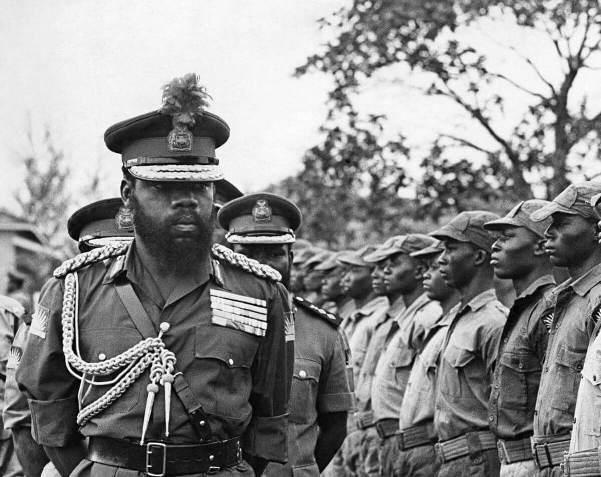
No. It’s not the Nigeria/Biafra Civil War, even though that could as well be seen as “needless” depending on your perspective or your side of the divide. But it came pretty much close to that.
It was a different kind of “civil war” that raged among Nigeria’s literary community – some sections of it, though – for the better part of the Christmas and New Year festivities. It degenerated into a scrutiny of the place of Achebe in the world literary firmament, though the trigger was the calling to question of the aesthetic value of Things Fall Apart, a highly and widely revered book that has recently come under a heavy dose of criticism by Nigeria’s “irreverent generation”. It was a war of words – utterly divisive, full of guile, bile and bitterness.
Abubakar Adam Ibrahim, author of Season of Crimson Blossoms and latest winner of the Nigeria LNG Prize for Literature, had published an article “Soyinka, Achebe and the irreverent generation”. I think the article first appeared in Daily Trust on December 25, 2016, but it soon went viral online, as such articles are wont to.
In the article, which was purely an individual opinion, Ibrahim highlighted the “increasing irreverence” with which young Nigerians, especially in the last few weeks of 2016, treated Wole Soyinka and Chinua Achebe, two names that “have been sacrosanct, revered and ascribed the status of demigods” in the Nigerian and African literary arena. He referred to the dust raised by “Wolexit”, Soyinka’s promise to tear up his American Green Card if Donald Trump won the US elections, and its aftermath that saw some young Nigerians – those Soyinka calls “noisome creatures, the nattering nit-wits of internet” – questioning the literary credentials of a man who won the Nobel Prize for Literature in 1986, long before some of them were born. He then mentioned how the literary merit of Achebe’s Things Fall Apart – a novel that was written when Achebe was 26 years old, published two years after, and has survived nearly six decades – was also called to question by a generation that has achieved virtually nothing in the world of literature.
Then he dropped what many “Achebe activists” considered as blasphemy: “If Achebe wrote ‘Things Fall Apart’ in 2016, I hardly think he would find a publisher. There are issues of literary aesthetics, among others, to be considered. This is no way questioning the greatness of the book (which has almost been made sacrosanct by African and other intellectuals). But he wrote the book in the 1950s, with scant exposure, in a period where there are no precedence to fall back on.”
That statement, in the minds of many, destroyed every accolade Ibrahim had given to Things Fall Apart in the said article and put him in the same class as those he tagged “irreverent generation”.
Many who felt Ibrahim shouldn’t have said that about Things Fall Apart took to the social media and hauled attacks on him. Some said the NLNG Prize had got into his head. Some said he wanted to achieve fame through the backdoor. Some questioned even how he won the NLNG Prize and wondered whether the Prize had gone the way of other things Nigerian. Some read “ethnic undertone” and outright “tribalism” in Ibrahim’s article, querying why the argument should arise in the first place. Some said his criticism lacked “depth” and “intellectual grasp”.
It soon became a full-scale war, between Achebe supporters on the one hand and Ibrahim’s defenders on the other, even assuming tribal dimensions. Echela Okwori wondered what “this war against TFA” hoped to achieve.
Ahmed Maiwada, an Abuja-based lawyer and writer, saw in the attacks against Ibrahim an attempt to shut down a man’s right to hold opinion. On Facebook, he made several posts on the matter. He called those criticising Ibrahim “terrorists”. He took on Pa Ikhide, a renowned literary critic, calling him a liar and an Achebe worshipper. The tone of the post showed it may have been a reaction to Ikhide’s earlier post. He referred to Achebe as “that drama queen who couldn’t measure up to his peers to bag the Nobel Prize in Literature” and who “was buried with the full honours of that failure”. He said he would publicly burn Things Fall Apart on New Year Day to shame Achebe supporters.
“Things Fall Apart is a black-and-white television, with broken speakers. I wonder why they continue to force school children to sit and watch it. It’s child abuse. Stop it!” he wrote in another post.
To justify his barrage of posts on the matter, Maiwada wrote: “Abubakar Adam Ibrahim had expressed his opinions. Why crucify him? I only stepped into the ring to point out the error in that tyranny of the literary Nigerian ‘establishment’. And I think the more we challenge established views, whether we’re right or wrong, the more we’ll be able to stand on our fundamental freedom of thought and expression, without the fear of intimidation or blackmail.”
Well, not many agreed with him. Some thought there were more to “these obsessive posts” than the matter at hand. Some also thought he was indirectly marketing Season of Crimson Blossoms, especially when he began to compare passages from the book and Things Fall Apart.
But while the war raged, there were a few who exercised restraint. Henry Akubuiro, Art editor of Sun Newspapers, was one of such. Without attacking Ibrahim, he intelligently poked holes in his claims to say that, indeed, “Achebe’s Things Fall Apart embodies sublime aesthetics” and to bring out some of these “illuminating aesthetics”.
“In the novel, you find didactic aesthetics as well as African poetics. Part of the greatness of Achebe in Things Fall Apart is using simplicity without lending himself to simplification,” he wrote.
But was the debate called for in the first place? There were those who thought so.
“I think what Abubakar Adam wrote is good for the sustenance of literature as an engagement for the most intelligent. He made certain points and blunders. In my opinion, both are necessary for MOTION. Nothing must be most sacred to a point of not being subjected to analysis, for good or otherwise. It is how progress is made,” Dami Toye wrote.
“This is the biggest acclaim TFA has received on Facebook especially by Achebe’s countrymen. Isn’t this beautiful? When l first read TFA I didn’t understand it as much as I do now having diligently followed the above comments. Please don’t stop!” Uzoh Desmond wrote, perhaps with a tinge of sarcasm.
And should an argument among writers, under any circumstance, no matter the provocation, degenerate into verbal vituperations? Shouldn’t such an argument stick to purely intellectual matters, devoid of tribal sentiments? Well?
There were those who saw the whole debate as wasteful dissipation of energy. Uche Peter Umez, multiple award-winning author, commenting on a post by Sylva Nze Ifedigbo, wrote: “The tragedy is that he [Achebe] wrote a trilogy much younger than many of us that are still struggling to write a passable collection of short stories or novels. And some of us might end up not writing one at all, until we get past 50.”
Judith Fumnanya Rapu made a similar point elsewhere: “Rather than trying to tear down a great piece, write a greater piece.”
And then, Chinedu Ohaegbulam said: “THEN, there was a literary vacuum yearning for vision; a visionary took up the challenge and filled the artistic void, which the masters of writing then astonishingly wowed! Achebe was born THEN and not NOW! NOW, a man is busy finding fault with THEN while the literary lacuna of now is crying for the visions and visionaries of NOW.”
But what Ibrahim wrote was neither a review nor literary criticism. He wrote an Op-ed in which he made a passing comment about Things Fall Apart. As Ernest Brisibe wrote in reaction to one of Maiwada’s posts, “Literary criticism is not a trivial or puerile exercise. It is an elevated art and should not be peddled like a second-hand cloth in a road-side ‘bend-down market’.”
True, the younger generation cannot be begrudged their right to hold opinions, but the energy dissipated in “trivial or puerile” criticism of established works could be better channelled into producing greater works of better literary merit. Shouldn’t those who go to equity go with clean hands?
CHUKS OLUIGBO

Join BusinessDay whatsapp Channel, to stay up to date
Open In Whatsapp