Zachariah Ibrahim dreams of becoming a pilot in the future. But that dream is fast fading away as he lives through daily sad realities of never being able to complete his education that could raise hope for the future let alone actualise that dream.
Ibrahim, 14, and the last of the seven children of his now helpless parents, lives in the Internally Displaced Persons (IDPs) camp in Durumi, Area 1, Abuja where each day reminds of hunger, struggle, penury, dejection and hopelessness.
Ibrahim sees the urgent need for Nigeria to have more aerial combatants to effectively protect the nation from the invaders, having witnessed his own entire local government Gwoza, in Borno State, sacked by the Islamic sect, Boko Haram about three years ago.
For days, he recounted, they had nothing to eat or drink. They roamed through the bush till they got to the neighboring Cameroon village where they were rescued and later conveyed to the Durumi IDP camp where their suffering has neither ended nor subsided despite the over-dramatised assistance from government, Charity organisations, Churches, international bodies and even individuals.
Recounting their journey into the IDP camp, Ibrahim, the promising boy who envisions a time when he will grow up to protect his community from further attacks, said his family and friends were all living happily in Gwoza, before members of the Boko Haram sect stormed their village.
“They came with mask and wearing army uniforms, they scattered our village, with guns and all of us jumped into the bush and ran away out of the village. Now all my family people are here in this camp,” he narrated.
“They came with mask and wearing army uniforms, they scattered our village, with guns and all of us jumped into the bush and ran away out of the village. Now all my family people are here in this camp,” he narrated.
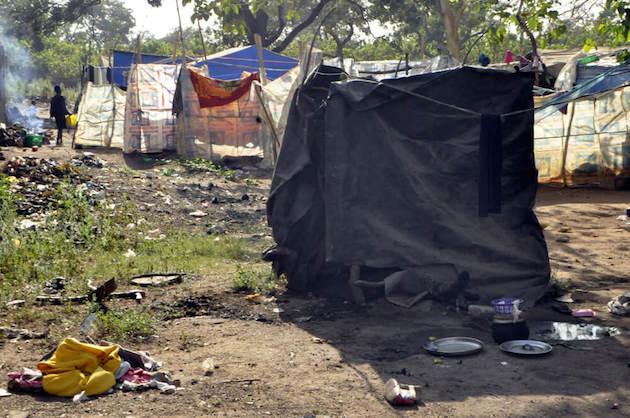
A visit by BDSUNDAY to the camp located at the heart of the town in Area1, Abuja, last Wednesday revealed that a lot more needs to be done to alleviate the poverty and poor living standard of the displaced persons as well as avert the social danger posed by the negative consequences of neglecting the welfare of the teeming population of embittered children and youths in the camp.
Beckoning on the general public to come to their aid in the camp, little Ibrahim pleaded: “I want government and other people to come and help our people here, to reduce this suffering we are in, to provide us with things like food, clothes, water, money and books for our school.”
“Also we don’t have toilets, we go to the bush to poo-poo (open defecation) and sometimes we see big black snakes in the bush.”
“We need boreholes. We don’t have water, we buy water every day. Also, they should come and give our people work and money to start small business,” Zechariah further pleaded.
While urging government to resolve the insecurity problem in the North East, he beckoned on the Boko Haram sect to desist from their hostilities and infliction of pain on helpless and innocent people.
“We need boreholes. We don’t have water, we buy water every day. Also, they should come and give our people work and money to start small business,” Zechariah further pleaded.
While urging government to resolve the insecurity problem in the North East, he beckoned on the Boko Haram sect to desist from their hostilities and infliction of pain on helpless and innocent people.
Every rising of the sun in the camp at Durumi which is just a 5-minute drive from the Old Federal Secretariat complex, is a sad reminder of another day of squalor.
Amirah, another average teenage girl, lives in the camp where the living conditions further exposes the vulnerability of girls like her to different kinds of abuses.
Imagine a situation where everybody who intends to use a “near conducive/convenient” toilet is required to pay the sum of N50 for access to the toilet or choose to go far deep into the bush to ease themselves.
Amirah, another average teenage girl, lives in the camp where the living conditions further exposes the vulnerability of girls like her to different kinds of abuses.
Imagine a situation where everybody who intends to use a “near conducive/convenient” toilet is required to pay the sum of N50 for access to the toilet or choose to go far deep into the bush to ease themselves.
Bathing in the public bathroom located at the extreme part of the camp requires the deposit of a N30 fee for access; else you are left with the choice of bathing in one of the nearby bushes or the makeshift bathrooms.
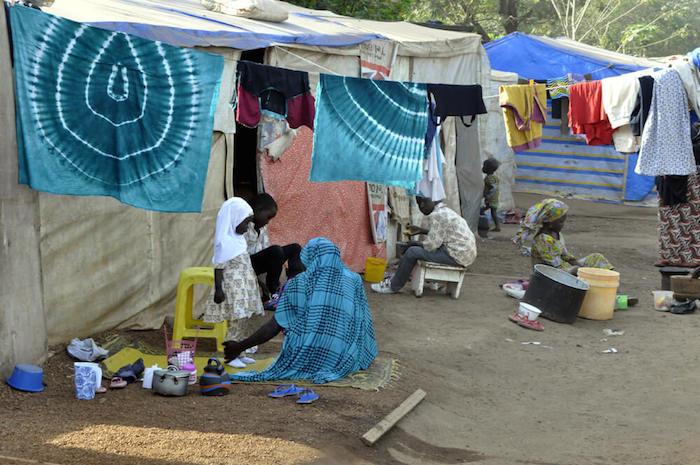
“Those are some of the challenges we women especially young ladies like my daughter Amirah face here on daily basis. Imagine how they struggle to cope with these challenges during their monthly cycle, honestly it’s really embarrassing,” Aja, Amirah’s mother lamented.
“Our condition in this camp has made so many people here do some things I am ashamed of saying. Imagine staying from week to week, no money to even buy drugs, sanitary wares, little food rations, no portable water to drink or bath, we buy water every time, N10 per gallon, so imagine how families are surviving here,” Aja lamented.
According to statistics provided by one of the camp officials, a total of about 2226 IDPs are encamped in Durumi camp which was specially designated for the displaced people of Bama and Gwoza Local Government Areas of Borno State.
About a total of 277 women, 12 orphan children, 46 breastfeeding, 657 youths amongst others are encamped in Durumi camp, with limited facilities provided for them. This is contrary to the report by Government agencies about how well they have tried to equip the camp with necessary facilities to alleviate their suffering.
The camp, comprising about 11 different clusters of shabbily-made cubicles/ kiosks scattered around the large expanse of land, poorly secured by perimeter fencing, has no presence of security personnel to safeguard the lives and property of the IDPs in the camp.
Although one of the IDPs claimed that sometimes plain cloth security operatives are posted within the camp to ensure there is no breech of law and order within the vicinity, even though our Correspondent could not spot any sign of security consciousness within the camp, considering the easy access he got into the camp without even being asked to provide any means of identification.
BDSUNDAY observed how high level of insecurity there may be aiding the purported cases of abduction, prostitution, child labour and other forms of abuses in the camp and of course attacks by insurgents.
Recall that the media was recently awash with reports of how some women in some IDP camps have resorted to prostitution, Sex-for-food and other forms of social vices out of desperation and survival moves, instead of just sitting idle and die of hunger.
The same can obviously be said of the Durumi camp as confirmed by Layatu Ayuba, the Woman Leader of the camp, who complained bitterly how the IDPs in the camp have unfortunately been abandoned and neglected by the government despite several promises.
“If not for the once-in-a-while help from NGOs, we would have all either died here of hunger or total neglect,” she added.
Ayuba, while bemoaning their condition, stressed that the camp cannot even boast of basic drugs in its clinic which was recently donated by the wife of Tukur Buratai, Nigeria’s Chief of Army Staff.
She narrated how with her bare hands, she has assisted women in labour to take delivery of their babies on several occasions, stressing that the camp has inadequate health facilities and officials to attend to the health and hygiene needs of the camp community which is populated with women and children.
Contrary to reports, the purported daily distribution of relief materials by authorities is a hoax, as BDSUNDAY confirmed. For days, there has been no single distribution of any relief material, be it food or clothing in the camp, our investigation revealed.
The plight of these IDPs under the current climatic condition, especially the rising temperature of the weather in Abuja, is better imagined than experienced. The situation is worsened by the makeshift kiosk/batchers constructed with zincs and other abandoned iron and polythene materials that they live in.
Furthermore, not only is the camp bereft of hygiene and sanitation facilities, manageable accommodation, security and so on, the only educational centre instituted inside the camp is now a shadow of itself.
Furthermore, not only is the camp bereft of hygiene and sanitation facilities, manageable accommodation, security and so on, the only educational centre instituted inside the camp is now a shadow of itself.
Investigation shows how enrolment rate of the school has drastically reduced from about 900 to 300 pupils; this, some respondents attributed to a lot of factors ranging from poor feeding condition, inadequate teaching staff, poor funding and a myriad of other reasons.
“The school is now a shadow of itself and lacks teaching aids like textbooks, markers, writing materials and so on,” Aminu Abubabkar, a volunteer worker and headmaster of the school, said.
Sadly too, there is no provision for Secondary education within the facility for the pupils who will graduate from primary six soon which means an obvious drop out and joining their peers to roam about the camp aimlessly.
Abubakar, who disclosed that the makeshift school which now has a population of about 300 pupils used to have about 11 volunteer teachers, but now has only three volunteer staff, due to inadequate finance.
Abubakar said: “They can barely transport themselves here every school day. Nobody is encouraging them, they ran out of resources, so they stopped coming. As for me, it is my passion for the children and the urge to help them that has kept me going in this project which drains at least N300 from my pocket as transport on daily basis.
“Most times, I trek from very long distance to this place when I don’t have money, just to make sure I am available to help teach these children. Many people from different organisations have come here to ask us about our needs, they take pictures and interview us, but they never come back to help or give us anything despite their promises, later on we hear and see in the media lies about things they said they gave to us. It’s all pure deceit. Many of them are fake.”
“Most times, I trek from very long distance to this place when I don’t have money, just to make sure I am available to help teach these children. Many people from different organisations have come here to ask us about our needs, they take pictures and interview us, but they never come back to help or give us anything despite their promises, later on we hear and see in the media lies about things they said they gave to us. It’s all pure deceit. Many of them are fake.”
“Although we have some faith-based organisations here from both the Christian and Muslim sides that have all at one point or the other done one project or the other, it is not enough. A lot still needs to be done. We don’t have adequate books to teach these pupils. The structures here are not near conducive, teaching and learning materials are inadequate. Also no convenience, the children go to the bush to ease themselves and it is not safe,” he stressed.
Another major problem highlighted by the Headmaster is the fact that many of the children come to school without breakfast and no hope for lunch. “So you can imagine trying to keep and teach a hungry and distracted child in the classroom; it is very difficult,” he stated.
In the course of investigation, our Correspondent learnt that previously, the children usually got snacks and other forms of refreshment in school, but presently, there are no resources to cater for such sensitive venture which helps attract and retain the attention of the pupils in school, consequently that has affected the number of pupils who turn up for school.
Asked if the school has a sickbay or clinic, in case of emergencies, Abubakar shrugged and stated that the school shares the only available small health facility with the entire camp. “If you go in there, not even a single tablet of Panadol is there.”
When BDSUNDAY visited the clinic, neither was a single sachet of Panadol, other cheap pain killers nor any drug at all sighted on the drug shelves. Not even a single health worker was sighted. A glance around the clinic shows inactivity, to further confirm the statements of Ayuba and Abubakar.
When BDSUNDAY visited the clinic, neither was a single sachet of Panadol, other cheap pain killers nor any drug at all sighted on the drug shelves. Not even a single health worker was sighted. A glance around the clinic shows inactivity, to further confirm the statements of Ayuba and Abubakar.
Yakubu Binbas, a 21-year-old indigene of Bama, Borno State, whose eyes were gradually filled with tears while explaining his predicament, also lives in the camp.
He narrated how he managed to learn and set up a vulcanizer workshop along Jabi road only for the overzealous officials of Abuja Environmental Protection Board (AEPB) to displace him from the place and cart away his tools, which now led to his eventual return to the camp in Durumi three months ago.
He narrated how he managed to learn and set up a vulcanizer workshop along Jabi road only for the overzealous officials of Abuja Environmental Protection Board (AEPB) to displace him from the place and cart away his tools, which now led to his eventual return to the camp in Durumi three months ago.
Binbas said armed with the technical know-how of vulcanizing skills, he left the camp when he saw that there was no secondary school for him to continue his education in the camp which according to him was cut short by the attack of Boko Haram in Gwoza while he was still in his first year in college.
BDSUNDAY observed that there are young boys like Binbas in the camp who are very handicapped, hence they resort to other anti-social vices and lifestyle, like marijuana smoking, which most times influence them into going into crime.
BDSUNDAY observed that there are young boys like Binbas in the camp who are very handicapped, hence they resort to other anti-social vices and lifestyle, like marijuana smoking, which most times influence them into going into crime.
As the nation gradually begins to enter into the festive Christmas mood, one can only but imagine what a gloomy season it would be for these families and individuals encamped in this pitiable condition inside Durumi, Area 1, IDPs’ Camp.
AMADI NNAMDI

Join BusinessDay whatsapp Channel, to stay up to date
Open In Whatsapp