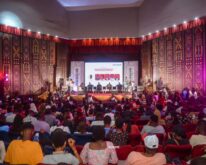
Senate President Bukola Saraki on Thursday assured Nigerians pledged that the stakeholders’ request for the allocation of one percent of the Consolidated Revenue Fund to health sector in the 2017 budget, will be prioritised when the budget proposal is transmitted by Mr. President.
Saraki gave the assurance at Citizen Townhall meeting held in Abuja, organised by One Campaign Africa, to commemorate 2016 World AIDS Day where stakeholders including People living with HIV/AIDS, called for allocation of one percent of the Consolidated Revenue Fund (CRF) to the health sector on annual basis.
While expressing displeasure over the non-implementation of various policies and programmes initiated by previous administrations, the Senate President stressed the need for Government to concede funding of infrastructure to the organised private sector.
He said: “our problem now is the implementation of the policies and programmes but I want to believe that this administration is moving in the right direction though it may be slow.
“We have the responsibility now to make sure that those laws are implemented. Let me take responsibility on behalf of everybody because you are tired of our grammar, so I take responsibility on behalf of everybody.
“The little fund that we have, we have competing needs especially considering the infrastructure deficit. So the only way is for Government to hands off from funding roads, ports and power.
“As long as Government is putting its money into port, railway and power, health and education will have to compete for funding.”
Going forward, Saraki who pledged to ensure improved funding of the health sector in the 2017 budget, underscored the need to invest in health insurance and community health services, just as he frowned at the decision of state Governors who failed to prioritise elephant projects that have no direct impact on the people at the grassroot.
On her part, Nachilala Nkombo, Executive Director of ONE Campaign for Africa urged Government at all levels to prioritise health of the citizenry.
She lamented that: “corruption and lack of transparency in the health sector, particularly, around HIV funding has undermined Nigerian government and donor efforts to control the pandemic.
“We need existing resources to be utilised so the government must invest in data for health and institutionalise Open Contracting in the health sector in order to strengthen transparency and improve outcomes in the fight against AIDS.
“We need better investments in the primary healthcare system as it provides the crucial infrastructure to better position the fight against HIV,” she said.
Also speaking, Desmond Elliot, member of the Lagos State House of Assembly who presented a petition to the Senate President, noted that allocation of one percent of the Consolidated Revenue Fund will go along way to reduce the scourge of HIV/AIDS on women and children across the country.
He also urged Federal Government to domesticate the African Treaty on 15 percent dedicated to health sector especially primary health service.
In a related development, the House of Representatives at the Thursday plenary, expressed concern over the plight over plight of 400,000 children who suffer from malnutrition and starvation in the North-East region of Nigeria.
According to Aisha Dukku, about seven million persons are in need of humanitarian assistance in the North-East region, ravaged by over six years of insurgency.
Dukku who expressed concern over the report of the United Nations of Tuesday 15th November, 2016, noted that about 75,000 children in Nigeria’s North East may die of malnutrition and starvation over the next few months unless urgent humanitarian aid is provided.
To this end, House mandated the joint committee on Internally Displaced Persons, Refugees and Initiatives on North-East Zone and Healthcare Services to make appropriate recommendations on the issue and report back to the House within one week.
In the bid to avert the crisis, she noted that about $5.1 billion for supply of food items to about 4.7 million perosn targeted for aids in 2016 out of the 14.8 million people affected by Boko Haram activities in the region.
“The children are part of seven million persons in need of humanitarian assistance in the region that has been ravaged by over six years of insurgency,” Dukku stated
“5.5 million persons need protection, safe and secure environment while over one million children are in need of access to education,” she said.

Join BusinessDay whatsapp Channel, to stay up to date
Open In Whatsapp