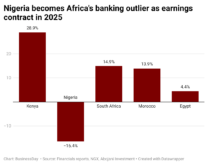
The recent disengagement of workers by deposit money banks is seen as a reflection of the macroeconomic indices that have impacted heavily on banks revenue.
The sharp drop in the price of oil impacted negatively on banks risk asset quality following their high exposure to oil and gas sector of the economy. Worse still, the removal of Commission on Turn Over (COT), Illiquidity and non-availability of foreign exchange affected revenues, deposit growth and asset quality of these banks.
Consequently, banks are suffering from increased Non-Performing Loans (NPLs). Non-performing loans of banks rose by 3.36 percent to N649.63 billion at end-December 2015, from N628.54 billion at end-June 2015. This reflected a 78.8 percent increase from the N363.31 billion recorded at end-December 2014. The NPL ratio rose to 4.86 per cent from 4.65 percent.
However, as part of strategies to restructure their operation by way of cutting costs and position for growth, the Nigerian lenders decided to lay off workers.
Specifically, Zenith bank plc terminated the appointment of about 1,200 workers, Ecobank laid-off 1,040, in Diamond bank about 200 staff were asked to leave and about 700 workers were sacked in FCMB, among others.
Responding to the development, Isaac Okoroafor, acting director, corporate communications, CBN, at the weekend said, “the issue of job security across the country is a general issue. It is not about one industry. It is about what our labour laws are saying. It is about what the industrial policy is saying and with collaboration of both the ministry and stakeholders; I think a solution will come out.
Also reacting to the mass sack of workers, Issa Aremu, general secretary, National Union of Garment and Textile Workers, said, “We commend the ministry of labour for intervening, by asking the banks to stop the laying-off of workers. We have also called on CBN to use its moral authority to encourage the banks to do exactly what CBN is doing. The CBN has been looking at a big picture of development and job creation. It is true that the banks are facing challenges just like any other sector of the economy but we believe that it should not be done at the expense of workers. More than ever before, this present government needs more jobs than taking away jobs.”
Meanwhile, Federal Government had at the weekend, in a statement issued by Chris Ngige, minister of labour, directed banks, insurance and financial institutions, to suspend on-going retrenchment in the sector.
“Following spate of petitions and complaints from stakeholders in the banking, insurance and financial institutions, I hereby direct the suspension of the on-going retrenchment, pending the outcome of the conciliatory meetings in the industry. This is as a result of the apprehension by my office of the various disputes in the sector, in accordance and in compliance with the provisions of the labour laws of Nigeria,” the statement said.
But the Nigeria Employers’ Consultative Association, (NECA) faulted the Federal Government’s directive saying it was not in a position to issue the directive to banks not to disengage workers.
HOPE MOSES-ASHIKE

Join BusinessDay whatsapp Channel, to stay up to date
Open In Whatsapp