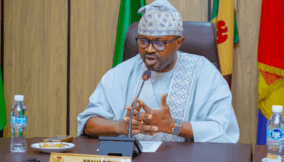
Babatunde Fashola, Minister of Power, Works, Land & Housing is expected to appear before the House of Representatives over the epileptic power generation across the country.
Also expected to appear before the Committee on Power at the scheduled investigative public hearing, are: management of National Electricity and Regulatory Commission (NERC), Nigerian Bulk Electricity Trading (NBET), Generation Companies (Gencos), Distribution Companies (Discos) and other relevant stakeholders.
The resolution was passed following the adoption of the motion of under matters of urgent public importance sponsored by Johnson Agbonayinma (PDP-Edo), who stressed the need to proffer solutions towards improved and sustainable electricity regime.
In his lead debate, Agbonayinma noted that in 2010 it was announced that the Federal Government owned Power Holding Company of Nigeria (PHCN) which had generation, transmission and distribution of electricity would be sold to private sector to increase efficiency and profitability.
He further said that after a land mark of $2.5 billion transaction, the PHCN was unbundled into successor companies to increase access to electricity services, improved efficiency, affordability, reliability and quality services delivery to the nation.
He expressed concern that after years of privatisation of electricity in the country, it had failed to bring positive impact to the Nigerian people.
“What we are seeing today in electricity supplies is comatose. When the Federal Government had the distribution and generation companies light was more constant than what Nigerians are experiencing today.”
Agbonayinma expressed worry that the private sector that inherited over 4,000 megawatts when it was being operated by the Federal Government was battling with leas than 1,500 megawatts putting the nation in darkness.
He, further worried that Government owned the NBET who in their contractual agreement entered into with the investors, promised to allocate and provide up to 5,000 megawatts.
He said that NBET after the agreement could only as at today provide less than 1,500 megawatts for the entire nation.
The lawmaker expressed dismay that with the harsh economic climate in the country, increase in petrol pump price, soaring rise on food items, collapsed roads, lingering unemployment, insecurity had contributed to the hardship being faced by Nigerians.
He also identified unnecessary hike in electricity tariffs, the non availability of electricity deteriorating which increased the hardship of Nigerians and depleted the economic base.
The motion was unanimously adopted by members through a voice vote and referred to the House Committee on power for further legislative action.

Join BusinessDay whatsapp Channel, to stay up to date
Open In Whatsapp