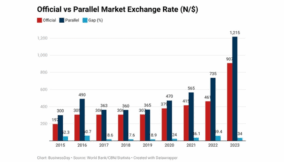
A couple of years ago, Nigerian economy was growing at between 6 to 7%.This was probably due to the fact that crude oil/gas, Nigeria’s main export earner, attracting 90% of foreign exchange, income and which constitutes about 11% of her GDP, was trading at over $100 per barrel. The most probable reason is that the oil boom and Nigeria’s fx reserve which at one point was estimated at about $60 billion attracted international portfolio and equity investors who came in droves to buy Nigerian treasury bonds which had a mouth watering yield of about 12% – an impossibility in the industrialized world.
By their very nature, portfolio investors are exactly what their name indicate-mere portfolio/briefcase carrying businessmen trading in papers and other intangible financial instruments as opposed to entrepreneur investors who bring in machines and other equipments used for the production of goods and in the process, create employment for Nigerians. Obviously, for many years, Nigeria had very few entrepreneurs as foreign direct investors, FDI in the real economy, but attracted hordes of portfolio/equity funds managers who take flight with their investments at the slightest suspicion of instability like oil price volatility or conflicts in the polity arising from political differences.
Nigeria also quickly booked a spot in the popular JP Morgan price index, owing to the excellent return on investments in bonds as opposed to manufacturing. Nigerian economy was thus adjudged to be growing at attractive GDP levels of 6-7% earlier mentioned. Unfortunately, it was only on paper that the growth was being recorded as new factories were not being set up as such; neither were more people being gainfully employed, which is really what governance, political leadership and progress in a society are about. Trade in financial instruments was flourishing so well that trading in treasury bills/bonds and other financial instruments was the trend, and importation of goods rather than manufacturing; gaming the system via fake fuel subsidy invoices and crooked crude oil for refined products swaps schemes, as opposed to refining the 450,000 barrels of crude oil allocated for local refining, gained traction and thus became the new business paradigm, rather than the exception in Nigeria.
As the so called GDP growth was exclusive to the rich as it mainly captured gains in treasury bills earning etc, Nigerian masses were groaning in poverty owing to the socioeconomic hardship foisted on them by fake economic growth that had no trickle down dynamics because it was not people centric and thus failed to make any positive impact on the lives of the ordinary folks.
As a result of the aforementioned polices that were not oriented towards alleviating poverty through employment generation, factories closed down-185 textile mills in kaduna state and environ (according to minister of state for industry, Aisha Abubakar) plus tyre and battery manufacturing plants that were located in Lagos, Sango Ota and surrounding areas.
Associated with factory closures, is the loss of jobs and the current unemployment crisis (about 12%) besetting our country is a legacy of anti job creation policies of previous administrations.
As president Muhamadu Buhari mentioned in China during his current visit, the existing huge trade imbalance between Nigeria and the world’s 2nd largest economy, China has to be bridged and that can only be done if and when Nigerian business men and women start partnering with their Chinese counterparts to produce locally the items that we are currently importing.
A critical facilitator or ingredient for such business relationship to blossom is stable supply of electricity and other infrastructure that enhance manufacturing such as transportation facilities like improved road networks, more modern railway lines and efficient sea and air ports to enhance distribution of goods.
The present situation, whereby the only business model is importation of Chinese finished products into Nigeria and export of our crude oil to China does not augur well as it is antithetical to the erstwhile import substitution policy of Nigeria which president Buhari has vowed to pursue more vigorously in order to create more jobs in Nigeria. So, going forward, instead of focusing on the size of the budget set aside for a project, and the value of the contracts awarded-in terms of the quantum of funds to be disbursed as contract sum, let’s start judging our governments both at the federal, state and local govt levels by the number of jobs created through their development initiatives to determine their impact in their domain.
Currently, growth and progress in our economy are measured by the GDP which is a sophisticated barometer of the sum total of volume and value of economic activities carried out in a specific period in a community or country. Experience in most part of Africa has shown that the method is kind of warped, as it mainly captures the fortune of the top 1% super rich and hardly reflects the misfortune of the 99% long suffering working and jobless masses in the middle or lower rung of the ladder.
During a recent debate on whether or not GDP is an optimal development indicator in Africa, following the palpable poverty manifesting on the streets in Africa, from Kano to Kigali, despite impressive GDP growth in Africa, it was reported that, that the immediate past Africa Development Bank, AfDB president, Francis Kaberuka, amongst other bureaucrats noted that GDP may not be a proper gauge. I would like to stretch that thought process further by adding that GDP is probably a deceptive measure of the state of the economy in Africa, as it does not directly or immediately reveal the number of people in the society that have roofs over their heads and food on their tables.
By applying a new rule, such as the number of people in employment (in the informal sector) as a yard stick for measuring progress and development in Nigeria, the true state of affairs can really be determined because every employed person is more likely to afford to rent or own a home and would also be able to have the proverbial three ‘square’ meals a day.
Another yardstick Nigeria could adopt for gauging progress in our society should be inflation rate. This reflects the hunger or poverty rate in the society because it is a direct measure of the cost of food, housing, transportation, health care and other essential utilities in the society. Following the current dislocations in the economy of Nigeria, inflation is about 10.8%, according to the latest figures from the national bureau of statistics, NBS.
. to be continued tomorrow
Magnus Onyibe

Join BusinessDay whatsapp Channel, to stay up to date
Open In Whatsapp