One year is a brief a period to assess the value of any leader’s foreign policy, yet sufficient to gain insights on the policy trajectory and if the efforts are gaining traction. A lot has been written on President Muhammadu Buhari’s foreign policy endeavours in his first year. Unsurprisingly, most commentaries relate to his perceived ‘junketing’ while Nigeria’s domestic scene remains in a flux. Much of the criticism rests on the N5.5 billion reportedly spent on foreign travels in eleven months of Buhari’s presidency. Such criticisms, to the extent they are partisan and sentimental are misplaced. Yet, any hard headed analysis will point to shortfalls in returns on quid-pro-quos.
I’m hesitant to join in the precipitous criticism of President Buhari’s frequent travels. This does not suggest any acceptance that the trips made so far are all of great value or cost-effective. I’d rather see the trips better conceptualized and executed. I’ll be keen also in evaluations of Buhari’s foreign policy solvency, and their overall gains, cognizant of the fundamental principle of a wise foreign policy, which should bring “into balance a country’s economic, political, and military commitments with its power, while maintaining a comfortable surplus of power in reserve.”
Since 29 May, 2015, President Buhari has undertaken a total of twenty-six foreign trips, spending some fifty days outside Nigeria. Some Nigerians deem such peripatetic disposition excessive. Yet, Buhari’s activist foreign policy role must be considered against his personal convictions, and against the backdrop of his foreign policy engagement as a military leader. Contextually, Rueben Abati’s remark, that “Presidential trips are important, and that by travelling abroad, the President is performing a perfectly normal function” resonates.
Aware of criticisms of Buhari’s frequent travels, presidential aide Femi Adesina said such travels were not frivolous. Buhari personally pleaded the need to engage his interlocutors directly to explain to them Nigeria’s needs and challenges. It’s recognized that as a military head of state from 1984 to 1985, Buhari’s foreign policy was remarkable for his non-direct engagement. He first sent General Joe Garba, a trusted diplomatic hand to the UN, and thereafter, devolved all foreign policy responsibilities to Prof. Ibrahim Gambari, his foreign policy vicar. It remains a matter of conjecture, if Buhari’s erstwhile non-engagement in foreign policy was voluntary or foisted on him by Nigeria’s domestic conundrum. Inthis his second coming, President Buhari’s foreign policy engagement is unfettered. Whatever his motives, he has made a definite change and charge into the foreign policy realm, by becoming his own foreign policy vicar, preceptor, articulator and implementer.
Hitherto, Nigeria enjoyed comparative advantage in Africa’s foreign policy realm. Her power position as Africa’s foreign policy bellwether grew from her domestic antecedents and strength. Paradoxically, just as Buhari inherited a parlous economy, dwindling foreign reserves and crashing oil prices, he also inherited a much-diminished foreign policy capacity and credibility, plus the fact that Nigeria’s diplomacy still can’t be operated in a vacuum; but in the “economic, political, and institutional environment both inside and outside the government.”Another critical strand relates to the modus operandi of Nigerian foreign policy practitioners, who having been “caught between what is ideal and actual reality, (they) now resort to ‘adhocracy’, in both the formulation and implementation of policy.”
Some other salient factors obtain. Months before Buhari appointed his ministers; he personally conducted his foreign policy, using career diplomats as advisers. As if to affirm that “the test of foreign–policy principles lies in their application to neighbours and more distant states”, he engaged both categories early and personally. Though he eventually appointed a foreign minister, it’s safe to assume that he reserved for himself, albeit informally, core foreign policy responsibilities. This supposition, tallies with Abati’s contention about Buhari being Nigeria’s “chief diplomat” and “chief spokesperson” and perhaps so, for good reasons. It’s thus the instructive thinking behind the Buhari’s present disposition that matters most. First, Nigeria’s present economic circumstances are far from glamorous and mirror closely the situation in the early 1990s, when Gen. Abacha admitted that “Nigeria’s “experience of the past year underlies the intimate interrelationship between our domestic strength and our country’s ability to pursue a vigorous foreign policy.”Second, Nigeria which spearheaded the “Africa has come of age” era of assertive foreign policy now spearhead Africa’s ‘economic limping’ era. Thus the assertion that “Nigeria, with help from South Africa, is killing the African story” may not be hyperbole after all. Such policy dissonance is perhaps what President Buhari seeks to change by taking charge. But heady questions persist: Has anything changed in Nigeria’s economic circumstances, including the nexus between her domestic strength hand her foreign policy wherewithal? By assuming an activist role, has President Buhari altered the myths, realities and challenges that have long mitigated the robustness and vibrancy of Nigeria’s foreign policy?
Doctrinally, Buhari’s foreign policy trajectory has positively been devoid of labels. But it’s unclear if this is by design, a tacit departure from Nigeria’s erstwhile sloganeering. Whatever is the case, it’s only the level of solvency of a nation’s foreign policy that matters. And solvency can be defined as return on investment or those tradeoffs that enhance the nation’s economic, political and military wherewithal. Still several national imperatives serve as variables for measuring the solvency of Buhari’s foreign policy. President Buhari campaigned on the platform of rescuing the Chibok girls, tackling Boko Haram, and waging an anti-corruption campaign. He also pledged to par the Naira to the Dollar. These resonating challenges persist.
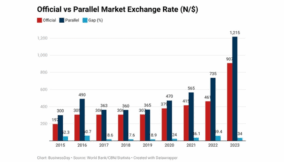
Despite the presumed gains from Buhari’s travels, Nigeria’s economy is still tanking, and replete with shortage of fuel, electricity, foreign exchange, faith and trust. As the Financial Times noted, “No economy can survive without fuel, electricity or foreign exchange.” Buhari’s foreign policy solvency is further challenged by ‘adhocracy’. Of the twenty six trips undertaken so far, the China visit stands alone in yielding clear results. Though not initiated by Nigeria, Chinese authorities in their enlightened self-interest, and to safeguard the lopsided Sino-Nigeria trade imbalance, offered Nigeria a Yuan-Naira currency swap and a$6bn loan. The currency swap, which is aimed more at undermining the US dollar as Nigeria’s main foreign exchange reserve, helps Buhari’s foreign policy solvency only in a limited way. As if to confirm the vagaries of such on-the-fly foreign policymaking, after the swap was announced, the Naira weakened further.
Three plausible strands may have influenced Buhari’s foreign policy inclinations: the desire to engender a new and robust foreign policy thrust; the desire to revitalize Nigeria’s stalled foreign policy impetus; and the desire to sustain the past and renowned foreign policy glory by hands-on engagement. Buhari conducting his foreign policy evokes power, dedication and priority. But whatever instructed his decision to assume full responsibility for his foreign policy machinery, also bequeaths on the president, total absence of plausible deniability, should his foreign policy performance prove lacklustre eventually. The president staying home more in his second year, may help sanitize the domestic environment and operational theatre, now remarkable for being nebulous, disquieting and for its imperviousness. While applauding President Buhari’s constructive engagement thus far, he needs to be advised that the foreign policy solvency he seeks must be orchestrated from home. The problem lies there as does the foundation of his foreign policy solvency.
Oseloka H. Obaze

Join BusinessDay whatsapp Channel, to stay up to date
Open In Whatsapp