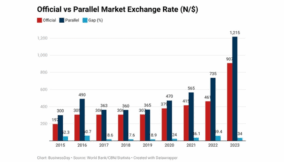
Nigeria’s economy is presently a mess. For those predisposed to positive speaking, this is not negative talk, but the reality. All over the country fuel queue and the time spent to refuel one’s car keeps increasing. Also, since we do not produce most of what we consume, the unavailability of forex has led to increase in the price of most commodities.
The federal government last year had foreseen a bleak future and asked Nigerians to prepare for tougher times. “I agree that 2015 has been a tough year, but then it’s like 2016 would still be tougher, at least in the early part of that year,” said the Special Adviser on Media to President Muhammadu Buhari, Femi Adesina, in an interview.
Not only Mr Adesina. Author Andrew Scott Cooper in an article on the New York Times, titled ‘How Saudi Arabia Turned Its Greatest Weapon on Itself’, predicted that “The instability and economic misery for smaller oil-producing states like Nigeria and Azerbaijan look set to continue.”
Mr Adesina built his prediction on the country’s overdependence on oil. “We have been running a mono-product economy based on oil, and as long as oil prices remain down, things will be tough.”
The world over, the oil industry is in its deepest downturn since the 1990s. Earlier in January 2016 Brent crude was below $30 a barrel. At the end of March it stood at $39 a barrel. The federal government’s solution is to diversify the economy, and Abia state is doing same.
Like most States in the country, Abia has been hit hard by the drop in oil revenue but has made commendable effort to diversify its economy through agriculture, increase in IGR and industrialisation.
Two of the once moribund companies in the state are soon to begin operation. They are Golden Guinea Breweries, in Umuahia and the International Glass Industry in Aba. Both are publicly traded companies with the government’s main input being the political will by the administration of Governor Okezie Ikpeazu to see them succeed.
Ikpeazu’s press secretary, Godwin Adindu, following Ikpeazu’s visit to inspect equipment installations at Golden Guinea wrote that “Significantly, we could see the new impetus for work in the effort by Governor Ikpeazu to revive and activate the moribund Golden Guinea Breweries in Umuahia and the International Glass Industry in Aba.”
In the not too distant past, Golden Guinea’s old production capacity was pegged at 24,000 bottles per hour but the new production line, using the latest technology, is projected to double and produce 48,000 bottles per hour. Also, at the peak of its operations before its unfortunate closure in 2003, the company had about 5000 workers, a figure also projected to double when operations resumes on or before June this year.
By sheer political will the Ikpeazu’s administration has been able to convince investors that own the Golden Guinea Breweries and the International Glass Industry to come back, and now that the federal government has resolved the dispute between Geometric Power and Enugu Electricity Distribution Company (EEDC), it can only get better.
In a report by the World Economic Forum, power was described as important for the running of factories: “Energy is the “oxygen” of the economy and the life-blood of growth, particularly in the mass industrialization phase that emerging economic giants are facing today as their per capita GDP moves between approximately US$ 5,000 and US$ 15,000.”
Governor Ikpeazu in his inaugural speech recounted Aba as being a thriving hub for manufacturing and commerce for many years, until “epileptic electricity” forced the shutdown of most indigenous and foreign owned industries, an issue which solution he stressed shall be pursued with vigour:
“We must therefore recognize and appreciate the efforts of the Geometric Power Group and the Federal Government’s NIPP project at Alaoji towards providing a solution to the perennial challenges of electricity supply to our state. The forthcoming operationalization of these plants will provide a critical input towards the actualization of our blueprint and roadmap for the regeneration of Aba and the entire Abia state.”
True to his words, the governor’s effort yielded result recently. Good news, the “FG resolves Enugu disco, Geometric Power dispute over Aba power supply”. It had been a longstanding dispute between both companies over who should supply electricity to consumers in Aba and Ariaria axis of the state.
Signing the agreement, former Minister of Power and owner of Geometric, Prof. Barth Nnaji, explained that the agreement gives the 141 megawatts plant the right to supply electricity to Aba and Ariaria and collect tariff based on approved tariff for EEDC. Any excess power remaining after supply would be taken by Enugu disco for distribution to its customers.
The present Minister of Power, Mr Babatunde Fashola who took over from Vice-president Yemi Osinbajo in brokering the peace deal stated that, “To the people of Aba, what is important is to emphasise the fact that they need more power for the fledging manufacturing concerns.”
It stands to say that Abia is ripe for an investor’s comeback. With the projected successes to be recorded by the state’s Education for Employment Programme, the manpower is here. The state is also building industrial clusters and Governor Ikpeazu has assured of unwavering government support for investors. Availability of electricity mixed with political will and Abia State is open for business. If you’re an investor, welcome!
Ojo Maduekwe

Join BusinessDay whatsapp Channel, to stay up to date
Open In Whatsapp