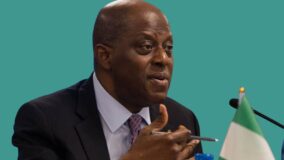
Lack of infrastructure, government control and collapse in the educational system has been identified as the canker worm that has eaten deep into the Nigerian economy.
These were the unanimous views of speakers and panellists at the Nigerian Economic and social risks summit, risks awards presentation organized by Nigeria Risks awards in Lagos recently.
In his opening remark, Anthony Ukpo, former Rivers State governor and chairman of TSI Group who also served as the chairman of the summit spoke on “Made in Nigeria products and services – promoting made in Nigeria”. He was of the opinion that Nigerians should concentrate on making Nigeria a tourist destination as a way of developing the country.
“We should stop thinking about export and start thinking of how we can attract import that will help us develop. We will never develop as long as we are exporting raw materials. Britain survives on tourism; they don’t have raw materials to export. We have numerous tourist places in Nigeria and we have refused to develop them,” he said.
While encouraging Nigerians to imbibe made in Nigeria products, he stressed the need for government to create an enabling environment for businesses to thrive.
“Government should look into the provision of infrastructure because an industry cannot succeed unless they have proper infrastructure. It’s impossible for us to produce everything in Nigeria because no country makes everything in their country but at least you must have the basics made in your own country and then you can bring in the others to fill in the gap”
Speaking on the topic, “Promises to reality- Current Economic climate in Nigeria”, Frank Aigbogun, Chief Executive Officer, BusinessDay Media Limited and special guest at the summit outlined four important areas affecting the Nigerian economy which includes fuel scarcity, inadequate power supply, shortage of foreign exchange and poor education.
He expressed disappointment in the manner in which the government handles economic matters in the country noting that Nigerians’ response to external challenge is what has kept the country where it is presently.
“It’s a shame that a country like Nigeria should have fuel scarcity. One of the paradoxes of Nigeria is that we wallow in shortages of things that abound in the country and my answer is simple, government should get away from the idea of fixing the price of petrol and allow the private sector to go in refine petrol and then sell petrol to people. Until government gets away from fixing price, we will only need a person like Aliko Dangote to set up a petrol refinery in Nigeria;” he advised.
In his view, Nigerians should be ready to pay good price for petrol. He said his test for seriousness of government when it talks about diversification of the economy is that it should diversify the one that is within its power, which is petrol.
He added that instead of exporting crude oil, government should make it possible for it to be refined in the country, add value and then unleash the petrochemicals industry. According to him, if this is done, it will solve the problem of fuel scarcity.
On power supply which has been a stumbling block to the industrialization of Nigeria, Aigbogun revealed that Nigeria flares the amount of gas that is equivalent to what France and Australia run their economies with everyday.
“Why is it that we flare so much gas and we can’t send gas to power stations in Nigeria? It is simply one thing, government control. For as long as government controls the price of gas and government is the only agency now transporting gas through the Nigerian gas company, so long will we fail at getting gas to power plants in Nigeria.”
The guest speaker described what is happening today in the area of foreign exchange shortage as taking the pain of devaluation without getting any value for it. According to him, Nigeria is already paying the price as if it has devalued. “I believe it is time for government to sit down and have a good discussion, we should not be fixated with this; for me, it’s not an ideology,” he stated.
He frowned at the idea of a law denying parents foreign exchange to pay their children’s tuition fees abroad.
“I believe it’s criminal that as a people in a country, we have allowed a situation where they say that as much as a million of our children are out studying and we are spending as much as $ 2-3m, a year paying fees. Every year, Nigeria gets Diaspora repatriation in excess of $8bn, so we are getting more money than we are losing outside,” he concluded.
Tunji Anjorin, Executive Director, Vitaform Plc said the operating environment in the country has watered-down the quality of products making people to downplay on the quality and pricing in order to be competitive.
“It’s not as if the skills and the capabilities are not there to produce quality products but where the cost of running these businesses is very high, it makes it difficult for quality products to come out from Nigeria.
“There are a lot of companies in Aba that can compete favourably with China if they have constructive support either from government or private to help them so they can compete,” Anjorin added.
The highpoint of the summit was the presentation risks awards in which BusinessDay Media Limited received the Award for risk leadership and media coverage in Nigeria while its CEO, Frank Aigbogun was honoured with the Lifetime Achievement Award.
CHINWE AGBEZE & CHIGOZIE EGWUATU

Join BusinessDay whatsapp Channel, to stay up to date
Open In Whatsapp