


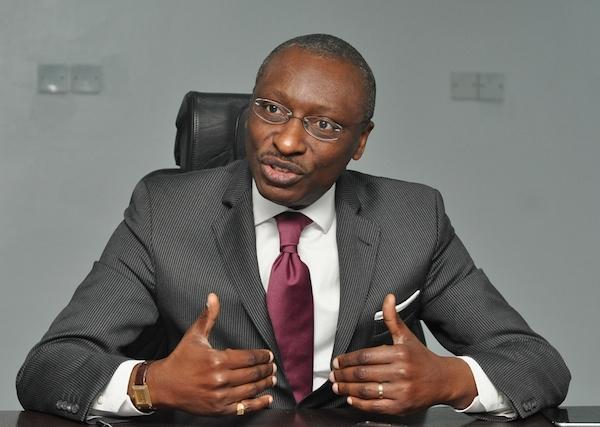
Charles Kie recently took over as the managing director and chief executive of Ecobank Nigeria. In this interview with select editors, John Omachonu, Acting Editor, BusinessDay, Kie says that the role of the bank is not just providing financial services, but also supporting and partaking in the development of the country. He also says that after a long phase of growth, where the bank has seen several acquisitions with the last being the merger with Oceanic Bank, the next target is attainment of leadership position and striving to be the most respected bank in the industry. Excerpt:
Since you came into the country and took over the management of this place, what were the initial issues you were confronted with?
First of all, before I come to the issues, I think it’s important to restate the position that this bank has in the country.
Ecobank Nigeria, by several dimensions is seen as the sixth largest bank in Nigeria, and is also systemically involved in banking. And therefore, it has a very critical role to play when it comes to not only providing financial services but also supporting the economic development of Nigeria. As an institution, we see our role, not just providing financial services, but also supporting and partaking in the development of each of the countries in which we operate.
After a long phase of growth where the bank has seen several acquisitions in this market and with the last large transaction we did, which was the merger with oceanic bank, I think the bank has come to a point where it has to clearly think about how to attain the leadership position in this market.
It is in that frame that it was told that after my predecessor has spent five years in his position, which is the rule we have in our group; a proper succession plan should be put in place, so that the team that are coming would have the mission of bringing Ecobank Nigeria to a leadership position in the banking industry.
So, I wouldn’t talk too much about the issues, rather, I would talk about the opportunities that we see ahead of us. Because, obviously, since I came, I hear a lot of people talk to me about the challenges the country is going through, the foreign currency issues, the oil price going down, but, as you probably know, whenever you are faced with challenges, you also have to look at the opportunities that come along with those challenges. And that requires at least two things; first, the ability to adjust to the conditions that are prevailing, and secondly, the means to really prepare to take on the opportunities that will come with the upside that the economy will offer, whenever it comes back to more normal conditions. And this is what my team and I are working on, in order to precisely drive Ecobank Nigeria to that position.
Specifically, what strategies are you trying to put in place to achieve this?
I could spend a lot of time talking about detailed strategy, but I don’t think this is the forum at this point. But as you can imagine, when it comes to driving change, it is important to understand the kind of vision that we have and what we are trying to achieve.
And what do we want to achieve? One, it’s important for us to say that we want to be the most respected bank in this country. Two, I think it is also important to state that we also want to be a leading bank in the nation, and when I say leading bank, it means, number 1,2, or 3.
Three, we want to be winning in the markets where we operate and precisely, looking at the opportunities that we have ahead of us. The opportunities in Nigeria are enormous, especially looking at the large population and the number of consumers who are still largely unattended to.
The bank penetration rates are still very low, and therefore, one of our key strategies is to make sure that we position ourselves to really tap into the opportunities that we see in that space. Another thing, obviously, is to make sure that we attract within our customers, the kind of attention they deserve.
What they need and what they expect to see from us is what should be driving us, as opposed to just coming with classic long standing products without any innovation. So, the second element is to provide innovation in the space of serving our customers and ensuring that we effectively penetrate sustainably, when it comes to serving them.
The third aspect is that because we also have responsibility to create value for our shareholders, it is important that we significantly improve the productivity of our staff and run this business in a profitable manner. This will require us taking steps to improve operational efficiency to reduce the cost of transactions, thereby improving the profitability of the bank.
For an organisation like ours to be nimble, it has to have a structure that really is in accordance to a world- class standard. And in doing that, when we come to a situation where we see imbalances or where we see that we are by far overstretched, compared to competition, then, it’s our role to make sure that we can bring the structure that we have at the lowest level possible, when it comes to people and we also improve the productivity of our people, so that we have a managed situation. We attract in Ecobank, the best talents of this market, and the ability of retaining and growing them is what really drives everything that we do.
We learnt that you are trying to convert some contract employees to permanent staff?
Yes, indeed, we have made that decision because we still have quite a number of what we call, outsourced staff. We thought that it wouldn’t be right having so many people whom are seen as being outsourced, without trying to find out whether in that population, we had real talents whom we could convert into permanent staff, and therefore, we decided that we would run a series of tests; identify those talents; ensure that there is a transparent process in place, and at the end of this process, some of them will be converted into permanent staff.
Can you just quickly explain what you mean by being the most respected bank?
It’s not just good enough to be a profitable bank; it’s not just good enough to have good service, but it’s also extremely important to abide by the regulations and to operate with the highest standards of the industry. The bank acquires trust and respect when such regulations and rule become part of the DNA of the whole organisation. Now, this is what sets it apart when it comes to knowing which bank to go to, even if they are the most profitable in the industry. So, it’s not just about the bottom-line, it’s about creating an environment where people have ethics; where people know what compliance is all about; where people know the regulations and set themselves the highest standards to operate with. With this, we want to become the most respected bank and we want this to be fully part of what we achieve in this industry.
Talking about expansion strategy, are we looking at Ecobank opening up branches or going into acquisitions, if the opportunity comes?
One topic that is dear to my heart is financial inclusion. And when it comes to financial inclusion, it is important to find the best means to achieve penetration of financial services, not branches. It is not about having a wide spread of branches across the country that makes a difference, it is about finding a means to actually reach anyone in the population without having to open a branch. So, obviously because technology has evolved, the means of achieving that will be alternative channels, not branches. What that will require is that we design a strategy that addresses each segment of the population. We do have a microfinance activity, and that microfinance will be developed in such a way that we make ourselves known and perceived as a leading microfinance institution in the country.
Obviously, the number of branches that will be dedicated to that activity will be defined, agreed on, duly approved and then, we will roll out a strategy to touch the population that today, requires microfinance as a means to have access to financial services.
For all the others, technology will drive it, obviously. Social media, analytics, and cloud, are items that drive what we do when it comes to operational efficiency and inclusion. And as a bank, these are the elements we will embed into our technology strategy, to precisely achieve that financial inclusion.
Looking at the economy of African states, apart from maybe Nigeria, South Africa, and Angola, in specific terms, how do you intend to drive this retail banking with the hope of breaking the barrier and reaching the unbanked, considering the fact that the purchasing power (to the average individual) is being gradually eroded?
Let us move away from the idea that population that are perceived not to have a high purchasing power do not have needs when it comes to financial services. How many people in the rural areas know how to send and receive money? A lot! In fact, more than we even think about. The mistake that has been made for a long time was to think bank penetration as regards to the bank accounts that people had, it is not about bankability, it is about financial access. What we are talking about today is to make sure that whoever has a disposable income can also have access to financial services, and as you know, mobile is a key means to achieving that. Obviously, we are investing in mobile, and we are investing in solutions that will allow that accessibility to be made available to the population. Indeed, when we think that the current situation is what can prefigure what will happen later, for me it’s not exactly the case. The country is just going through a phase, but we should understand economies are cycle related. It’s just a cycle and we just happen to be at the bottom of that cycle, but at some point, there will be a rebound. We now need to think about what we are going to do to precisely attract those people in the financial sector, so that we, at the bottom of that cycle can effectively take advantage of the upside, whenever it comes.
Can I have a glimpse into your 2015 financials?
Well, we have just closed the account and they have not been published yet, so it will be difficult for me to actually give you. Not too many countries would have absorbed the shock of seeing seventy percent of their resources going away, without literally tumbling, especially with the challenges that the country is being faced with and knowing full well that this country has a chunk of its economy related to oil and gas. And because the banks have been financing the real sector, particularly the oil and gas industry, it can only be expected that the situation will have an impact on the portfolio of banks.
So much so that you might exceed the threshold of five percent, or making a loss or breaking even?
No, I’m just saying that the situation the country has gone through can only translate into a deterioration of the credit portfolio, particularly those related to oil and gas.
What is the contribution of Ecobank Nigeria to the group?
Depending on the dimension, we can say between 40 and 45 percent.
In how many countries does the group operate?
We operate in 33 countries with full licenses. Out of these countries, Nigeria is the largest by far- in terms of its size in terms of contribution to the asset size; and the number of staff we have. That is the reason it is so important for the group, that Nigeria takes a leadership position.
And how many people are employed in the group?
The group today has about 20,000 people and out of this, Nigeria has 9,000.
You spoke of being impressed with the financial inclusion programme of the current administration, as it offers a lot of opportunities for banks, but there is one area that has been contentious over the years, and that is the interest rates which have been described as unfriendly to businesses?
I think people should understand that interest rates are not artificial. It is about supply and demand and therefore, there is obviously an intrinsic link between how much money is supplied in the economy and the rate that it can be offered. The question here is not so much about rates, it’s about competitiveness; how we make sure that this economy remains competitive, and how we make sure that industries operating in this country, remain competitive.
What is your strategy in terms of training and development for your staff in respect of this new vision?
A lot of people talk about customer service, but not all of them manage to translate what they know about customer service into reality. My view is that to achieve excellence in customer service, the teams have to be hired, trained, and framed to achieve the level of customer service that we want. And therefore, it can only become part of the DNA of the organisation, which is what we want to focus on to make sure that the people we attract, train, and retain are in fact moulded, to fully embrace the culture we want to build when it comes to customer service.
Analysts have been suggesting that there would be a rise up in mergers and acquisitions in the banking sector this year, is Ecobank looking that way?
Let me just make a clear statement- as far as Ecobank is concerned, the group as a whole, has come to the end of its geographic expansion and its inorganic growth. At this point in time, we are not talking about acquiring a bank or merging with a bank; this is not on the agenda. The only thing we want to do now is make sure we consolidate and grow organically, strong enough to attain the leadership position that we have set as our objective. This is what will drive everything that we’ll do in the next two years.
What is your vision for Ecobank Nigeria in terms of market share and product development by the time you’ll be leaving?
We are taking a five year horizon as the least time to see the full impact of all the strategies we have put in place, and we think that by 2020, we should be in the leading position i.e., number 1, 2, or at a minimum, number 3 in the Nigerian market.

Join BusinessDay whatsapp Channel, to stay up to date
Open In Whatsapp


