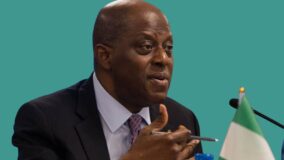
Following the economic crisis occasioned by continued fall in oil prices, experts in economic matters have challenged the government on adequate structure, discipline and growth framework to restore Nigeria’s economy.
This was a unanimous call by the Society for Corporate Governance Nigeria (SCGN), as part of its continuing effort to promote and develop corporate governance and best practices in Nigeria.
Pat Utomi, director/fellow of SCGN, and Ayo Teriba, CEO, Economic Associates, who were guest speakers at the Executive Breakfast Meeting organised by SCGN in Lagos recently, with the theme: “Nigeria’s economic realities: Myths and Facts,” highlighted some of the challenges confronting the nation and gave their views on how to move the nation forward.
Utomi pointed out that the current Nigerian economic situation was a dé ja vu, and as a result there was need for discipline, planning and a proper governance approach in order to improve the current uncertainties in the economy.
“In improving the economy, the affected stakeholders should be identified and an evaluation on the impact of various choices made by them should be identified and rectified,” he said.
He stressed the need for stakeholders to be disciplined and committed in order for the Nigerian people to have faith in the credibility of the budget process and the economy in general.
The professor of political economics said that in order to be an economy that would do well, it was important for Nigeria to have a growth framework that would ensure that right policy choices were made, the human capital was adequately available, entrepreneurship and entrepreneurial skills were available, growth and improvement of culture and value system were present and a proper leadership structure was in place.
In his speech on “Nigeria’s Economic Outlook,” Ayo Teriba noted that due to the global shocks, the Nigerian economy had been greatly affected, thereby leading to a negative economic outlook.
“Contrary to most beliefs, the fall of the naira is majorly as a result of a shortage of foreign exchange, as a result of drop in oil prices and not necessarily the devaluation of the naira,” he said.
He further said that with or without oil, Nigeria remained the largest economy in Africa and would contribute $25 billion out of the expected $100 billion of the whole continent.
According to Teriba, it has become necessary for the leaders to step aside and aggressively court direct foreign investments in order to boost the nation’s economy, while noting that there is a need to block leakages through putting an end to oil theft, oil-subsidy abuses, and abuses of duty/tax waivers.
He also advised withdrawal of ‘autonomy’ from all revenue-collecting agencies and capture value created by government interventions, citing Lagos and FCT as examples.

Join BusinessDay whatsapp Channel, to stay up to date
Open In Whatsapp