Recent developments in the global economy and, in particular, that of Nigeria have made it imperative for us to return to the subject of equity in the design and application of public policy. We made a passing submission on this subject in a recent contribution on this page, calling attention to the growing inequality of incomes in the world and by extension our country. Today we bring the issue of equity once again to the front burner; not because equity is a new concept or unknown to our public policy, but in order to restate the fact that economic growth and equity are not necessarily incompatible. More particularly, we need to emphasize the fact that continued lip service to the issue of socio-economic equity boosts the informal sector and by extension, the number of our people structured to the periphery of decent living or even below the poverty line.
There is no doubt that most oil-dependent economies of the world are going through appreciable financial difficulties. And their troubles do not appear to be going away in a hurry, given some facts available on the global oil market. While Russia and Saudi Arabia are engaged in a fight for supremacy and control of the oil market, producing about tem million barrels per day apiece, at the moment, other producers are not letting up.
On the other hand, Iran, which was recently freed from crippling isolation, is hungry for a return of the market share it lost to many years of economic sanctions. It has come back and it’s in a hurry to produce more but the rank of oil consumers is not growing. Although still doing less than a million barrels a day, Iran’s output is likely to hit that volume before the year ends. On the other hand, OPEC is still pumping more oil into the market each moment you take a look, probably for the same reasons as the others. Evidently therefore, oil prices, which have hovered below $40 in recent weeks, may not recover much this year.
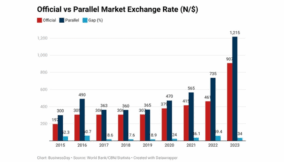
So, fewer dollars come into the coffers of those who depend on oil. As we write this script, nobody is sure of what constitutes the core elements of the Nigeria’s foreign exchange policy. And nobody should be blamed because we all jointly pushed the country to this point of confusion. Nor is anyone in a position to predict the exchange rate of the local currency the next day. The only thing that is predictable about the currency today is that the exchange rate will worsen against it each morning – talk of self-fulfilling prophesies. And that is not a very smart prediction, the direction being obvious even to the uninitiated.
The value of any country’s currency depends on the demand for and supply of that currency. For as long as the price of oil, the country’s main foreign exchange earner, continues to drop, so does her capacity to supply foreign exchange. Price is the equilibrating mechanism that allocates resources to those who can afford them. Exchange rate is a price – the price of one currency in terms of the other – so it will move in tandem with the demand and supply of foreign exchange.
This diminished capacity to provide foreign exchange shows up in a mismatch between demand and supply. Meanwhile, we know from elementary economics that once demand exceeds supply, prices must rise. So it is only natural that as long as our demand for foreign exchange exceeds our supply, the exchange rate can only go against the local currency. The implications of this situation are already on the streets of many oil-dependent economies, including Nigeria. Many Nigeria children, who were forced by circumstances to go abroad to seek quality education, are on the verge of losing their places and being sent back home. Their parents have been queueing up for the limited foreign exchange provided by the Central Bank, for school fees.
I have never been a fan of an economic system based on hand outs and allocations. So I do not support a situation where a few people who have access to political power would allocate among themselves any of our national patrimonies, including land and the hard currency we earn from oil. In my view, all kinds of unwarranted subsidies are being doled out, especially to those who do not need them or who can afford to pay for them. My view is that if we decide to move away from the allocative economy, we need to go all the way through.
One of the fall outs is that some witch doctors and “economic experts” are already proffering “solutions” that seek to extend the list of items to be starved of foreign exchange, beginning with children’s school fees. Their top idea is that government should stop providing foreign exchange for school fees. Evidently, these experts spoke in a hurry. What do we make of BTAs, Estacodes and such? Perhaps it is time to question everything. I find it strange that the first thing a Nigerian parent seeking ways to conserve foreign exchange is thinking of banning is forex for children’s school fees and doesn’t care if the children should be thrown out of schools around the world.
These parents have been bleeding to pay these school fees even at the best of times, while government-appointed heads of public schools transform from humble teachers to affluent elite. These experts have not said anything about reconstructing the public educational system and making it safe for our children. Evidently, such a rule will neither affect treasury looters nor those comfortably seated atop cosh-cow institutions that take their bills. Of course, those who have got their share, fairly or unfairly, of the national cake have no need for foreign exchange from Central Bank so the children of the struggling working class can come home.
There should be a complete review of the way and manner public resources are spent. The amount we spend on feeding visitors to top public officers and government houses alone is a national scandal. And check out what they eat and drink – foreign food and expensive drinks bought with hard currency. Equity is the missing link in all our national dealings.
Emeka Osuji

Join BusinessDay whatsapp Channel, to stay up to date
Open In Whatsapp