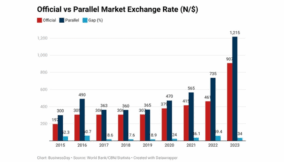
Investors in Nigeria were hugely disappointed with the outcome of the MPC meeting with no announcement on FX liberalisation, and all interest rates unchanged. Given the comments by President Buhari in the December Budget speech, many had been hoping for a formal re-opening of the interbank FX market – at least some minor step towards the resumption of two-way trading. It was not to be.
Perhaps in light of the renewed pressure on oil prices, perhaps because of a willingness to let current stimulus measures run their course, there was no opting for FX market liberalisation at this meeting. Instead, financial institutions were asked to do their ‘patriotic duty’ and increase lending to the real economy.
The policy stance appears problematic for a number of reasons:
First, in the absence of a more flexible FX regime, and changing external fundamentals, demand will need to contract in order to sustain the FX rate at a fixed level, c. 197, while avoiding any damaging run-down of FX reserves. Any lending to the real sector that succeeded in boosting real growth would inevitably increase demand for imports. (When economies grow, demand for imports tends to increase as well). At this point, the non-availability of FX for imports, given the lack of a smoothly functioning FX system, is likely to be the main impediment to a growth resurgence. The cost of the fixed exchange rate regime, in terms of growth forgone, is high. It is doubtful that it can be offset by increased domestic lending. In an FX-constrained environment, more lending might only exacerbate existing inflationary pressures.
Second, Nigeria will find it more difficult to preserve its FX reserves in the absence of FX market flexibility. There is little incentive for larger foreign inflows – whether direct investment or portfolio flows – to finance its current account deficit. Investors will likely remain on the sidelines, given the perceived overvaluation of the FX rate, and the still-significant risk of an eventual devaluation. Any further decline in Nigeria’s FX reserves may harm perceptions of its creditworthiness, at a time when Nigeria may need to borrow externally to finance ambitious infrastructure plans.
Third, the greater the spread between the parallel market and the official rate, the greater the perception of official NGN overvaluation. This remains the case even though the parallel market is largely a retail market, lacking the depth and liquidity needed to meet the demands of Africa’s largest economy. The risk is (even with the best of intentions) that a widening spread with the parallel market will encourage round-tripping, creating further pressure on reserves. There is an additional downside too. When the interbank market eventually opens, any overshooting of the exchange rate may be even more pronounced.
Razia Khan

Join BusinessDay whatsapp Channel, to stay up to date
Open In Whatsapp