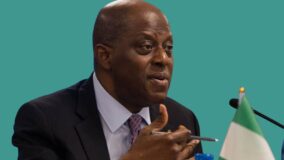
Consumer spending as well as local and foreign direct investments in all sectors of the economy will remain flat in 2016, until the Federal Government does the right thing to boost other sectors of the economy, says Bismarck Rewane, CEO, Financial Derivatives Company Limited, in Lagos over the weekend.
Rewane, who spoke during the ‘Nigerian Economic Outlook 2016,’ said the nation’s economy in 2016, would be driven by government multipliers such that if government borrowed to execute capital projects, local and foreign direct investments would definitely follow suit.
“2015 was a rough year, but 2016 will be a tough year. The year will be flat but Nigerians are going to see slight changes by year-end. The banking sector is also going to be stressed within a compressed margin and this will go a long way to highlight the fact that banks need to be mindful of their operational cost,” he predicted.
According to Rewane, Nigeria’s exchange rate has to be corrected given the fact that exchange rate arithmetic is very critical to every aspects of business, especially as regards investments and inflow of income in and out of the economy.
He said the current politics of foreign currency transaction questions investors’ confidence and also enthroned uncertainty in the economy.
“I do not think that the Central Bank of Nigeria (CBN) will accept to further devalue the naira, but the apex regulatory bank will be compelled by the current economic imperatives. CBN will be forced to adjust the currency due to the present financial exigencies such as lower oil prices, US fed tightening, which will result to capital flight,” he said.
Continuing, he said: “Currency adjustment will be done reluctantly but afterwards, investment will come and the nation’s GDP will grow. The economy will get better but very slowly.”
While noting that export business will also be flat and import will go down, Rewane listed agriculture, civil works and construction, including solid minerals, as the nation’s growth sectors within this difficult times.
He further predicted that inflation would go up to double digit within the year under review from the current 9.5 percent to almost 14 percent. Some state governments, he said, will find it difficult to cope with the current economic difficulties such that there would be two more bailout from the Federal Government.
The financial analyst however assured Nigerians that government spending in most critical sectors of the economy such as power and transport infrastructure, would not be cut down, and that capital inflow would increase by fourth quarter of 2016.
Speaking on ‘Nigeria Oil and Gas: Perspectives and Opportunities,’ Mutiu Sunmonu, former managing director of Shell, said effective cost management was very critical in the midst of fallen oil price such that investors, who manage their cost well would also make money from the oil business.
To him, the current economic situation presents opportunity for investment due to the fact that fall in price of oil is a short-term trail that will change within a short while.
“Businesses in Nigeria are not prepared for the toughness of 2016. There is need for oil and gas businesses to diversify their operations by going into the midstream and downstream because the future is very promising. People also need to think out the best way to differentiate their businesses from others, demonstrate integrity and market understanding,” he said.

Join BusinessDay whatsapp Channel, to stay up to date
Open In Whatsapp