The current stance of accommodative monetary policy moving towards a low interest rate environment is expected to be supportive of expansionary fiscal policy change intended to raise aggregate output in an economy with less than full employment.
Moreover, real borrowing cost is actually now at 1 percent with bond yields at about 10.5 percent and inflation rate at 9.5 percent. In essence, the government appears to be benefitting from inflation tax, but most financial analysts focus mostly on the nominal borrowing costs of financing fiscal deficits.
The markets and the open economy
In addition, policymakers must appreciate the context of markets they operate in and in a world of free capital flows and floating exchange rate regimes, economic uncertainty is swiftly punished by foreign portfolio investors, financial markets and institutions including global rating agencies and purveyors of indices such as JP Morgan index.
The love affair of foreign portfolio investors will be severely tested even if the country relaxed capital controls and enacted a floating exchange rate. The current spread between rising US interest rates and declining Nigerian rates provides insufficient compensation for the perceived risk of Nigerian investment given rising external current account deficits, rising fiscal deficits and low oil prices. In essence, a much larger depreciation of the exchange rate would be required to compensate them for lower interest rates and bond yields.
All of this brings us to the issue of monetary policy trilemma. The unholy and impossible monetary policy trinity is not merely a theoretical construct. It is a valid practical proposition. As Michael W. Klein and Jay C. Shambaugh once noted: “Governments face the policy trilemma – the rest is commentary.”
The CBN cannot successfully pursue its accommodative monetary policy strategy while simultaneously controlling the currency without imposing capital controls. It must choose only a combination of two out of three at any point in time.
The politics of exchange rate regime
Given the distributional effects of the choice of exchange rate regimes, different interest groups lobby for the regime that they perceive to favour their group.
The economic interests of the electoral constituencies (including grassroots support by owners of labour and an army of unemployed youth) that brought President Buhari to power are quite distinct from those of some owners of capital who actually opposed his ascendancy. This fact is not lost on the president and his kitchen cabinet; they are fully aware of it. According to the president, “We are carefully assessing our exchange rate regime keeping in mind our willingness to attract foreign investors but at the same time, managing and controlling inflation to level that will not harm the average Nigerian. Nigeria is open for business. But the interest of all Nigerians must be protected. Indeed, tough decisions will have to be made. But this does not necessarily mean increasing the level of pain already being experienced by most Nigerians.”
In this context, it is no surprise that the government has sacrificed capital mobility in favour of an implicit fixed exchange rate and the ability to orient monetary policy towards lowering interest rates to support fiscal and development policies aimed at tackling unemployment.
To illustrate this fact, the trade union and labour union have been quite vocal in their support for the current exchange rate regime. After all, the vast majority of Nigerians do not use foreign exchange to undergo foreign medical tourism, send their children for schooling abroad, buy exotic cars, and travel to Dubai, Paris and London on vacation and for luxury shopping.
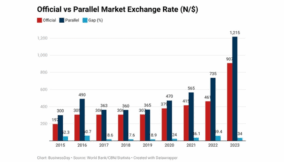
They have realized that the promises of exchange rate depreciation from N1 to over N200 to the US dollar over the last three decades have not led to increased productivity, export competitiveness, and domestic revenue diversification nor weaned the country off import dependency. They also know that Nigeria’s domestic shortcomings – fiscal leakages, institutional, structural, and infrastructural constraints – cannot be solved by simply debasing the currency.
On the other hand, some economic agents have been subtly campaigning against it. In particular, financial institutions have seen an erosion of their three major sources of profitability – treasury, foreign exchange, and cheap public sector deposits – which are indeed tied to the policy choice arising from the trilemma. Then add the nearly 20 percent decline in the stock markets, you understand the pain of the weeping boys of the equity and FX markets!
Beware of the wisdom of the crowds
The phrase “beware of the wisdom of the crowds” then aptly describes the perceived popular reactions within the financial markets to the statement on exchange rate regime in the presidential address. Some appear to have misinterpreted this statement to mean that another round of devaluation of the naira is coming soon, perhaps early in 2016. While this may still happen, the president in his media chat at the end of 2015 appeared to have deflated those devaluation delusions by restating his stance on devaluation of the naira. The CBN had also signalled that flexibility in exchange rate management implies prioritizing exchange allocation to hitherto well-established letters of credit, importers of raw materials and essential capital goods.
While the financial markets and markets intelligence gurus tend to focus more on market constraints, they neglect the systemic constraints of the monetary trilemma and domestic political considerations relating to the choice of exchange rate regimes. They should wake up to the scent of change in the air.
Temitope Oshikoya

Join BusinessDay whatsapp Channel, to stay up to date
Open In Whatsapp