Everything! In a letter to the prime minister of Malaysia during that country’s crisis in 1998, Paul Krugman, Nobel prize winner in Economics, wrote: “Currency controls are a risky, stopgap measure, but some gaps desperately need to be stopped.” (The International Monetary Fund at the time had a contrary view.) In general, free capital mobility (in search of high returns) usually from advanced economies to emerging markets is great for foreign exchange accumulation. However, rapid, high inflows and outflows of capital, usually short term, can cause volatility and distortions to local currency exchange rates and the wider economy. The following paragraphs articulate the dilemma faced by the Central Bank of Nigeria (CBN), impact of control measures and outlook for 2016.
Since the commencement of rapid decline of oil prices in 2014, the CBN has been in the eye of the storm. I would imagine that there are a number of things that give CBN Governor Godwin Emefiele sleepless nights top of which would likely be the risk of complete depletion of Nigeria’s foreign reserves. If the Q4 2014 foreign exchange utilisation of USD17.5 billion is taken as our average quarterly requirement, we need no divination to realise that such voracious appetite for the dollar which we have no powers to print cannot be sustainable (at US$50 per barrel and daily production of 2.2 million barrels, annual gross dollar inflow stands at only about US$40 billion).
By default, regulators are controllers. The CBN is constrained to adopt short-run control measures in response to uncontrollable external events that have far-reaching domestic impact for our reserves. Emefiele in adopting the control measures most likely takes comfort in knowing that the IMF has over the years come to accept that targeted and temporary capital controls under exchange rate peg regimes could be effective given economic conditions such as we are experiencing in Nigeria today. In its annual review of currency regimes, the IMF also revealed that at the beginning of 2015, 65 percent of its member countries had one form of fixed exchange rate or another.
The long-run objective of CBN’s exchange rate policy is to preserve the value of the domestic currency and maintain a favourable external reserve position that supports the overall goal of macroeconomic stability. Even though a (managed) pegged exchange rate system under market pressure can quickly force a high decline in the value of the naira, there is no consensus or historical precedent in Nigeria that indicates that adopting a free float for the naira exchange rate will serve our economic interests better. Emefiele has prioritised stability of the exchange rate and some degree of monetary policy autonomy over full capital mobility.
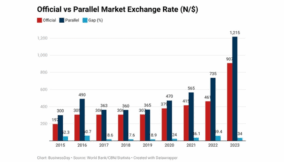
Control of foreign exchange flows out of Nigeria affects domestic prices of imports, exchange rate volatility especially in the parallel market and short-term investments. One of the main arguments by investors against controls is the impact on investments. In the course of my work, I do acknowledge that many investors have shown preference to wait till the official naira rate finds its “true” value before making investments. Exchange controls represent a major disadvantage, especially for portfolio investors (whose investments are least likely to increase economic growth) but less so for long-term strategic investors because their investment decisions are anchored on structural characteristics of the real sector of our economy.
If current estimates of USD6 billion annual spending on the Boko Haram insurgency are credible, the recent successes achieved in bringing the crisis to a near close would serve to further reduce pressure on our external reserve position. Improvement in our domestic crude refining capacity will also greatly reduce our annual dollar requirement of about USD9 billion for refined products importation. The list of 41 items banned from access to the official foreign exchange markets is another measure which, if successful, will over the medium to long term reduce the rate of depletion of reserves, through local sourcing and production of those items.
Gradual but strict application of foreign exchange (especially to capital imports) reduces import of consumer goods because the production structure of the domestic economy would become increasingly oriented towards consumer goods. Ultimately, a more industrialised Nigeria with export orientation would then reduce pressure on reserves. Maybe it’s time to also restore the export expansion policy incentives of the Federal Government. Apart from diversifying manufacturing toward export, for inward dollar remittances, we urgently require more Nigerian businesses to champion the internationalisation (not Africa only) of our flag through acquisitions and investments in US and European industries, like information technology, renewable energy, biotechnology, pharmaceuticals, infrastructure, etc. India, China and Middle East countries are doing just that, so why can’t we?
One of the negative outcomes of capital controls is reduced growth and the CBN is well aware of this. The last decision of the Monetary Policy Committee reduced the CBN lending rate to 11 percent (even though still high) so as to spur growth through private sector naira borrowing. However, it may be optimistic to expect the expansionary impact of reduced interest rates to be quick and far-reaching given that most banks, due to loan losses on dollar-denominated assets, will likely curtail lending until their capital positions are restored (through additional equity capital raising) to more accommodative levels.
To conclude, exchange and capital controls do not substitute for a coordinated package of monetary and fiscal policy to foster economic growth and development. It is inevitable that on our path to economic liberty, there will be periodic crises and evidence shows that policymakers and regulators require all they have in their arsenal to reduce the impact of such crises. The cost of capital controls increases over time; therefore, the CBN should conduct regular assessment of effectiveness of its controls policy as well as consider reducing the frequency of its tweaks with a view to eliminating the controls completely within the shortest possible time.
Tough times…but this phase too will pass. Happy New Year Nigeria!
Mayowa Amoo

Join BusinessDay whatsapp Channel, to stay up to date
Open In Whatsapp