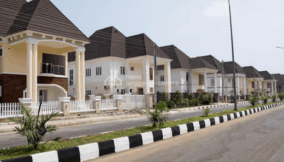
…as income trails rent with ratio surging above UN benchmark
Low- and mid-income households in Abuja, Nigeria’s federal capital territory (FCT), are inching closer to breaking point and social dislocation as the rental crisis in the city deepens, pushing many to the suburbs.
The city’s housing market is, increasingly, sliding deeper into an affordability crisis over rising construction costs and mounting charges by landlords and agents who push rents beyond the reach of many.
Findings show that many tenants are grappling with sharp rent increases, multiple agency and legal fees, caution deposits, and service charges that now consume a significant share of household income.
Arbitrary rent increases in the city, as in other large cities like Lagos and Port Harcourt, have reached an alarming level. The rent-to-income ratio in these cities has surged 60-70 percent, more than double the 30 percent recommended by the United Nations (UN).
The situation has triggered calls for government intervention, with residents and housing stakeholders warning that the worsening rental burden is forcing families out of the city centre and deepening economic hardship.
A BusinessDay survey across districts such as Kubwa, Lugbe, Lokogoma, Gwarinpa, Wuye and Jahi indicates that apartment rents have risen by between 40 percent and 120 percent over the last two years.
In Lokogoma, for instance, a two-bedroom apartment that rented for about N1.2 million in 2023 now goes for as much as N2.5 million, excluding agency and legal fees. In Jahi and Wuye, similar apartments now attract over N4 million yearly.
The increases are driven largely by rising construction costs, according to developers and landlords, who cite higher prices of cement, reinforcement, paints, electrical fittings and diesel following naira depreciation and cost-push inflation.
Cement prices, which averaged about N7,500 per bag two years ago, now sell above N11,000 in parts of Abuja, while transportation and energy costs continue to rise.
For many residents, however, wages have remained stagnant despite soaring living expenses.
Gift Ameh, a media professional, said housing costs now consume nearly 80 percent of her annual income. “The experience has been terrible. There is little or no regulation, and rents are increasing at unreasonable rates.
When I moved into my estate at Lokogoma , I was paying about N300,000. It later increased to N350,000, then N500,000. Today, the least rent there is about N1 million,” she lamented.
According to her, even self-contained apartments have become unaffordable for low-income earners. “If you see anything below N1 million now, it is probably a gatehouse close to the security post,” she said.
Read also: Expert explains why land is not Nigeria’s real estate problem
Ameh said the rising cost of accommodation, transportation and food had made it difficult for many residents to save or invest, pointing out that housing has taken a huge chunk of people’s income such that, at the end of the month, there is almost nothing left.
She also blamed weak regulation of estate agents for the worsening crisis, noting that desperate house seekers are often subjected to exploitative conditions and arbitrary charges.
Ameh wants the government to regulate the sector, especially the activities of agents, adding that there should be some form of property valuation and limits to arbitrary increases.
Similar concerns were raised by Adebayo Ayoni, a civil servant, who described the rental situation in Abuja as “alarming.”
“A house that used to rent for N300,000 now goes for over N1 million,” he said. “Some landlords increase rents by over 100 percent within a short period, and many residents are being pushed to unsafe or distant areas because they cannot cope.”
Ayoni attributed much of the problem to estate agents who, according to him, pressure absentee landlords to raise rents.
“This whole challenge goes down to the suffering masses,” he said. “People are already crying. Government needs to intervene urgently through affordable housing schemes and stronger oversight of the sector.”
Several residents who spoke with BusinessDay said additional charges such as agency fees, legal fees and caution deposits now account for between 20 and 30 percent of total rental costs.
Jason Adeleke , a legal practitioner living in Area 1, said his rent for a self-contained apartment rose from N400,000 to N800,000 after negotiations with his landlord.
“It was initially increased to N1 million before we settled at N800,000,” he said. “When you add agency fees, legal fees and service charges, the total cost becomes overwhelming.”
John Tunde, a resident of Lokogoma, said his one-room apartment, previously rented for N350,000, now costs N1.5 million. “In the past four years, my landlord has reviewed the rent twice, yet salaries have remained the same,” he said.
Some residents said the pressure has forced many households to relocate to satellite towns such as Gwagwalada, Kubwa and Mararaba in search of cheaper alternatives, although rents in those areas are also rising rapidly.
James Idoko, a public servant living in Kubwa, said his rent increased from N1.8 million to N2.5 million during his last renewal.
“My salary alone cannot sustain these expenses,” he said. “A lot of people are moving farther away from the city centre because they can no longer afford rents in Abuja.”
Aliyu Musa, another civil servant, called for legislation to regulate the housing sector and review workers’ salaries in line with inflation.
“Some landlords are putting serious pressure on families while salaries remain stagnant,” he said. “Government should review housing policies and provide accommodation support for workers.”
Landlords and developers, however, argue that rising rents reflect broader economic realities rather than exploitation alone.
Aliyu Wamakko, former president of the Real Estate Developers Association of Nigeria (REDAN), said regulating rents without addressing the rising cost of building materials would be ineffective.
“There is no way rents can come down when the cost of cement and other building materials keeps rising,” he said.
According to him, government intervention should focus more on stabilising the prices of construction inputs.
“The primary issue is the cost of building materials, especially cement,” Wamakko said. “Government must declare an emergency in that area and support manufacturers with incentives that can reduce production costs.”
He nevertheless urged landlords to show empathy in dealing with tenants.
“Landlords should put a human face to what they are doing because everyone is affected by the economic situation,” he said.
As pressure mounts across the FCT, residents say the worsening rental crisis now threatens the living conditions of middle- and low-income earners, with many warning that without urgent intervention, decent housing may soon become unattainable for a large segment of Abuja’s workforce.

Join BusinessDay whatsapp Channel, to stay up to date
Open In Whatsapp