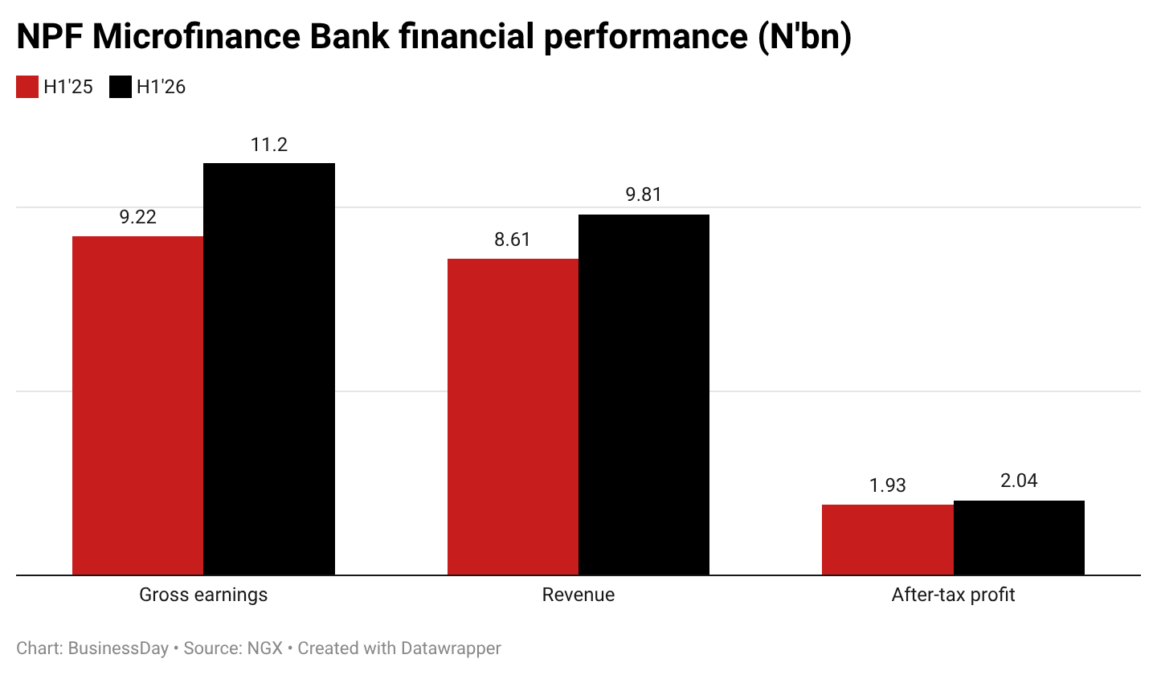
NPF Microfinance Bank Plc grew its half-year profit by 5.7 percent to N2.04 billion in the six months ended June 30, 2026, as stronger interest income from its expanding loan book outweighed rising funding and operating costs, amid Nigeria’s high interest-rate environment.
According to the second quarter interim financial statement, the lender reported profit after tax of N2.044 billion, compared with N1.934 billion in the corresponding period of 2025.
The second quarter alone contributed N1.021 billion, up from N959.1 million recorded in the same quarter last year. Earnings per share improved to 34 kobo from 32 kobo, reflecting the steady growth in shareholders’ returns.
The performance was driven primarily by a significant expansion in interest-earning assets. Gross earnings surged to 21.2 percent to N11.18 billion in H1 2026 from N9.23 billion in H1 2025, while interest income rose 25.2 percent to N10.18 billion, reflecting higher yields on loans and advances as well as investment securities.
Although the cost of funds increased sharply, the bank maintained healthy lending margins. Interest expense more than doubled to N1.35 billion from N610.2 million, mirroring the elevated interest-rate environment and higher deposit costs across the banking sector.
Even so, net interest income expanded 17.4 percent to N8.83 billion, demonstrating that asset yields continued to outpace funding costs.
Non-interest income, however, softened. Fees and commission income declined by 9.5 percent to N985.6 million from N1.09 billion, suggesting weaker transaction-related revenues compared with the previous year. The moderation indicates that the bank’s earnings growth remained overwhelmingly dependent on traditional lending activities rather than fee-generating services.
Total revenue increased 14 percent to N9.82 billion, supported by the expansion in net interest income. Other income remained relatively insignificant at N11.5 million, while impairment losses on financial instruments stayed negligible at N1.24 million, pointing to stable credit quality and effective risk management despite continued macroeconomic pressures.
The biggest drag on profitability came from operating expenses.
Personnel costs increased 11.7 percent to N2.82 billion, reflecting higher employee compensation, while other operating expenses surged 18.2 percent to N3.38 billion from N2.86 billion. The increase mirrors the inflationary pressures affecting businesses across Nigeria, including higher energy, technology, regulatory and administrative costs.
Depreciation expenses also rose to N380.2 million, while amortisation of intangible assets climbed sharply to N47.2 million, indicating continued investment in technology infrastructure and banking systems.
Despite these cost pressures, profit before tax advanced 7.7 percent to N3.20 billion, compared with N2.97 billion a year earlier. Income tax expenses rose to N1.15 billion, limiting the pace of bottom-line growth but still allowing the bank to deliver improved net earnings.
The balance sheet reflects continued business expansion.
Loans and advances to customers increased to approximately N45.15 billion at the end of June 2026 from about N39.71 billion at the end of December 2025, reinforcing the bank’s focus on credit creation. Customer deposits also expanded to N36.89 billion from N31.48 billion, providing additional funding for loan growth while demonstrating continued depositor confidence.
Total assets grew to N61.70 billion, up from N53.26 billion a year earlier, supported by increases in loans, investment securities and other earning assets. Shareholders’ equity improved to N14.64 billion, compared with N13.29 billion in June 2025, reflecting earnings retention and stronger capital accumulation.
The microfinance bank closed its last trading day on Friday, July 24, 2026 at N5.10 per share on the Nigerian Stock Exchange (NGX).
The company stock has gained 37.5 percent on that price valuation, ranking it 64th on the NGX in terms of year-to-date performance, with a arket capitalisation of N30.6 billion.

Join BusinessDay whatsapp Channel, to stay up to date
Open In Whatsapp