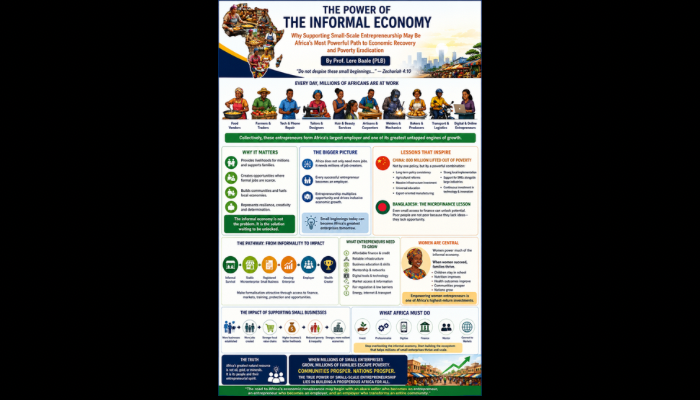
Why supporting small-scale entrepreneurship may be Africa’s most powerful path to economic recovery and poverty eradication
Africa has spent decades searching for the silver bullet that will eradicate poverty and unlock sustainable economic prosperity. Governments have pursued industrialisation, attracted foreign direct investment, implemented structural reforms, borrowed heavily for infrastructure, and launched countless poverty alleviation programmes.
These efforts are important.
Yet one of Africa’s greatest economic assets has remained largely underestimated, underfinanced, and underappreciated.
“Do not despise these small beginnings…” — Zechariah 4:10.
It is the informal economy.
Every morning before sunrise, millions of Africans are already at work. Women fry akara and bean cakes by the roadside. Farmers transport produce to local markets. Young people repair mobile phones, sew garments, braid hair, manufacture furniture, weld metal, bake bread, process cassava into garri, produce kulikuli, operate motorcycles, design graphics, sell online, and provide hundreds of essential services.
Collectively, these entrepreneurs constitute one of the largest economic ecosystems on the continent.
The future of Africa depends on how effectively we support them.
The largest employer in Africa
The informal economy is often portrayed as a sign of economic weakness.
In reality, it represents remarkable resilience.
Across much of Africa, informal businesses account for the majority of employment and provide livelihoods for millions of households. For many young people, women, and families with limited access to formal employment, the informal economy is not a temporary alternative—it is the economy.
It feeds families.
It pays school fees.
It finances healthcare.
It creates opportunities where none previously existed.
It keeps local communities functioning.
Rather than viewing the informal sector as a problem to eliminate, Africa should increasingly see it as a foundation to strengthen, modernise, and gradually formalise.
Poverty is not a lack of ability
One of the greatest misconceptions about poverty is that poor people lack ideas or ambition.
Nothing could be further from the truth.
Walk through any African market, and you will encounter extraordinary creativity, persistence, innovation, and determination.
The challenge is rarely a lack of willingness to work.
The challenge is the absence of opportunity.
Millions of entrepreneurs operate with inadequate capital, unreliable electricity, poor transport infrastructure, limited business knowledge, weak market access, and almost no affordable financing.
Many businesses remain small not because they lack potential but because the ecosystem prevents them from growing.
Africa does not have a job problem alone
Africa certainly needs more formal employment.
However, it is unrealistic to expect governments and large corporations alone to create enough jobs for one of the world’s fastest-growing populations.
The mathematics does not work.
Economic recovery must therefore be built upon two complementary strategies:
Creating jobs.
Helping people create jobs.
The second strategy has not received the attention it deserves.
Every successful entrepreneur eventually becomes an employer.
Every thriving microenterprise creates demand for suppliers, transporters, artisans, accountants, marketers, and service providers.
Entrepreneurship multiplies opportunities.
The Akara seller is not the problem
People sometimes dismiss small traders with statements such as the following:
“You cannot akara-sell your way out of poverty.”
That observation misses the real issue.
The problem is not Akara.
The problem is that many entrepreneurs never receive the support required to transform a micro-business into a scalable enterprise.
Every successful food company began by selling food.
Every successful bakery once baked a few loaves.
Every successful fashion brand once stitched a single garment.
Every successful technology company once served its first customer.
Small beginnings are not signs of failure.
They are the birthplace of enterprise.
The woman selling akara today could own a recognised food chain tomorrow—if she has access to finance, training, branding, food safety standards, modern equipment, digital payments, quality packaging, and new markets.
Africa must stop laughing at humble beginnings and start investing in them.
Lessons from Bangladesh
One of the most influential development stories of the modern era emerged in Bangladesh.
The expansion of microfinance demonstrated that many low-income households did not require large amounts of capital to improve their livelihoods.
Often, relatively small loans enabled families to purchase productive equipment, expand trading activities, rear livestock, or establish home-based enterprises.
Microfinance is not a universal solution, and research shows that its impact varies across local contexts. However, it fundamentally challenged one important assumption: that poor people are incapable entrepreneurs when given appropriate opportunities and support.
Africa should build upon that lesson.
Finance matters.
But finance alone is insufficient.
Capital must be accompanied by education, mentorship, infrastructure, technology, and market access.
The missing middle
Many African businesses remain trapped between survival and growth.
They are too large to survive indefinitely as subsistence enterprises.
Yet they are too small to access commercial financing.
This “missing middle” represents one of Africa’s greatest untapped economic opportunities.
Helping millions of microbusinesses become sustainable small businesses may produce a greater long-term impact than focusing exclusively on attracting a handful of large corporations.
Economic transformation occurs when thousands—indeed millions—of enterprises grow simultaneously.
Women are Africa’s hidden economic giants
Across African markets, women dominate significant portions of informal commerce.
They trade food.
They process agricultural products.
They manufacture household goods.
They operate salons.
They provide catering services.
They run pharmacies, retail shops, tailoring businesses, and countless other enterprises.
When women earn stable incomes, entire families benefit.
Children remain in school.
Nutrition improves.
Healthcare becomes more accessible.
Household resilience increases.
Supporting women entrepreneurs is therefore not charity.
It is one of the highest-return economic investments available to any nation.
From informality to opportunity
The objective should not be to eliminate the informal economy.
The objective should be to make it more productive.
Businesses should gradually transition through clear stages:
• Informal survival
• Stable microenterprise
• Registered small business
• Growing enterprise
• Employer
• Wealth creator
Formalisation should become attractive because it offers access to finance, legal protection, training, insurance, government support, digital services, export opportunities, and larger markets—not because entrepreneurs fear punishment.
Entrepreneurship is an ecosystem
Too often, governments launch loan schemes without addressing the broader barriers to business success.
Money alone does not create prosperity.
Entrepreneurs also need:
• Reliable electricity.
• Good roads.
• Affordable internet.
• Business education.
• Mentorship.
• Digital skills.
• Bookkeeping knowledge.
• Access to quality inputs.
• Modern equipment.
• Market information.
• Fair taxation.
• Supportive regulation.
An entrepreneur operating within a strong ecosystem is far more likely to succeed than one relying solely on credit.
Changing the national mindset
Africa must also change how it defines success.
Young people should not believe that dignity exists only in white-collar employment.
Building an enterprise should command the same respect as securing an office job.
The roadside entrepreneur should not be viewed merely as someone struggling to survive.
They should be recognised as potential business owners, employers, taxpayers, innovators, and wealth creators.
Nations become prosperous when entrepreneurship becomes aspirational.
Measuring What Truly Matters
Governments often celebrate GDP growth, foreign investment, and new infrastructure.
These are valuable indicators.
But another set of questions may be even more revealing:
How many new entrepreneurs started businesses this year?
How many micro-enterprises became sustainable small businesses?
How many women-owned businesses expanded?
How many young entrepreneurs became employers?
How many households permanently escaped poverty?
These measures reflect the everyday realities of citizens and the inclusiveness of economic growth.
Africa’s Greatest Untapped Resource
Africa’s greatest natural resource is not oil.
It is not gold.
It is not cobalt.
It is not lithium.
It is its people.
Every market stall represents ambition.
Every workshop represents creativity.
Every roadside business represents resilience.
Every microenterprise represents a possibility.
Hidden within Africa’s vast informal economy are millions of future manufacturers, exporters, technology founders, food processors, retailers, logistics providers, and industrialists.
Some of tomorrow’s largest African companies are operating today as small family businesses with limited capital and enormous determination.
The challenge before governments, financial institutions, development partners, universities, business schools, and the private sector is clear.
Do not overlook the informal economy.
Invest in it.
Professionalise it.
Digitise it.
Finance it.
Mentor it.
Connect it to larger markets.
Help it scale.
When millions of small enterprises become productive businesses, millions of families rise above poverty.
Communities become more prosperous.
National economies become more resilient.
And Africa moves closer to achieving not merely economic growth, but inclusive and sustainable development.
The road to Africa’s economic renaissance may not begin in the boardroom of a multinational corporation.
It may begin with an akara seller who becomes an entrepreneur, an entrepreneur who becomes an employer, and an employer who helps transform an entire community.
That is the true power of small-scale entrepreneurship.
That is the promise of the informal economy.
And that may well be Africa’s most powerful pathway to economic recovery and the eradication of poverty.
Prof Lere Baale: CEO – Business School Netherlands International – Nigeria

Join BusinessDay whatsapp Channel, to stay up to date
Open In Whatsapp