When Spain lifted the 2026 FIFA World Cup trophy, Nigeria’s flag was visible on the global broadcast. Yet, the celebration masked a striking national paradox. The Nigerians dominating the world’s most-talked-about sporting event were not athletes representing the republic, but private musicians representing themselves.
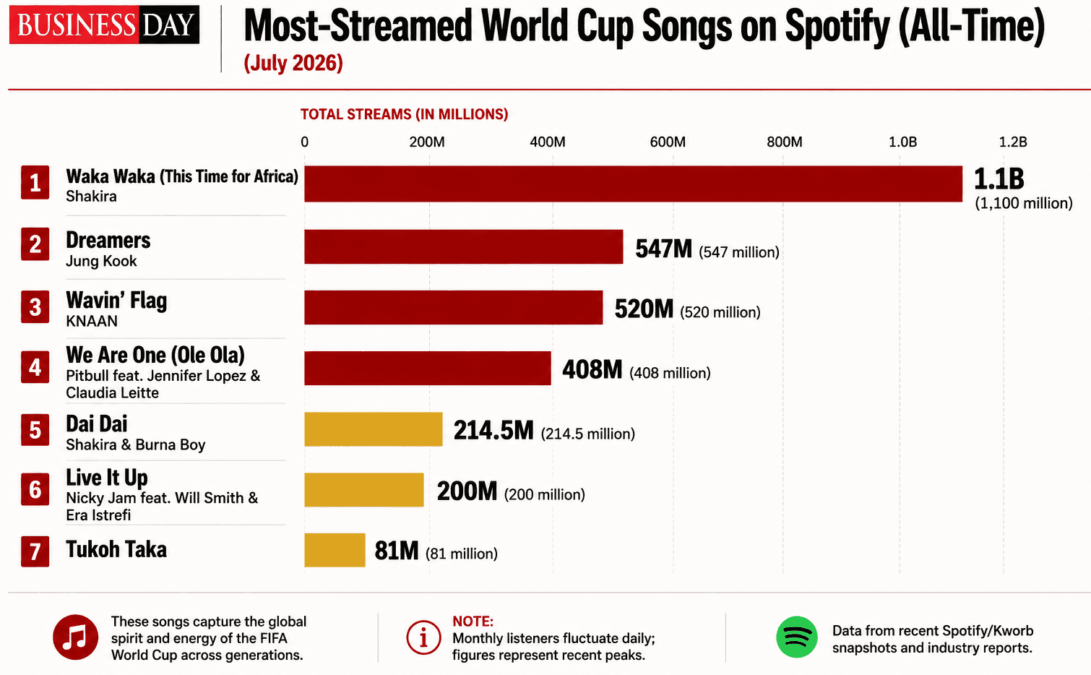
For Nigerian artistes, the 2026 World Cup was beneficial. Burna Boy headlined the first-ever World Cup final halftime show and opening ceremony alongside Shakira with their hit “Dai Dai,” joining the league of Nigerian stars like Davido, Rema, and Ayra Starr to appear on the global stage. While official sources are yet to confirm any payment for his live performance, some media reports speculate that he received figures ranging from $1.45 million up to $7 million. One tabloid, Jvision Entertainment TV, claimed the Grammy award-winning artiste received a total of $7M. $4m for his contribution in the production of the song and $3m for his opening ceremony performance.
Industry insiders view this moment as the elevation and exportation of Afrobeats’ uniqueness to the world. Okoeguale Ehizojie, popularly known as Dadaboy Ehiz, noted that Afrobeats is no longer a newcomer to these global stages. With Davido’s performance at the previous World Cup and Burna Boy’s historic appearance at both the 2026 opening ceremony and halftime show, the genre has reached its pinnacle, leveraging football’s status as the world’s most-watched sport.
“We’ve had Rema perform at the Ballon d’Or, Tems performed at the FIFA Club World Cup final halftime show at MetLife Stadium, the first Nigerian/African artist in that slot, and Burna Boy headlining the kick-off show before the Champions League final; we can’t quantify Afrobeats anymore,” Ehiz said.
Other Nigerian artists with prior World Cup ties include Femi Kuti, who performed at the 2010 opening ceremony in South Africa. With the official tournament album surpassing 336 million streams, these artists have gained visibility and an avalanche of windfalls. Beyond upfront performance fees that can reach into the millions for top-tier African acts, these musicians are securing long-term wealth through publishing rights, synchronisation deals, streaming, brand deals and royalties.
As a contrast, the Nigerian government and the Nigeria Football Federation (NFF) have once again proven that state-run enterprises are black holes of mismanagement. For the second consecutive tournament, following the disaster of Qatar 2022, the Super Eagles failed to qualify for the World Cup. This absence is not merely a dent in national pride; it is a staggering economic loss for the country.
By missing out on the expanded 48-team tournament, the NFF squandered a minimum of $10 million in guaranteed FIFA participation payouts. That includes $2.5 million earmarked for preparation and roughly $10 million for a group-stage exit. Had the team progressed, those figures could have skyrocketed toward the $50 million awarded to the champions.
Unlike private music royalties, FIFA payouts represent vital non-oil revenues, tourism boosts, and merchandising funds completely lost to the Nigerian economy. The Super Eagles’ failure was largely self-inflicted: a chaotic qualifying campaign marred by erratic managerial changes, poor tactical execution, and recurring scandals over unpaid player allowances that triggered training boycotts.
This meant that the NFF missed the funds, tourism boosts, kit sales and the loss of generational talent currently excelling in Europe but never getting the opportunity to represent their home country in their prime. While Afrobeats stars independently navigate the global music ecosystem with precision, the NFF cannot even manage basic logistics.
These failures have drawn severe public backlash. Former captain Mikel John Obi and popular creators like C.Mobike have publicly called out the NFF, describing it as an “extremely incompetent set of people” plagued by embezzlement, lack of integrity, and a culture of unaccountability.
He points out how the federation single-handedly sabotages Nigerian teams through poor decisions, such as benching reliable players during crucial moments, leading to missed opportunities like World Cup qualification. According to Mobike, the NFF’s focus remains narrow and superficial, often limited to the Super Eagles, while broader issues like owing players bonuses and failing to develop grassroots and domestic football persist, effectively “repainting a collapsing building” rather than fixing systemic rot.
He has actively pushed for reform by raising a public petition to overhaul the NFF and its electoral system. In late 2025, he announced the petition on Change.org, urging Nigerians to sign and demand transparency, accountability, and a football system that truly serves the people and not just officials.
He emphasised that ordinary citizens must get involved by pressuring the NFF Congress, Ministry of Sports, and National Assembly, highlighting how the current setup has ruined domestic leagues like the NPFL and stifled talent development across the country.
As Nigerian sports look toward 2030, the music industry provides a shining light: purge administrative corruption, build transparent structures, and let undeniable talent lead the way.

Join BusinessDay whatsapp Channel, to stay up to date
Open In Whatsapp