When President Bola Tinubu’s administration launched the Renewed Hope Cities and Estates Programme, it promised to break the barriers to homeownership for millions of low- and middle-income Nigerians through affordable mortgages, rent-to-own schemes and outright purchase.
But a BusinessDay investigation shows that for many of the Nigerians the programme is meant to serve, the houses remain financially out of reach, exposing a widening gap between government policy and economic reality.
The affordability challenge comes at a time when Nigeria’s housing crisis continues to deepen. The Federal Government’s National Housing Data Technical Committee estimates that the country will have a housing deficit of about 14.9 million units in 2025, driven by rapid urbanisation, population growth, weak mortgage financing and inadequate housing supply.
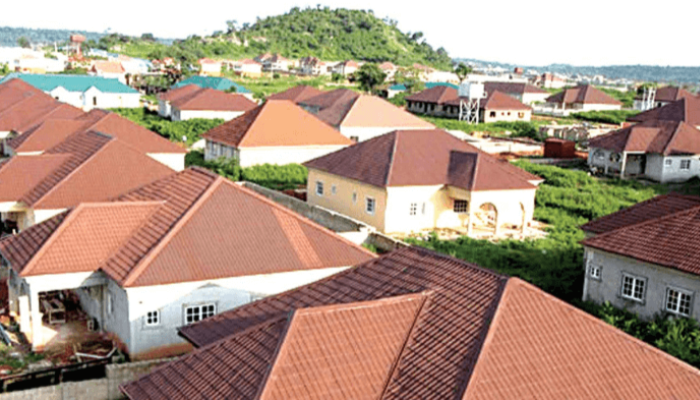
Against that backdrop, the Federal Government unveiled the Renewed Hope Cities and Estates Programme to deliver 100,000 housing units across Nigeria through 12 estates and three cities located in Abuja, Lagos and Kano. The scheme targets civil servants, artisans, traders, commercial drivers and other low- and medium-income earners who have long been priced out of Nigeria’s property market.
In May 2024, the government also launched an online portal, promising to simplify homeownership and remove bureaucratic bottlenecks.
However, BusinessDay’s review of the mortgage requirements for one of the flagship Renewed Hope City projects in Karsana, Abuja, raises fresh questions about whether the intended beneficiaries can realistically own the homes.
Using the mortgage calculator for a two-bedroom housing unit valued at N48.5 a prospective buyer would first need to raise an equity contribution of N9.7 million before qualifying for a mortgage of N38.8 million.
At interest rates comparable to those offered under the National Housing Fund scheme, monthly repayments range between approximately N274,000 over 25 years and N349,000 over 15 years, depending on the repayment period.
For a 15-year mortgage, monthly repayments are estimated at about N338,000, while lenders also require that a borrower’s debt-to-income ratio should not exceed 33% of documented monthly income.
This means an applicant would typically require a monthly salary of between N900,000 and over N1 million to qualify for financing, far above the earnings of many civil servants and other low-income workers, whose monthly incomes often range between N70,000 and N150,000.
The affordability gap is not limited to home ownership.
Across Abuja, surging rents are forcing households and businesses to relocate as infrastructure development fuels speculation in the property market.
Among those affected is Jumoke Oluwaseun, Head Teacher of First Land International School, Abuja told BusinessDay she is preparing to relocate her school after rent in her neighbourhood increased by more than fivefold within a year.
“Do you know that the cost of renting a three-bedroom apartment in my estate is now N5 million? This was the same estate where a four-bedroom apartment rented for about N800,000 before prices suddenly went up.
“It was like landlords were waiting for the completion of the African Medical Centre and the Apo Road project,” she said
She said newly completed apartments in the area are commanding rents of up to N12 million, a development she believes is pushing long-term residents and small businesses out.
“I run my school in a three-bedroom apartment and I don’t think I can keep up anymore. I have to pay my teachers while ensuring school fees remain affordable.
“If you increase fees by just N10,000, parents complain because there are many schools competing for the same students.
“These rising rents are pushing us away. I will have to move somewhere else and start all over again,” she added
Her experience reflects the broader impact of Abuja’s property boom, where infrastructure investments have increased land values but have also accelerated rent inflation in surrounding communities.
Housing policy experts say the affordability crisis stems from decades of neglect of Nigeria’s mortgage finance system.
Eze Onyekpere, Lead Director of the Centre for Social Justice (CSJ), argues that the National Housing Fund established under the 1992 National Housing Fund Act was originally designed to provide long-term, affordable mortgages to contributors but was undermined by years of poor governance.
“Workers contributed 2.5% of their salaries with the expectation that they would access affordable housing loans.
“But over time, the fund became what many people considered a slush fund. Contributors rarely benefited while loans were extended to estate developers who never contributed,” he said
According to Onyekpere, the consequence is that developers now build houses with public financing but sell them at prices beyond the reach of the workers the schemes were designed to benefit.
He questioned the sustainability of relying on budget allocations and external borrowing to finance affordable housing instead of strengthening the mortgage fund.
“If somebody earns N150,000 monthly, that amounts to N1.8 million a year before feeding, transport or school fees.
“Even if the person miraculously saved every naira, it would still take about 10 years to accumulate N18 million.
“So how does such a worker raise N9.7 million equity and still pay a monthly mortgage of over N300,000? The mathematics simply doesn’t work,” he explained
He called for a comprehensive reform of the National Housing Fund, including stronger governance, compulsory contributions, annual government support and professionally managed revolving mortgage financing.
Housing analysts say the findings highlight a broader policy dilemma. While increasing housing supply is critical to reducing Nigeria’s nearly 15-million-unit housing deficit, supply alone will not solve the crisis if the target beneficiaries cannot afford the homes being built.
Offering a broader industry perspective, Festus Adebayo, Chief Executive Officer of the Africa International Housing Show (AIHS), said housing should be treated as a strategic economic sector capable of driving inclusive growth rather than merely a social welfare programme.
“Housing is far more than the construction of buildings. It is an engine of economic growth. It creates jobs, stimulates manufacturing, supports financial services, promotes urban development, improves public health, strengthens family stability, and contributes significantly to national productivity,” Adebayo said.
He noted that while Nigeria has one of the world’s largest housing deficits, the crisis also presents a significant opportunity to stimulate investment, expand homeownership and accelerate economic development if backed by the right policy reforms.

Join BusinessDay whatsapp Channel, to stay up to date
Open In Whatsapp