

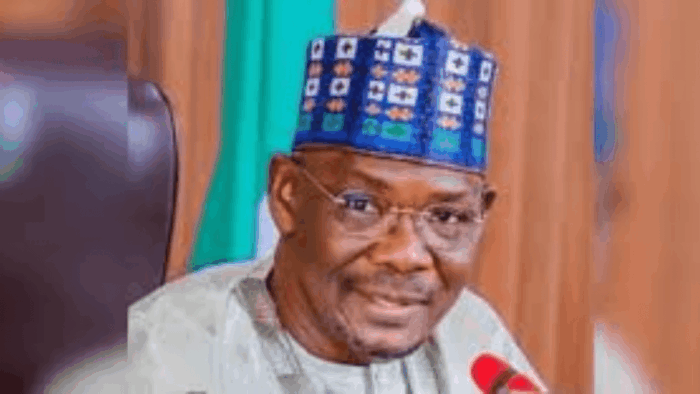
Abdullahi Sule Governor of Nasarawa State has reignited Nigeria’s debate over religion and politics, insisting that the 1999 Constitution does not require political offices or electoral tickets to be shared along religious lines, as he defended same-faith presidential tickets and dismissed opposition criticism over inclusiveness ahead of the 2027 general election.
Speaking on Tuesday during an appearance on Channels Television’s Politics Today, Sule said the Constitution places greater emphasis on federal character, inclusiveness and equitable representation than on religious considerations, arguing that the issue of faith has often been misinterpreted in political discourse.
The governor was responding to criticism by Rabiu Musa Kwankwaso, the 2027 vice-presidential candidate of the Nigeria Democratic Congress (NDC), over issues relating to representation. Sule described the remarks as predictable opposition politics.
“I think it is normal for Senator Kwankwaso, whom I respect a lot, to say that because he’s in the opposition. He cannot say anything good. It is expected of him to say that,” Sule said.
He maintained that the constitutional provisions frequently cited in debates over inclusiveness do not prescribe religious balancing in appointments or electoral tickets.
According to him, Section 14(3) of the 1999 Constitution, which establishes the federal character principle, seeks to ensure equitable representation across the federation, while Section 15 promotes national integration and discourages ethnic discrimination. Neither section, he argued, makes religion a constitutional requirement.
“There is no place where it talks about religion. Section 14 didn’t talk about religion. Section 15 did not talk about religion,” he said.
To reinforce his argument, Sule pointed to the election of President Bola Tinubu and Vice-President Kashim Shettima on a Muslim-Muslim ticket in 2023, as well as the late Chief MKO Abiola’s presidential bid with Babagana Kingibe in the 1993 election.
“You can see both elections have been clear that the Muslim-Muslim ticket has won. I pray that one day Nigeria will have a Christian-Christian ticket, and it will win. That’s what I pray to see,” the governor said.
Sule, however, stressed that political realities vary across states and should not be conflated with national politics. He said his decision to retain Emmanuel Akabe, a Christian, as deputy governor of Nasarawa State was driven by competence rather than religion.
“I have always had a Christian as a deputy, Emmanuel Akabe. In Nasarawa State, it has always been a Christian. We thought it was important because Emmanuel Akabe is competent and our state is different from Nigeria. You cannot take a particular state,” he said.
The governor noted that several states already operate with same-faith leadership, citing Enugu and Bayelsa as examples of states with Christian-Christian political leadership.
“Take Enugu, for instance, they are Christian-Christian. Take Bayelsa; it’s Christian-Christian,” Sule added.
His comments come amid renewed scrutiny of religious and regional representation in Nigeria’s politics as political parties position themselves and potential alliances begin to take shape ahead of the 2027 general election.

Join BusinessDay whatsapp Channel, to stay up to date
Open In Whatsapp


