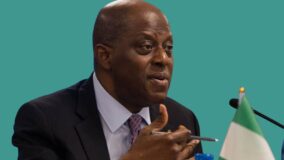
Debt Management Office says Nigeria needs $250 billion for the next 10 years to tackle infrastructure deficit in the country.
Abraham Nwankwo, DMO director-general, who put the country’s debt profile at $64 billion, said this would not affect the economy negatively.
Nwankwo, who stated this when he appeared before the Senate Committee on Foreign and Local Debts Thursday, explained that 84 percent of the entire debt profile was owed locally, as against 16 percent foreign loan.
“Even before the collapse of the oil prices, it has been estimated, more than five years ago that Nigeria needed a minimum of $25 billion per annum continuously for up to 10 years to enable it to close its infrastructure deficit.
“That has been established by all relevant experts and institutions. In addition, the collapse of the oil prices by our own estimate shows that public revenue from oil had dropped by about $16 billion per annum,” Nwankwo told the Senate Committee.
According to the 2016 to 2018 Medium Term Expenditure Framework (MTEF) and Fiscal Strategy Paper (FSP), currently at the Committee stage, the country will borrow N1.835 trillion in 2016, with a breakdown of N1.2 trillion domestic borrowing and N635 billion foreign borrowing.
Similarly, the documents revealed that the nation would service its domestic debt for next year with N1.307 trillion and N54 billion for foreign debt; however, Nwankwo believes the loans are healthy for the nation’s development.
He explained that debts owed local contractors were not part of the domestic debts quoted, because their details were under the purview of the Budget Office of the Federation and the National Planning, because they were operational debts.
“We have been sensitising Nigerians that we need to do better because our tax GDP ratio is very low compared to countries in our debt role. Their entire GDP ratio is about 18 percent, whereas for Nigeria, it is about 6 percent, which means that we are not being effective in collecting taxes to reflect the size of our economy.
“This has implications for debt service. Certainly, there is need to be careful even though there is space we need to relate debt service to revenue. The solution is that we have a big gap to fill because when we move upward from the 6 percent tax GDP ratio, we will have a lot of money to solve our problems including servicing our debts.
“For now our debt servicing GDP ratio is still very low but we are optimistic because there is room to collect tax from the existing level of economic activities,” he said.
On the proposed N1.835 trillion borrowing for the 2016 fiscal year, the DMO boss said government projection was in the right direction.
He added that the proposed borrowing and exploration of other sources of revenue would act as a strong base for growth in agriculture, solid minerals and petrochemical.
He said the oil and gas were still useful because the nation could re-process them to manufacture other products like fertilizers and plastics, among others that would even have more positive impact on the economy than exporting crude.
He said for a country to achieve a sustainable development, it should not rely only on mono-economy.
He added: “Borrowing is being done to achieve positive impact on the economy, it will lead to growth, creation of employment and build solid capacity for the future which will help us to diversify our economy.
“What the government is planning to do now is to explore at least five out of the 34 solid minerals that we have. We will develop, and process them for export.
“From the Debt Management Office perspective, the MTEF/FSP as presented to the National Assembly, is perfect for the times and a good recipe for dealing with the challenges of the collapse of the oil prices and the need to rapidly develop and diversify the economy, build infrastructure.
“Aside revenue generated, there are openings in local and international borrowing. If we must borrow, we must have options. Whatever we do also take into account the federal nature of the government. That is the reason each state has its own department of debt management.”
Chairman of the committee, Shehu Sani, commended the Federal Government initiative aimed at finding alternative revenue to oil.
He, however, canvassed stiffer punishment for any individual or agency of government that misapplied foreign or local debts meant to improve the living standards of Nigerians.

Join BusinessDay whatsapp Channel, to stay up to date
Open In Whatsapp