African banks are accelerating investment in artificial intelligence even as nearly one in three institutions cannot say whether the technology is generating value, highlighting a growing disconnect between spending and accountability as lenders race to modernise operations.
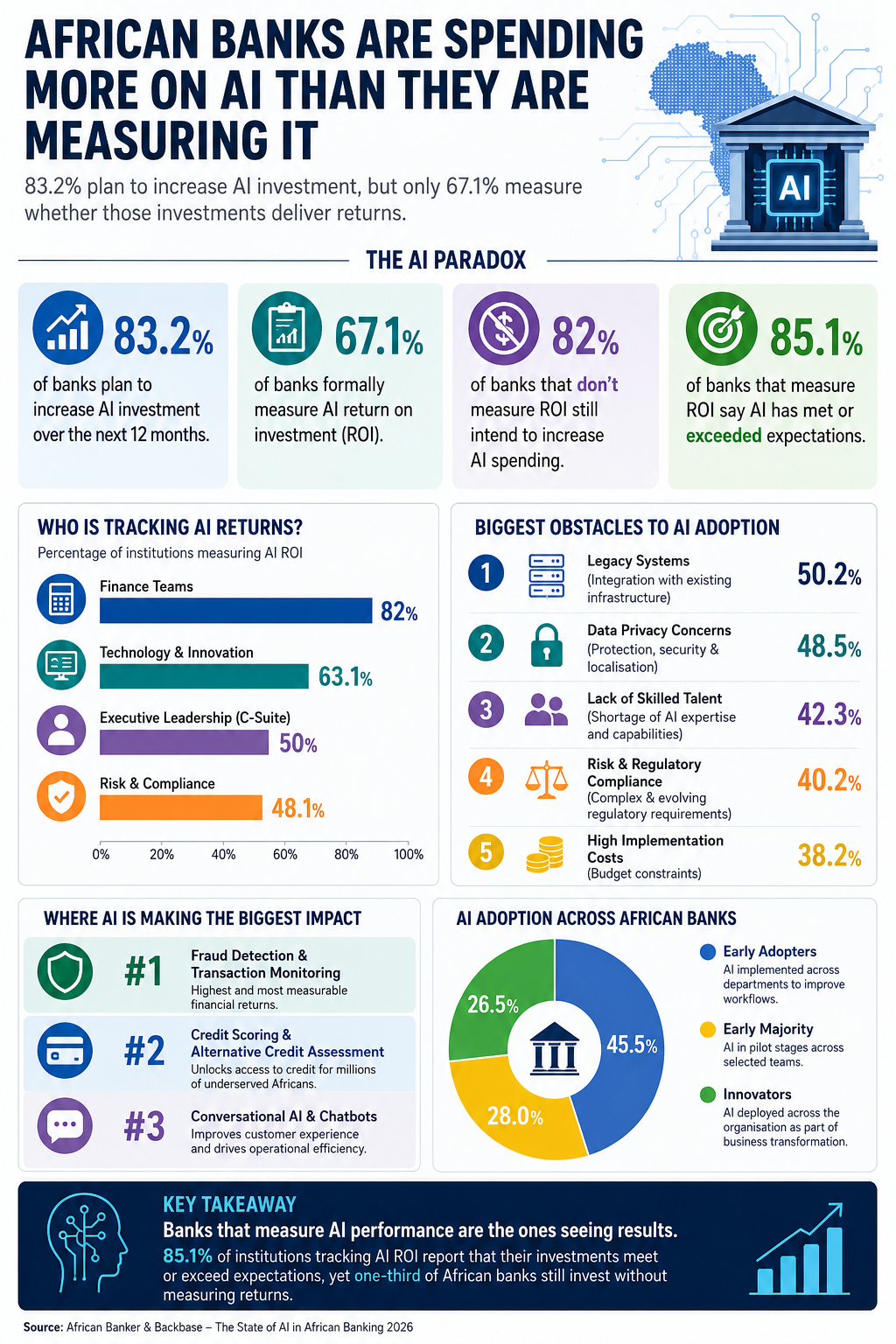
A new report by African Banker, produced in partnership with Backbase, found that 83.2 percent of banks are likely or very likely to increase AI investment over the next 12 months, despite only 67.1 percent formally measuring the return on those investments.
More strikingly, 82 percent of institutions without any formal AI return-on-investment (ROI) framework still plan to expand spending, suggesting many lenders are committing more capital before proving existing projects are paying off.
Read also: Nigeria’s $15bn AI Moment: 88% already use it; choose wisely
The findings point to a new phase in Africa’s AI adoption, where banks are shifting from experimentation to deployment under increasing pressure from boards and investors to justify technology spending.
“The question is no longer whether to invest in AI, but what the return on that investment is,” the report said, arguing that rising cloud costs, foreign exchange pressures and tighter data localisation rules are forcing banks to become more disciplined about digital investments.
The study surveyed 277 senior banking executives across 37 African countries, making it one of the most comprehensive assessments of AI adoption in the continent’s banking industry.
Ironically, banks that do measure returns are largely being rewarded. Among institutions with formal ROI frameworks, 85.1 percent reported that AI projects either met or exceeded their original financial projections, while more than half said returns surpassed expectations altogether. Only about 15 percent said AI investments had failed to deliver anticipated value.
The report suggests that the problem is therefore not AI itself, but how banks govern and evaluate it.
One of its more surprising findings is that senior executives responsible for approving technology spending are among the least likely to measure its success.
Finance departments recorded the strongest accountability, with 82 percent tracking AI returns, followed by technology and innovation teams at 63.1 percent. Executive leadership measured ROI only 50 percent of the time, while risk and compliance teams performed even worse at 48.1 percent, despite being heavily involved in implementing AI systems.
The report describes this as one of African banking’s biggest governance blind spots, arguing that AI investment decisions are increasingly being made without sufficient evidence of business impact.
“There is a governance issue rather than a structural one,” the report noted, warning that institutions risk accumulating AI debts without returns if governance fails to keep pace with adoption.
The appetite for AI nevertheless remains strong across the continent.
Nearly 87 percent of banking leaders expressed a positive or very positive view of AI’s role over the next two years, while almost half of surveyed institutions have already progressed beyond pilot programmes into organisation-wide deployment. Overall, 45.5 percent identified themselves as Early Adopters, 28 percent as the Early Majority, and 26.5 percent as Innovators, using AI across core banking functions.
Customer-facing chatbots remain the most common application, used by 49 percent of banks, but the report found that the greatest business value comes from less visible functions.
Fraud detection and transaction monitoring emerged as the AI use case delivering the clearest financial returns, followed by AI-powered credit scoring and alternative credit assessment. Conversational AI ranked third in overall impact.
The emphasis on credit scoring could have broader implications for financial inclusion. The report notes that while financial account ownership in Sub-Saharan Africa has risen to 58 percent, around 42 percent of adults remain unbanked. AI models capable of analysing mobile money and alternative transaction histories could help banks extend credit to millions of customers previously excluded from the formal financial system.
Despite the optimism, structural weaknesses continue to threaten banks’ AI ambitions.
Legacy technology integration was identified by 50.2 percent of respondents as the biggest internal obstacle to AI adoption, ahead of data privacy concerns at 48.5 percent, shortage of skilled personnel at 42.3 percent, regulatory compliance at 40.2 percent, and implementation costs at 38.2 percent.
The report found a contradiction that may explain why many banks struggle to quantify AI performance. Nearly half of respondents believe their existing banking systems are highly capable of supporting AI, yet more than half of their IT budgets continue to be spent maintaining ageing infrastructure instead of funding innovation.
On average, 55.7 cents of every IT dollar is spent maintaining legacy systems, leaving fewer resources available for modern cloud-native platforms that AI increasingly requires.
Aymen Daoud, regional vice president for Africa at Backbase, said African banks do not fundamentally have an AI problem.
“They have an architecture problem,” Daoud said, arguing that fragmented banking systems are preventing institutions from scaling automation effectively.
He said autonomous AI agents require unified customer data and governance frameworks that many banks currently lack.
Read also: Meta, AI image rights and the urgent case for African AI sovereignty
Macroeconomic conditions are adding further pressure. The report notes that cloud computing, AI processing power and software licensing are largely priced in U.S. dollars, while bank revenues are generated in local currencies that have weakened significantly in recent years. It cites the Nigerian naira’s loss of more than 40 percent of its value against the dollar between 2023 and 2025 as one example of how exchange-rate volatility is making AI adoption more expensive.
The findings also mirror a broader global shift towards demanding measurable outcomes from AI investment. Financial regulators and central banks are increasingly focusing on governance, accountability and risk management as AI becomes embedded in core banking operations.
For African banks, however, the report concludes that AI is already proving its value, but only for institutions disciplined enough to measure it.
“AI pays off. The return is real, but it requires the discipline to measure it,” the report affirmed.


Join BusinessDay whatsapp Channel, to stay up to date
Open In Whatsapp