Across the world, several coastal cities face projections that large parts of their urban areas could be permanently submerged by water by 2050. Many have spent decades investing in flood-control systems, coastal protection and climate adaptation, but still regard rising sea levels as one of their greatest long-term threats.
Climate modelling and elevation data from organisations such as Climate Central show that major cities including Jakarta in Indonesia, Mumbai in India, Ho Chi Minh City in Vietnam, Bangkok in Thailand, Shanghai in China, Alexandria in Egypt, New Orleans and Miami in America face increasing risks from rising sea levels and are projected to either have large areas submerged or chronically flooded by 2050.
Despite their different geographies, they all recognise flooding as a strategic threat requiring continuous investment rather than seasonal intervention.
However, Lagos, Africa’s largest coastal city and Nigeria’s commercial capital, faces similar risks but continues to respond to flooding largely as a seasonal emergency rather than a long-term existential challenge. Without such a change in approach, today’s annual floods may become tomorrow’s irreversible urban crisis in Lagos.
These threats result from the combined effects of climate change and human-induced environmental degradation. Scientists describe the situation as a “deadly paradox”, in which land is sinking while sea levels continue to rise. Excessive groundwater extraction, expanding concrete infrastructure and collapsing sediment layers are causing many coastal cities to subside, even as global warming raises sea levels through melting ice sheets and the thermal expansion of oceans. Meanwhile, rapid urbanisation has destroyed natural flood buffers such as mangrove forests, wetlands and river deltas, making coastal cities more vulnerable to permanent inundation.
Lagos is already exhibiting many of the same warning signs confronting these vulnerable coastal cities.
Flooding has become an annual feature of life in Lagos. As a low-lying coastal megacity, the city experiences recurrent flooding throughout the rainy season, which runs from March to December under the West African monsoon cycle. The highest risk usually occurs between July and October, when prolonged rainfall saturates the ground, overwhelms drainage systems and frequently submerges major roads and residential communities. Although the brief “August Break” temporarily reduces rainfall, heavy downpours soon return, increasing both flash and riverine flooding.
In some years, water releases from the Oyan Dam further worsen flooding in parts of the Lagos mainland. According to the National Emergency Management Agency (NEMA) and the Lagos State Ministry of Environment, the most vulnerable areas include Lekki, Victoria Island, Lagos Island, Ikeja, Surulere, Agege, Alimosho, Ikorodu, Isheri, Owode and Ketu, where flooding repeatedly disrupts homes, businesses and critical infrastructure.
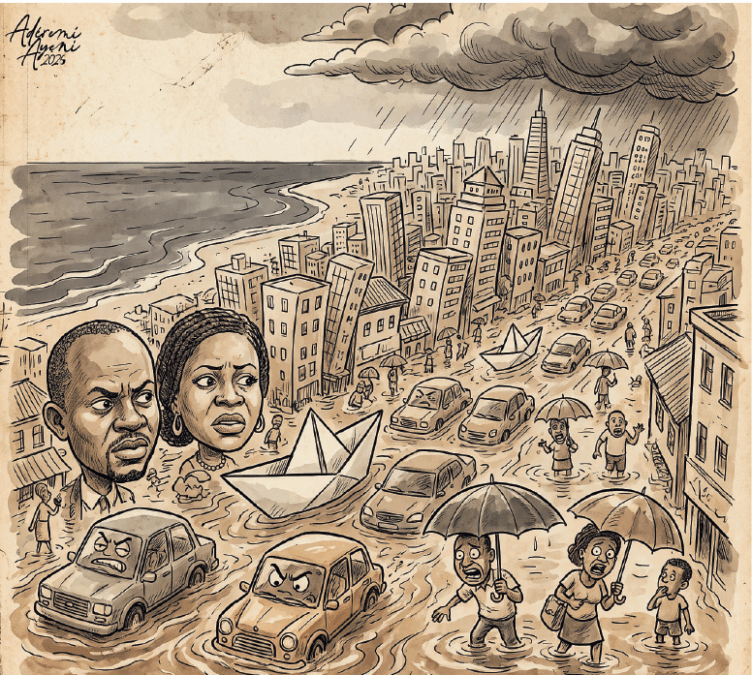
The sad reality for Lagosians is that, despite government budget allocations exceeding ₦106 billion for drainage infrastructure, very little appears to have changed in the city’s ability to manage flooding effectively. Every rainy season, thousands of residents watch floodwaters invade their homes, particularly on Lagos Island, destroying properties worth millions of naira, displacing families and disrupting livelihoods. Floodwaters regularly submerge vehicles on major highways, while some communities resort to using canoes to navigate flooded roads. The problem extends beyond the Island, with overflowing drains and impassable roads disrupting communities across the mainland.
This has become an annual cycle of destruction in which reactive rather than preventive responses fail to protect lives, property and critical infrastructure. The persistence of the crisis raises serious questions about whether Lagos has a credible long-term flood management strategy. The concern is even more urgent given projections that about 1.4 million residents could be at risk and that flooding could cost the city an estimated US$40 billion by 2050 if inadequate long-term infrastructure planning continues.
Even cities facing similar flood risks are investing in long-term engineering and nature-based solutions to reduce their vulnerability. In New Orleans, authorities have constructed massive surge barriers, reinforced levees and one of the world’s largest pumping systems to keep floodwaters out and rapidly remove excess water. Shanghai has pioneered the “Sponge City” approach by replacing impermeable surfaces with porous pavements, rain gardens and wetlands that absorb stormwater, while deep drainage tunnels, intelligent floodgates and extensive waterways redirect and store excess water during heavy rainfall. Meanwhile, Miami has installed industrial stormwater pumping stations and backflow preventers that prevent seawater from flowing back into streets during high tides, complemented by the elevation of roads, seawalls and buildings to improve the city’s resilience against chronic flooding.
Lagos should learn from these experiences by adapting proven technologies and policies to its own environment. Beyond engineering, the city needs a genuine long-term flood resilience strategy. Urban planning should discourage development in high-risk flood zones while restoring wetlands and other natural flood buffers. Drainage infrastructure must be expanded and maintained using modern hydrological modelling rather than reacting after disasters occur. Early-warning systems, emergency evacuation planning and stronger coordination between state agencies should become permanent features of urban governance, supported by transparent project monitoring and public accountability for implementation.
Annual flooding should no longer be treated as an unavoidable consequence of heavy rainfall. It is an increasingly predictable risk whose consequences will become more severe if current patterns continue. The cities projected to face permanent inundation by 2050 are investing today because they recognise the cost of inaction. Lagos should do the same. Treating flooding as a long-term existential threat rather than a recurring seasonal inconvenience may prove one of the most important decisions the city makes about its future.
More from our YSoT Column


Join BusinessDay whatsapp Channel, to stay up to date
Open In Whatsapp