


Every nation possesses a statistic that quietly shapes the way it understands itself. For decades, Americans have watched quarterly GDP growth as a barometer of economic confidence. Inflation has become the defining political statistic across much of Europe. China’s remarkable rise has been narrated through manufacturing output and export volumes. In many developing countries, poverty rates, unemployment figures and debt ratios dominate public debate.
Nigeria is no different. Our national conversation is driven by numbers. Oil production. Exchange rates. Inflation. Foreign reserves. Fiscal deficits. Debt-to-GDP ratios. Poverty statistics.Every month, another indicator enters public discourse, generating headlines, political arguments and expert commentary. Each contributes something valuable to our understanding of the country.
Yet taken together, they leave one persistent question unanswered. Why does Nigeria repeatedly underperform relative to its extraordinary potential? For decades, we have searched for explanations. Some blame corruption. Others point to leadership. Many emphasise oil dependence, weak infrastructure, policy inconsistency, ethnic fragmentation or inadequate investment. Each explanation contains an important element of truth. Yet none fully explains why the same pattern recurs across sectors, across administrations and across generations.
How does a country blessed with one of Africa’s largest economies, one of the world’s youngest populations, abundant natural resources, globally recognised entrepreneurs, internationally respected professionals and immense cultural influence continue to struggle to translate those advantages into consistently superior national outcomes?
Perhaps the problem has never been that we lacked answers. Perhaps we have simply been asking the wrong question.
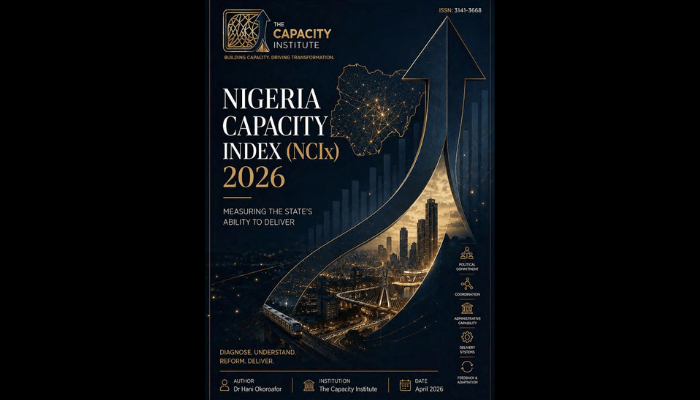
That is the significance of the Nigeria Capacity Index 2026. Its overall score of 54.2 is not intended to compete with GDP, inflation or the Human Development Index. Nor should it be interpreted as another league table designed to reward or embarrass governments. It is something fundamentally different. It is an attempt to measure the institutional capability that sits beneath every policy, every reform and every development ambition.
In other words, it measures the strength of the machinery through which Nigeria attempts to convert vision into reality. That distinction cannot be overemphasised.
When people first encounter the figure of 54.2, their instinctive reaction is often to ask whether it represents success or failure. The question is understandable, but it misses the point. Capacity is not an examination in which countries either pass or fail. It is a diagnostic assessment of institutional capability. A doctor does not measure blood pressure to praise or condemn a patient. The measurement exists to understand the condition of the underlying system. The exact same principle applies here.
The score of 54.2 therefore tells us neither that Nigeria is condemned to underperformance nor that its institutions are incapable of improvement. It tells us something considerably more useful: that the country’s execution architecture remains structurally constrained. It identifies the principal bottlenecks that repeatedly interrupt the journey from political intention to measurable public outcome.
That diagnosis immediately resolves one of the great paradoxes of modern Nigeria. It explains how a country can simultaneously produce world-class individuals and inconsistent public institutions. Individual achievements by Nigerians demonstrate that Nigeria possesses an extraordinary reservoir of human capability. Yet talent does not organise itself. Institutions do. That is the difference between potential and capacity.
Potential concerns the assets available to a nation – its people, resources, geography, markets and opportunities. Capacity concerns the institutional ability to organise those assets into sustained national performance.
Countries become prosperous not simply because they possess abundant potential but because they possess institutions capable of converting potential into productivity.
That is why the Nigeria Capacity Index 2026 deliberately distinguishes between the country’s remarkable promise and its present execution capability. A score of 54.2 should never be interpreted as a measure of Nigeria’s future possibilities. On the contrary, it highlights the distance that remains between what Nigeria could achieve and what its current institutional architecture consistently delivers.
The detailed findings reinforce this conclusion. Political commitment emerged as one of Nigeria’s stronger dimensions. Contrary to popular perception, the country rarely suffers from a shortage of ambitious policy ideas. Successive administrations have produced comprehensive plans.
Administrative capability also proved considerably stronger than simplistic narratives often suggest. Across the federal and state governments are thousands of dedicated professionals whose technical competence compares favourably with their counterparts elsewhere.
Yet excellence remains unevenly distributed. It is not consistently connected into a coherent national execution system. That is where the Index identifies Nigeria’s most significant challenge. Coordination. National development is not achieved through isolated institutions working independently.
Infrastructure, for instance, requires transport ministries to work seamlessly with finance ministries, environmental regulators, procurement agencies, state governments and private contractors. It is precisely within those interactions that Nigeria’s execution capacity remains most constrained.
The evidence is visible across virtually every sector of national life. Nigeria has produced impressive policies that faltered during implementation, not because they lacked intellectual merit but because execution became fragmented. In many instances, individual institutions performed reasonably well within their own mandates, yet the system as a whole delivered less than the sum of its parts.
This is an important distinction because it changes the diagnosis. For years, the tendency has been to search for a single explanation for Nigeria’s developmental frustrations: corruption,
leadership, inadequate funding, ethnicity or weak legislation. Each undoubtedly contributes to the national story. But the Capacity Index suggests that these are often symptoms interacting within a broader institutional ecosystem rather than isolated causes operating independently.
In complex systems, outcomes often emerge from the interaction of many variables. A world- class hospital depends not only on outstanding surgeons but on reliable procurement, laboratory services, nursing systems, maintenance and administration. Excellence emerges from integration.
Nations are no different. The countries that consistently outperform expectations are rarely those blessed with the greatest natural advantages. They are those that have become exceptionally good at organising themselves.
Closer to home, Rwanda offers an instructive lesson. Regardless of differing political perspectives, there is broad international recognition that its public administration has become increasingly disciplined in implementation, service delivery and performance management. Vietnam presents an equally compelling example. Over several decades it has strengthened the institutions responsible for coordinating industrial policy, attracting investment and managing export-led growth. These countries became successful because they progressively strengthened the institutional architecture through which governments delivered results.
This is precisely why the Nigeria Capacity Index should never be interpreted as a verdict on Nigeria’s destiny. Capacity is not fixed. It is cumulative. Capable states are built rather than inherited. They emerge through sustained reforms that strengthen execution one layer at a time.
That is why the figure of 54.2 should be understood less as a destination than as a baseline. Every meaningful reform requires an accurate starting point. It is impossible to improve systematically what has never been measured systematically. The significance of the Nigeria Capacity Index therefore lies not merely in assigning a score but in identifying a pathway. Once institutional strengths and weaknesses become visible, reform becomes more intelligent. Coordination failures can be addressed directly.
Administrative capability can be strengthened where it is weakest. Delivery systems can be redesigned. Feedback mechanisms can become continuous rather than episodic. Progress itself becomes measurable. That is why the Index has implications extending far beyond the Federal Government. State governments can use the same framework to understand why similar resources often produce markedly different outcomes. Local governments can diagnose service delivery constraints with greater precision. Public agencies can benchmark their institutional performance over time rather than relying solely on expenditure or activity reports.
But capacity is not simply a governmental concept, but an organisational principle. Increasingly, sophisticated investment decisions are no longer driven solely by macroeconomic statistics. They also depend upon confidence that institutions can implement reforms, administer regulations predictably, enforce contracts fairly and maintain policy continuity over time. In other words, investors evaluate execution capability whether they explicitly describe it in those terms or not.
For Nigeria, this insight arrives at an important moment. The country is entering a period in which expectations are exceptionally high. Economic reforms are being pursued with renewed determination. States are competing more aggressively for investment. In such an environment, the quality of execution will matter more than ever before.
The Nigeria Capacity Index should therefore be seen as an instrument of national learning rather than national criticism. Its purpose is not to identify failure but to illuminate opportunity. It reminds us that institutional capability can be strengthened just as financial capital can be accumulated or infrastructure expanded. More importantly, it provides a disciplined framework through which that strengthening can be observed, measured and sustained over time.
Perhaps that is the most important contribution the Index can make. It encourages Nigeria to judge itself not merely by the promises it makes or even by the outcomes it achieves, but by the institutional capability it is steadily constructing beneath those outcomes. That is a far more demanding standard of accountability – but it is also a far more hopeful one, because institutions, unlike circumstances, can be deliberately improved.
Ultimately, the significance of 54.2 does not lie in the number itself, but in what the number reveals. It reveals a nation of extraordinary potential whose institutional operating system has
yet to match the scale of its human capability. It reveals strengths upon which transformation can confidently be built and constraints that can no longer remain invisible. Above all, it reminds us that Nigeria’s greatest developmental challenge is not a shortage of ambition, resources or talent; but the patient construction of institutions capable of converting all three into consistent national performance. That is why 54.2 should be remembered as the beginning of a different conversation about Nigeria.
Dr Hani Okoroafor is a global informatics expert advising corporate boards across Europe, Africa, North America and the Middle East. He serves on the Editorial Advisory Board of BusinessDay. Reactions welcome at [email protected]

Join BusinessDay whatsapp Channel, to stay up to date
Open In Whatsapp


