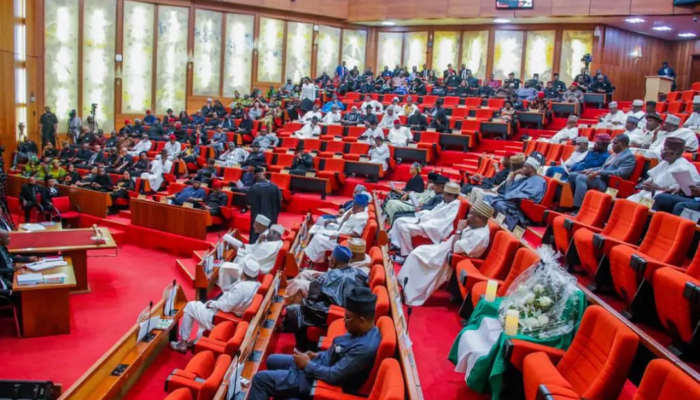
There have been divergent reactions to the recent passage by the Senate of the Federal Road Safety Corps (FRSC) Amendment Bill 2026, which seeks to amend Nigeria’s road traffic laws by criminalising preaching on commercial buses.
The amended legislation contains an updated schedule of 52 traffic offences and their corresponding penalties that bring Nigeria’s road safety laws at par with current realities.
According to lawmakers, the review was designed to modernise the country’s traffic regulations, provide a more effective deterrence against violations, and equip the FRSC with stronger legal tools to enforce road safety standards.
If signed into law by President Bola Ahmed Tinubu, the amended legislation will replace several outdated fines and penalties that lawmakers argued no longer reflect prevailing economic conditions or adequately discourage traffic offenders.
The Senate expressed the optimism that the amendment would improve road discipline, enhance commuter safety, strengthen public confidence in traffic law enforcement, and contribute significantly to reducing road crashes and fatalities across Nigeria.
However, one of the proposed amendments in the bill has generated much needed reaction from a section of the country’s population – considering it a direct attack on their faith.
The Senate had proposed a ban on hawking, trading, and preaching in commercial vehicles.
Under the proposed amendment, any person found engaging in any of the prohibited activities inside a commercial vehicle commits an offence and, upon conviction, will be liable to a N50,000 fine.
According to the lawmakers, the measure was introduced to minimise distractions that could interfere with drivers’ concentration and endanger passengers.
The lawmakers noted that commercial vehicles should remain free from activities capable of compromising safety.
However, some stakeholders have termed the proposed amendment as a targeted attack on the Christian community in Nigeria.
They also questioned the modality of the enforcement on the back of the recent judgment of the Federal High Court in Kano barring the FRSC from enforcing traffic laws on designated state roads.
Joseph Ojo, presiding bishop, Calvary Kingdom Church (CKC), said the amendment raised more questions than answers. He also questioned the modality of enforcing the said amendment if finally signed into law by President Bola Tinubu.
“I think it’s in the process of trying to silence the voice of the Christians. You know, they are trying in several ways, Sharia, and all the other laws,” he said.
Ojo disclosed that those who pushed for the amendment thought it would silence the Church in Nigeria.
He added that implementation might pose a huge challenge for the FRSC and other law enforcement agencies who might be saddled with enforcing the new amendment.
“But the truth is, no law actually works in Nigeria because of the corrupt nature of police and law enforcement agencies,” he said.
The cleric also highlighted the Lagos State traffic law that bans tricycles (Keke) from plying the Lagos-Badagry Expressway and how it is being abused by the riders with no level of enforcement on sight.
“I went down to Badagry today. They said that no tricycle should be on Badagry Expressway – They are giving the law enforcement officers room to be corrupt and enrich themselves,” he said.
According to him, law amendments alone cannot guarantee compliance from the people. “No law works in Nigeria until sanity enters in it and they have a right not to work in Nigeria. Even the election will not work.”
Another Lagos-based cleric also aligned his thoughts with that of Ojo, suggesting that there might be more to the amendment, especially because of its timing.
“That decision further confirms this administration’s evil intention against the Church. The government has been complicit in the alleged genocide of Christians in Nigeria,” Tope Ilesanmi, senior pastor, Revival Summit, told BusinessDay.
According to him, the lawmakers appear less concerned about the level of insecurity and the growing numbers of Nigerians being kidnapped or killed across the country.
“The Law makers haven’t lifted a finger to legislate against insecurity but preaching in the bus or not is their priority.
“The lawmakers are very insensitive to the mood of the nation. While Christians are crying about loved ones in the hold of bandits, the lawmakers were only thinking of how to add insults upon our injuries?
Ilesanmi, a former chairman of the Pentecostal Fellowship of Nigeria (PFN), Ikeja Province, added that the legislation against preaching in public buses is a backdoor attack on the Church.
“They chose this time because they knew the Church had a more debilitating evil at hand and wouldn’t pay attention to such a lesser problem,” he said.
Another pastor based in Ogun State,
Olusola Daniel Olatomi, pastor, Christ Firstfruits Assembly, said that there is a historical perspective to the matter. According to him, Nigerian society grew with the culture of public preaching.
He added that Nigerians are said to be religious because they love to pray and to be prayed for irrespective of religion; and that such disposition encourages Nigerians to accommodate public preaching.
“It is disheartening that Nigeria as a nation will get to the point that preachers will be penalised by the state for preaching in public buses,” he said.
He however questioned the underlying purpose of the bill; asking: who initiated this bill? And what interest does this provision in the bill serve and who does the provision serve?
He added that if the bill is signed into law by President Bola Tinubu, it will further create and support an imperative that has been on the table for a long time about Christian persecution in Nigeria.
“It must however, be noted that this cannot be divorced from the prophecies of our Lord Christ Jesus ( Matthew 5:11-12,John 15: 20).
“Persecution will arise against those who hold on to the gospel of our Lord Christ Jesus. If care is not taken, they will tell the Church of Christ Jesus where to preach, what time to preach and who to preach to,” he said.
According to the cleric, every effort to shut down the spread of the Gospel of Jesus in Nigeria will fail. He reiterated that this is not the first time and it might not be the last time.
“At a point in history, the apostles of our Lord Jesus Christ were told not to preach with the name of Jesus, they failed woefully.
“Saul of Tarsus tried to shut down everyone with the name of Jesus; he eventually became one of the promoters of the Gospel of Jesus. This too will fail,” he added.
He however urged Nigerian Christians to innovate their approach to evangelism and that the Church must wake up to pursue things that are of utmost importance to the faith and the Kingdom, rather than the pursuit of mundane and irrelevant things.
“Is the Church building the faith of its parishioners on sand or on the rock which is Christ Jesus?
“This is calling on the Church to reinvent the communication methods that have been in use to reach the dying souls,” Olatomi said.
The Kano judgment
While Nigerians await the presidential assent of the proposed amendment to the FRSC laws – a recent court judgment might throw spinners in the way of the Corps’ enforcement modalities.
The federal high court in Kano recently barred the FRSC from operating on state and local government roads.
The court also declared the FRSC’s operations on township roads within Kano metropolis unlawful, holding that they violated the fundamental rights of citizens.
The judgment was delivered in favour of Abba Hikima, a Kano-based lawyer who sued the FRSC over an incident that occurred in July 2025.
According to the suit, the FRSC operatives mounted roadblocks on township roads in Kano and stopped motorists, including Hikima, demanding driver’s licences and questioning them despite the absence of any primary traffic offence.
Hikima subsequently approached the federal high court, noting that the corps had unlawfully violated his fundamental rights.
He stated that the FRSC’s statutory mandate covers only federal highways and does not extend to state or local government roads.
M.S. Shuaibu, the presiding judge, ruled that the FRSC officers acted outside their statutory powers by stopping, questioning and delaying motorists on township roads.
It also stated that the actions breached the constitutional rights to personal liberty and freedom of movement guaranteed under sections 35 and 41 of the 1999 Constitution.
The judge granted all the reliefs sought by Hikima, including a perpetual injunction restraining FRSC personnel from stopping or harassing motorists on Kano state roads without lawful authority.
He also ordered the corps to publish a public apology in a national newspaper and awarded the applicant N800,000 in damages and costs.

Join BusinessDay whatsapp Channel, to stay up to date
Open In Whatsapp