The federal government has announced plans to roll out a nationwide household survey to generate updated, reliable data on the number of out-of-school children in the country.
This becomes necessary, as Tunji Alausa, the minister of education, admitted that current estimates, ranging between 15 and 20 million, no longer reflect the true scale of the problem.
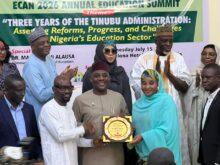
Alausa disclosed this on Wednesday at the 2026 Annual Education Summit organised by the Education Correspondents Association of Nigeria (ECAN) in Abuja, themed ‘Three Years of the Tinubu Administration: Assessing Reforms, Progress and Challenges in Nigeria’s Education Sector.’
The minister disclosed that the ministry would work with the National Bureau of Statistics on the exercise, positioning it as part of a broader push to anchor education policy and funding decisions in verifiable data rather than outdated assumptions.
Besides, Alausa said that the federal government interventions have returned more than one million out-of-school children to classrooms over the past two years.
However, he emphasised that without accurate baseline data, tracking real progress and designing targeted interventions remain difficult, an admission that underscores longstanding concerns among development economists about the reliability of Nigeria’s education statistics.
Alausa linked the data drive to President Bola Tinubu’s broader commitment to evidence-based governance, arguing that credible statistics should also strengthen the ability of citizens and the media to hold public officials accountable.
Moreover, the minister pointed to reforms, beyond the survey, under the Renewed Hope Agenda, including expanded investment in technical and vocational education, STEM programmes, digital transformation initiatives, and improved education governance structures.
He also cited three consecutive years without industrial disruption in tertiary institutions, universities, polytechnics and colleges of education, which he attributed to sustained engagement with unions in the sector, a notable shift given Nigeria’s history of prolonged academic strikes.
On global competitiveness, Alausa noted that Nigeria now has 24 universities ranked among the world’s top 1,000 institutions, up from 21 previously, with public universities holding the country’s top four positions.
Suwaiba Ahmad, the minister of state for education, urged journalists to support education reforms with balanced, responsible coverage, describing education as central to building a productive economy and reducing poverty.
Aisha Garba, executive secretary of the Universal Basic Education Commission (UBEC), reaffirmed the commission’s commitment to ensuring every Nigerian child has access to quality basic education “regardless of background, location or income level.”
Meanwhile, Nigeria continues to grapple with one of the world’s largest populations of out-of-school children, a burden driven by poverty, insecurity, cultural norms, inadequate infrastructure, child labour, early marriage, conflict-driven displacement, and weak access to quality schooling, particularly in rural areas.
Analysts say the planned survey, if executed rigorously, could offer the clearest picture yet of a crisis that has long been measured more by estimate than by evidence.

Join BusinessDay whatsapp Channel, to stay up to date
Open In Whatsapp