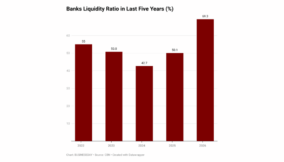
Nigeria’s banking system is awash with cash, yet much of that money is ending up back at the Central Bank of Nigeria (CBN) instead of flowing to businesses and households in the form of loans.
Recent data from the CBN and the Financial Markets Dealers Association (FMDA) show commercial banks increasingly depositing excess liquidity with the apex bank through the Standing Deposit Facility (SDF), highlighting a paradox in Nigeria’s financial system, abundant liquidity alongside relatively subdued credit growth.
The trend underscores how the CBN’s tight monetary policy, aimed at curbing inflation and supporting the naira, is influencing banks’ lending behaviour and reshaping money market activity.
According to the CBN’s Monthly Economic Report for February 2026, average liquidity in the banking system rose by 23.69 percent to N3.08 trillion from N2.49 trillion in January. The increase was driven mainly by fiscal injections, repayments of maturing Nigerian Treasury Bills (NTBs) and Federal Government bonds, while Remita collections and foreign exchange sales also boosted liquidity.
Excess cash finds its way back to the CBN
The impact of the liquidity surge was immediately reflected in banks’ activities at the CBN’s standing facilities.
Deposits through the Standing Deposit Facility rose to N61.07 trillion during February from N50.69 trillion in January. On a daily basis, banks deposited an average of N3.05 trillion with the apex bank, compared with N2.41 trillion in the previous month.
By contrast, borrowing from the CBN through the Standing Lending Facility fell sharply to just N250 billion during the month from N1.87 trillion in January, indicating banks had little need for overnight funding because liquidity was plentiful.
The trend has continued in recent weeks.
CBN data showed commercial banks’ deposits under the Standing Deposit Facility increased by 14.24 percent to N4.74 trillion on Monday from N4.15 trillion recorded on Friday after the apex bank repaid about N1.71 billion in maturing securities.
The repayment injected fresh liquidity into the banking system, leaving banks with surplus cash that they preferred to deposit overnight with the CBN rather than lend to one another in the interbank market.
The Standing Deposit Facility allows banks to earn interest on excess reserves placed with the CBN, making it an attractive short-term investment when liquidity is abundant.
Why are banks choosing the CBN over lending?
At first glance, the behaviour appears counterintuitive.
The banking system is liquid, and total credit to the economy increased to N57.88 trillion in February from N57.41 trillion in January. However, the increase represented only a modest 0.82 percent monthly growth despite the large liquidity injection.
Several factors explain the cautious lending approach.
First, the CBN’s tight monetary stance has significantly increased returns on risk-free assets.
Banks can earn attractive overnight returns by depositing excess funds with the apex bank while avoiding the credit risks associated with lending to businesses and households.
Second, elevated interest rates continue to suppress loan demand.
Although the average prime lending rate eased slightly to 19.29 percent in February from 19.54 percent in January, the average maximum lending rate climbed sharply to 35.17 percent from 32.68 percent.
Such borrowing costs make many investment projects unviable and discourage businesses from taking fresh loans.
Third, banks remain cautious about credit quality in a high-interest-rate environment where repayment risks tend to increase.
Read also: StanChart scales back Nigeria rate-cut outlook as inflation risks persist ahead of MPC
Consumer borrowing declines
The preference for safety is also evident in household lending.
The CBN report showed consumer credit outstanding declined by 20.48 percent to N3.03 trillion in February from N3.81 trillion in January.
Retail loans recorded the sharpest contraction, falling by 41.85 percent, while personal loans declined marginally by 0.40 percent.
The report suggested repayments may have exceeded new loan disbursements during the period.
Although personal loans still accounted for nearly two-thirds of total consumer credit, the decline points to weaker household borrowing despite improved banking system liquidity.
CBN continues to sterilise liquidity
The rise in liquidity has not gone unnoticed by the Central Bank.
Throughout February, the CBN conducted aggressive Open Market Operations (OMO) to absorb excess cash.
The apex bank offered N1.80 trillion worth of OMO bills during the month, attracting subscriptions of N6.35 trillion before allotting N4.77 trillion at an average stop rate of 20.42 percent.
With N4.62 trillion in maturing OMO bills during the period, the operations resulted in a modest net liquidity withdrawal of N150 billion.
The government also maintained active borrowing through Treasury bills and FGN bond auctions.
Investors submitted N8.87 trillion in bids for Treasury bills against N2.30 trillion offered, reflecting strong demand for government securities despite declining stop rates.
Similarly, FGN bond auctions attracted subscriptions of N2.70 trillion against N800 billion offered.
Recent repayments fuel another liquidity wave
The liquidity story has intensified beyond February.
According to the Financial Markets Dealers Association, average system liquidity improved by 50.81 percent last week to N4.33 trillion from N2.87 trillion as inflows exceeded the CBN’s liquidity sterilisation efforts.
While the CBN withdrew about N1.06 trillion through Treasury bill auctions, repayments from maturing securities amounted to N2.50 trillion, resulting in a net liquidity injection of roughly N1.44 trillion.
Liquidity conditions are expected to strengthen further, with another estimated N3.12 trillion projected to enter the banking system, about 95 percent of which will come from maturing OMO bills.
With no Treasury bill or FGN bond auctions scheduled during the week, analysts expect the CBN to rely mainly on fresh OMO auctions to absorb part of the excess liquidity and keep short-term interest rates stable.
Aku Pauline Odinkemelu, a member of the Monetary Policy Committee (MPC), recently said the apex bank would continue using active OMO operations as its primary day-to-day liquidity management tool while maintaining a tight monetary policy stance to anchor inflation expectations and support macroeconomic stability.
Liquidity boosts appetite for government securities
Rather than flowing into private sector lending, much of the excess liquidity is finding its way into the fixed-income market.
According to Coronation Merchant Bank, favourable liquidity conditions drove strong buying interest across Treasury bills, OMO bills and FGN bonds last week.
Average Treasury bill yields declined by 22 basis points to 19.72 percent, while average OMO yields eased to 21.58 percent.
FGN bond yields also fell by 15 basis points to 17.63 percent as investors increased purchases across the secondary market.
Demand at the latest Treasury bill auction remained robust.
Although the Debt Management Office offered N700 billion, investors submitted bids worth N2.03 trillion, with the 364-day bill attracting N1.86 trillion in subscriptions.
What does this mean for the economy?
The growing preference for parking surplus funds with the CBN illustrates one of the key consequences of Nigeria’s current monetary policy framework.
The Central Bank’s aggressive liquidity management has succeeded in keeping money market rates broadly within its policy corridor while helping to contain inflationary pressures and support exchange rate stability.
However, the same framework has also encouraged banks to favour low-risk, high-yield placements with the CBN and government securities over expanding private sector lending.
Although credit to agriculture, industry and services continued to grow modestly in February, the pace remains far below the expansion in banking system liquidity.
Unless inflation moderates significantly and monetary conditions ease, analysts expect banks to continue balancing the opportunity to earn attractive risk-free returns against the higher risks associated with commercial lending.
For now, Nigeria’s banking system remains highly liquid, but much of that liquidity is circulating between commercial banks and the CBN rather than reaching the broader economy where businesses and households continue to face expensive and relatively constrained access to credit.

Join BusinessDay whatsapp Channel, to stay up to date
Open In Whatsapp