Africa’s startup ecosystem delivered one of its strongest performances in company exits during the first half of 2026, but beneath that positive headline lies a more troubling trend: fewer startups are securing funding, especially at the earliest stages where future high-growth companies are born.
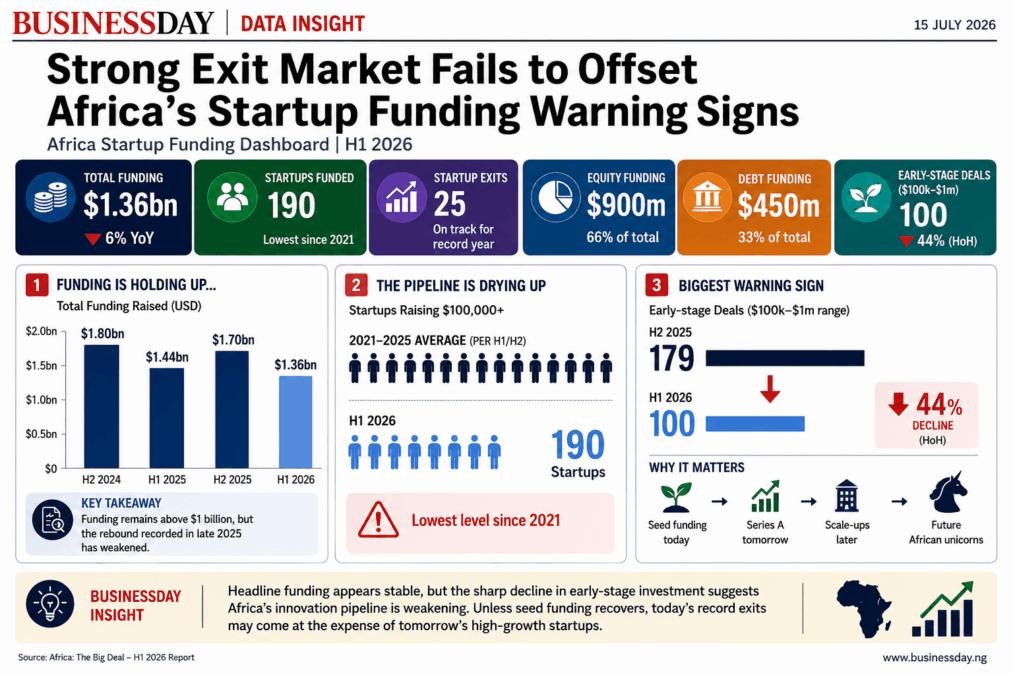
New data released by Africa: The Big Deal shows that startups across the continent raised $1.36 billion between January and June 2026, broadly in line with the $1.44 billion raised during the same period in 2025.
However, funding remained 22 percent below the $1.7 billion recorded in the second half of 2025, suggesting that the rebound seen late last year has lost momentum.
Read also: Nigerian startup beats 500 rivals to give Africa first UN AI innovation crown
While the total amount invested appears resilient, the number of startups attracting capital tells a different story.
Only 190 African startups raised at least $100,000 during the first six months of the year, the lowest number since Africa: The Big Deal began tracking deals above that threshold in 2021.
Even more worrying, the number of startups raising between $100,000 and $1 million fell by 44 percent, dropping from 179 in the second half of 2025 to just 100 in H1 2026.
Industry analysts say that trend poses a much bigger long-term risk than the relatively stable headline funding figures suggest.
“The decline in early-stage financing is the real story,” said Max Cuvellier Giacomelli, venture capital analyst and founder of Africa: The Big Deal.
According to him, while total investment has remained relatively stable because of a handful of larger transactions, the shrinking pool of funded startups threatens the future pipeline of scale-ups.
“The underinvestment in early-stage companies will eventually create a pipeline problem unless it is corrected quickly,” he noted.
The figures show that equity financing remained relatively stable at $900 million, accounting for about two-thirds of all funding, while debt financing stood at $450 million, almost unchanged from a year earlier. However, debt financing ended three consecutive six-month periods of growth, reflecting a more cautious lending environment.
The latest report mirrors concerns repeatedly raised by investors and founders that Africa’s venture capital market has become increasingly selective, favouring established startups with proven business models while leaving younger companies struggling to raise seed and pre-Series A funding.
Those concerns have also been echoed by stakeholders. Lexi Novitske, general partner at Norrsken22, had noted that investors are becoming far more disciplined than during the funding boom of 2021 and 2022, with greater emphasis on profitability, strong unit economics and sustainable growth rather than rapid expansion.
Similarly, Zachariah George, managing partner at Launch Africa Ventures, has argued that the continent is not suffering from a shortage of entrepreneurial talent but from a shortage of risk capital available to founders at the earliest stages.
According to George, many promising startups now face a widening funding gap between angel investment and institutional venture capital, making it harder for innovative businesses to survive long enough to attract larger investors.
Industry observers say the trend could reduce the number of African startups reaching Series A and Series B funding over the next few years, ultimately slowing innovation, job creation and digital transformation across the continent.
For Nigeria, the continent’s largest startup ecosystem by deal volume, the slowdown could be particularly significant. Although Nigerian startups continue to attract major investments and acquisitions, a prolonged decline in seed funding could shrink the pipeline of companies capable of becoming future market leaders.
Despite those warning signs, the report offers one bright spot. Africa recorded 25 startup exits during the first half of 2026, putting the continent on track to surpass the 48 exits recorded in 2025, the highest annual total on record.
Among the biggest transactions were Flutterwave’s acquisition of Nigerian fintech Mono in a deal estimated at between $25 million and $40 million, and South African payments company Araxi’s acquisition of Pay@ for $62 million.
The growing number of acquisitions is increasingly viewed as evidence that Africa’s startup ecosystem is maturing beyond fundraising toward delivering returns for investors.
Read also: Africa’s startup ecosystem raises $843m in five months
Analysts say successful exits play a critical role in attracting global capital because they demonstrate that investors can eventually realise returns on their investments through acquisitions or other liquidity events.
Still, many believe exits alone cannot sustain the ecosystem if fewer startups are entering the investment pipeline.
Without stronger support for early-stage founders, today’s record exits could come at the expense of tomorrow’s innovation champions, leaving Africa with fewer companies capable of scaling into the next generation of billion-dollar businesses.
The first half of 2026 therefore presents a mixed picture: an ecosystem proving it can produce successful exits and attract significant capital, but one that risks weakening its long-term growth unless early-stage investment recovers. Stable funding totals may reassure investors today, but the sharp fall in the number of funded startups suggests the continent’s innovation pipeline is under increasing strain.


Join BusinessDay whatsapp Channel, to stay up to date
Open In Whatsapp