Nigeria’s ambitious plan to raise mining contribution to gross domestic product (GDP) to 50 percent is being challenged by harsh realities, as insecurity, inadequate geological data, illegal mining, underinvestment and structural bottlenecks continue to constrain growth, BusinessDay investigations reveal.
The target, championed by Dele Alake, minister of Solid Minerals Development, reflects the Federal Government’s determination to transform the mining industry into a major pillar of economic diversification and reduce dependence on oil revenues. However, industry experts and operators say the goal remains far from reach under current conditions, saying that the sector requires a far deeper structural transformation than current reforms have delivered.
Official data from the National Bureau of Statistics (NBS) show that mining and quarrying contributed 4.23 percent to GDP in the first quarter of 2026, slightly lower than the 4.38 percent recorded in the corresponding period of 2025, though significantly higher than the 2.15 percent contribution recorded in the fourth quarter of 2025. While the figures point to progress, they also underscore the enormous gap between current realities and the government’s long-term aspirations.
For Shekwonyadu Iyakwari, professor of Applied Mineralogy and Exploration Geology at the Federal University of Lafia, the 50 percent target is unrealistic under prevailing circumstances.
Read also: Niger Ministry of Mineral Resources, Police command partner against illegal mining
“For the sector to move from about 0.1 percent historically to where it is today, the progress is commendable. But looking at what is required for mining to contribute 50 percent to GDP, we are nowhere near that,” he told BusinessDay.
According to him, insecurity remains the single biggest obstacle standing in the way of meaningful expansion. Large stretches of Nigeria’s mineral-rich belts continue to grapple with banditry, kidnapping and illegal mining activities, making exploration and commercial operations increasingly difficult.
“Wherever large-scale illegal mining occurs, insecurity follows. Regulatory agencies cannot even access these areas to assess activity,” he said, noting that many operators now spend heavily on private security arrangements and local vigilante groups simply to remain operational.
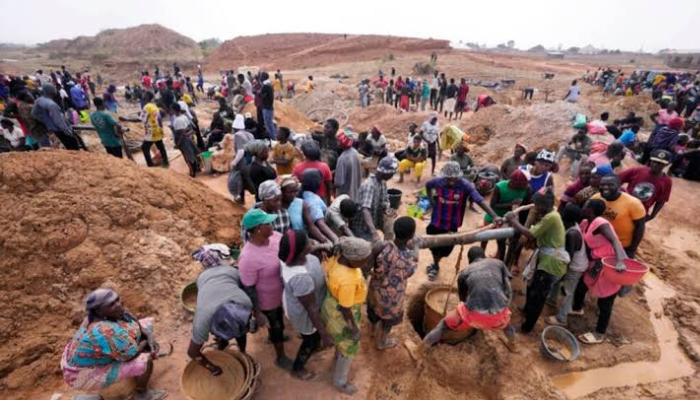
The scale of the challenge extends beyond artisanal operators. Industry stakeholders say illegal mining has evolved into a sophisticated network involving both small-scale diggers and larger operators with access to heavy equipment.
“Big companies with excavators and heavy equipment also engage in illegal mining. Illegal mining is not just about people digging with shovels,” an industry stakeholder familiar with operations across several mining belts said.
The persistence of illegal mining continues to undermine the government’s ability to accurately measure production volumes, revenue generation and mineral reserves. Analysts say this weakens regulatory oversight and contributes to significant revenue leakages.
Experts argue that alongside enforcement efforts, authorities must tackle the broader ecosystem enabling illegal mining. Recommendations include the creation of specialised mining police units in conflict-prone areas, deployment of digital licensing systems, stricter monitoring of mineral exports, stronger border controls and disruption of illicit financial networks linked to mineral smuggling.
Beyond insecurity, stakeholders identify the lack of credible geological data as one of the most significant impediments to attracting large-scale investment into the sector. Despite frequent claims about Nigeria’s vast mineral wealth, investors continue to complain about inadequate exploration data and the absence of internationally verifiable reserve estimates.
“Apart from insecurity, the issue of geological data is critical. We can say we have minerals, but can we quantify them properly? Investors want verifiable data,” Iyakwari said.
He noted that countries such as South Africa and Botswana built globally competitive mining industries through decades of systematic exploration and the development of reliable geological databases, significantly reducing investment risks and uncertainty.
The professor also challenged recurring claims by public officials regarding the scale of Nigeria’s mineral deposits, arguing that such assertions often lack the scientific data required to convince serious investors.
“We keep making claims about the resources we have, but investors want figures backed by data. They want evidence of reserves, not estimates. Without that information, attracting major mining investments becomes difficult,” he said.
Despite these concerns, analysts acknowledge that reforms introduced by the Ministry of Solid Minerals Development have begun yielding measurable results.
Olatunji Akinade, chairman of the SOMEA 2026 Jury, described the minister’s targets as aspirational benchmarks designed to drive momentum within the sector.
“Inspirations drive focus. They help create a sense of direction and urgency. If reforms are sustained and continuously improved, the sector can achieve significant growth, but transformation does not happen overnight,” he said.
According to Akinade, one of the most significant shifts under the current administration is the push towards local value addition rather than the export of raw minerals. He noted that increased domestic processing would create jobs, generate higher revenues and retain more economic value within the country.
“When you process minerals locally, you create jobs, increase earnings and ensure that more of the value remains within the Nigerian economy. That is where the real gains lie,” he said.
The ministry recently disclosed that more than 300 illegal miners had been arrested over the past two years, with over 100 already prosecuted. While experts describe the development as a positive step, they insist enforcement alone will not solve the problem.
“I think it is a step in the right direction. But government must also formalise artisanal mining through cooperatives so that operators can be monitored and regulated effectively,” Iyakwari said.
Stakeholders further warn that Nigeria faces growing competition from other resource-rich countries seeking to attract the same pool of mining capital. While government officials have embarked on investment roadshows and engagements with foreign investors, experts say Nigeria must create a more competitive operating environment if it hopes to secure substantial inflows.
Akinade noted that exploration remains one of the most underfunded segments of the industry despite its critical role in unlocking future investments.
“The exploration we are benefiting from in some countries today was carried out many years ago. Exploration is expensive, but without it, you cannot generate the data investors need. The sector requires significant funding if it is to realise its potential,” he said.
Industry operators argue that future growth will depend less on ambitious GDP projections and more on the implementation of practical reforms. They point to increased exploration spending, improved reserve estimation, stronger security architecture, expanded local processing capacity and stricter enforcement against illegal mining as more meaningful indicators of progress over the next three to five years.
For many observers, the challenge is no longer the absence of policies or legislation. Rather, it is the gap between policy formulation and implementation.
“The laws are in place. The regulations exist. What is missing is implementation,” an industry expert said.
Until insecurity is brought under control, exploration activity expands significantly and investment conditions become more competitive, experts say Nigeria’s ambition of making mining a dominant contributor to GDP may remain more aspirational than achievable.

Join BusinessDay whatsapp Channel, to stay up to date
Open In Whatsapp