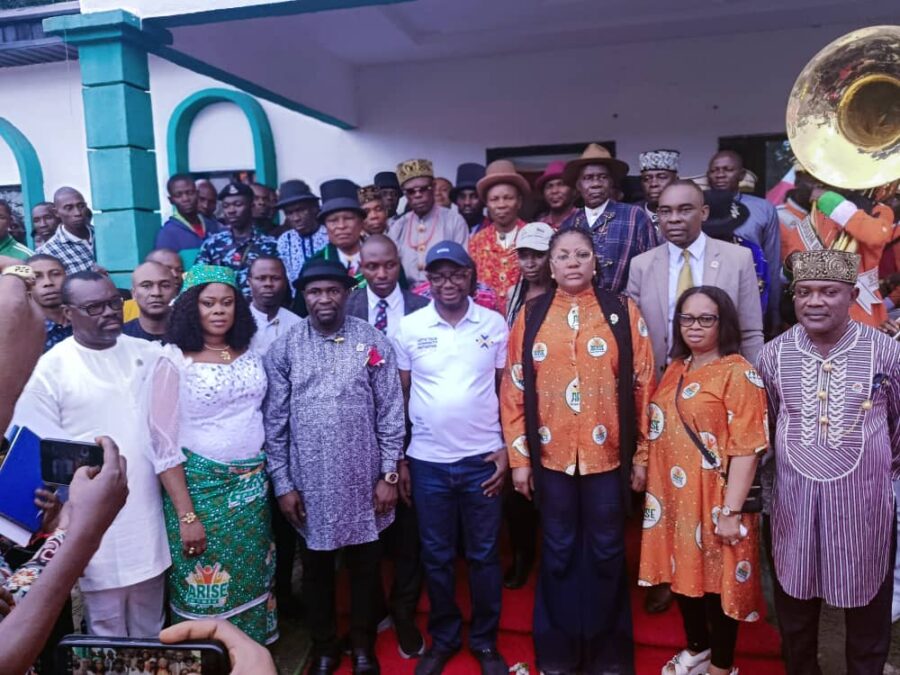
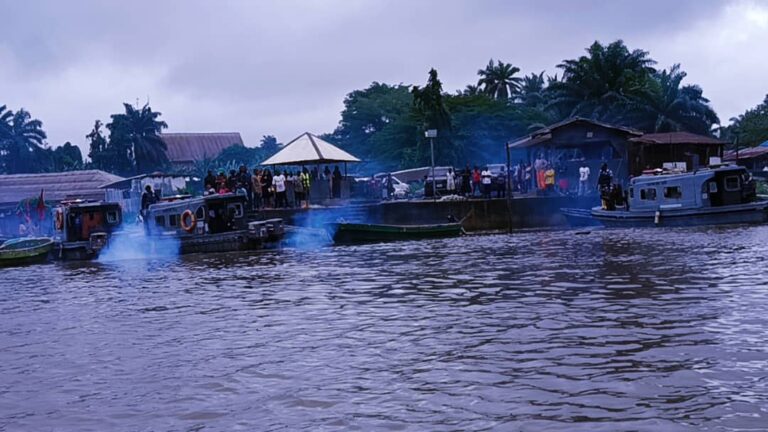
When the Minister of Humanitarian Affairs and Poverty Reduction, Dr. Bernard Doro, travelled through the waterways of Eastern Obolo Local Government Area, Akwa Ibom state, the visit was expected to assess the humanitarian realities confronting one of Nigeria’s most strategically important coastal communities. Instead, it evolved into something much broader: a demonstration of how humanitarian policy, infrastructure investment and public-private collaboration can work together to drive inclusive economic development.
Across Iko Town, Edowik Village, Olokpong, Emoruke, Otunene and Akaze, the minister encountered communities whose livelihoods depend largely on fishing and marine resources but whose development has long been constrained by environmental vulnerabilities, limited connectivity and inadequate social infrastructure.

These challenges are not unique to Eastern Obolo. They reflect the development paradox confronting many resource-producing communities across the Niger Delta, where significant economic activity has not always translated into corresponding improvements in living standards.
It was against this backdrop that Dr. Doro’s visit highlighted the importance of Akwa Ibom State’s evolving humanitarian framework under Governor Umo Eno’s ARISE Agenda.
The visit comes at a period when Nigeria is expanding its social protection architecture.
The Federal Government recently commenced the distribution of N4.2 billion under the Renewed Conditional Cash Transfer Programme to 56,402 vulnerable beneficiaries across Akwa Ibom State, with each beneficiary receiving N75,000 through preloaded debit cards over three months. The programme is designed to cushion the effects of inflation, rising food prices and declining household incomes while improving household resilience.
Akwa Ibom has deliberately complemented this national intervention with state-led programmes that extend beyond direct financial assistance.
Through the Ministry of Humanitarian Affairs, programmes such as the ARISE Share and Care Initiative deliver food directly to vulnerable households across the state’s 31 local government areas.
Instead of expecting elderly citizens, widows, persons living with disabilities and indigent families to travel long distances to access government support, humanitarian assistance is taken directly to their communities.
According to Princess Emem Ibanga, the Commissioner for Humanitarian Affairs, the state has already reached more than 650,000 households through food security and palliative interventions, making humanitarian support one of the central pillars of the ARISE Agenda.
The state’s humanitarian philosophy extends beyond food security.
The ARISE Compassionate Homes Initiative is providing permanent housing for vulnerable families across Akwa Ibom, replacing temporary relief with sustainable support that restores dignity while improving household stability.
Other interventions, including the ARISE Initiative for the Elderly, disability inclusion programmes and grassroots empowerment schemes, recognise that poverty reduction requires coordinated investments in human capital rather than isolated welfare programmes.
Dr. Doro’s visit offered an opportunity to evaluate how these interventions are being implemented in communities where development challenges remain significant.
Community leaders acknowledged ongoing state government investments in road infrastructure, housing projects, educational support, empowerment programmes and food security initiatives. They particularly highlighted the access road connecting Eastern Obolo to other parts of Akwa Ibom, describing it as one of the most transformative infrastructure projects for the area.
Improved connectivity has implications far beyond transportation. Better roads reduce travel time, lower logistics costs, improve access to healthcare and education, facilitate agricultural and fisheries value chains and expand market opportunities for rural communities. Infrastructure, therefore, becomes an economic intervention as much as a physical one.
The minister’s engagement also drew attention to another critical pillar of sustainable development: partnership with the private sector.
Eastern Obolo remains an important oil-producing area, making collaboration between government and operating companies essential to improving living conditions within host communities.
During his visit, Dr. Doro engaged with Sterling Oil Exploration and Energy Production Company (SEEPCO), emphasising the need for stronger Corporate Social Responsibility initiatives that directly improve the welfare of host communities.
His position reflects a growing consensus that resource extraction should generate measurable social and economic benefits for the communities where production takes place.
Corporate Social Responsibility is increasingly viewed not as philanthropy but as a strategic investment in sustainable development. Beyond statutory obligations, investments in education, healthcare, vocational training, environmental sustainability, clean water, community infrastructure and youth empowerment help create more stable operating environments while contributing to long-term local economic growth.
The minister’s engagement with SEEPCO therefore reinforced an important policy objective: sustainable development requires governments, communities and the private sector to work within a shared framework of responsibility.
Equally significant was Dr. Doro’s recognition of Governor Umo Eno’s development initiatives and his emphasis on stronger coordination between federal and state governments in tackling poverty.
The experience in Akwa Ibom illustrates how complementary interventions can produce greater impact than isolated programmes. While the Federal Government injects purchasing power into vulnerable households through conditional cash transfers, the state government addresses food security, housing, community welfare and social inclusion through institutional programmes tailored to local realities.
Rather than duplicating efforts, both levels of government are gradually building a more integrated social protection ecosystem.
The Ministry of Humanitarian Affairs has emerged as the coordinating institution linking these interventions under the ARISE Agenda, extending its mandate beyond emergency response to include food security, elderly welfare, disability inclusion, humanitarian partnerships, women’s empowerment and poverty reduction.
The next phase of this strategy is expected to deepen economic inclusion through targeted support for women’s cooperatives across all 31 local government areas, strengthening access to capital and expanding livelihood opportunities for rural women.
Taken together, these interventions reflect a broader understanding of humanitarian governance.
Effective social protection is no longer measured solely by the volume of relief distributed or the size of budget allocations. It is increasingly measured by whether vulnerable citizens gain improved access to food, housing, healthcare, education, economic opportunities and the infrastructure necessary to participate productively in society.
For Eastern Obolo, Dr. Bernard Doro’s visit brought national attention to both the challenges and the opportunities that define Nigeria’s coastal communities.
It also demonstrated that when humanitarian policy is supported by infrastructure development, strategic partnerships and responsible private sector participation, compassion becomes more than a moral obligation—it becomes an economic development strategy.
As Nigeria continues to refine its approach to poverty reduction and inclusive growth, Akwa Ibom’s experience offers an important lesson: sustainable development is achieved not through isolated interventions, but through coordinated policies that place people at the centre of governance while mobilising every stakeholder, government, communities and industry, to contribute to shared prosperity

Join BusinessDay whatsapp Channel, to stay up to date
Open In Whatsapp