For 18-year-old Yemisi Ayoola, dropping out of school was never part of her dream.
After finishing Junior Secondary School, her parents could no longer afford to continue her education. Instead of moving closer to her future, she stayed at home, watching her dreams slowly fade.
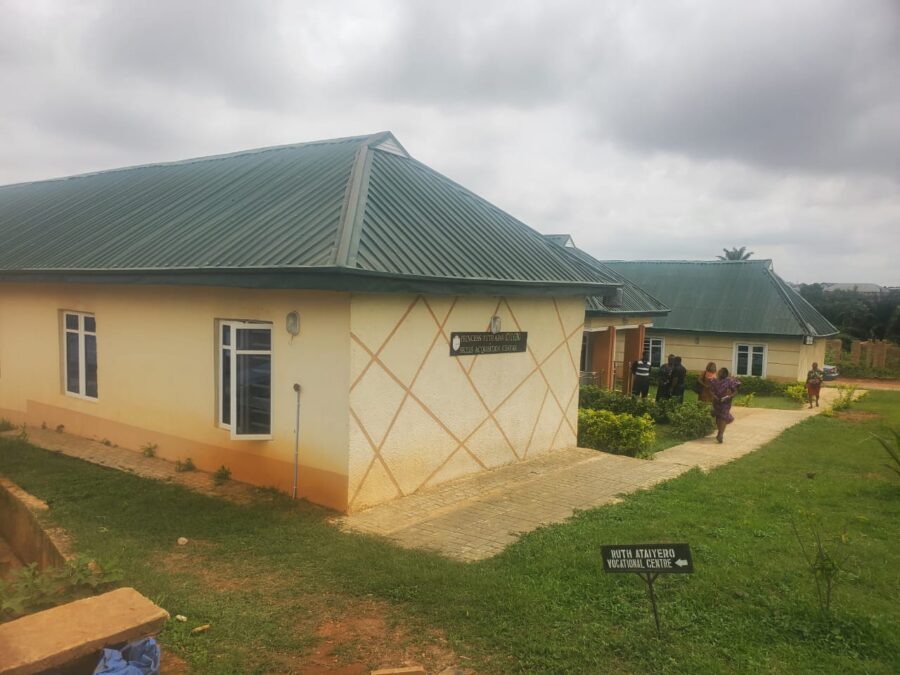
Today, she spends her mornings learning hairdressing and makeup at the Princess Ruth Ainu Ataiyero Skills Acquisition Centre in Ilesa, Osun State, a place she says has restored her hope.
“If government can help me go back to school after this training, I will be very happy,” she told BusinessDay.
For 22-year-old Janet Yemi, who has spent the past few years working as a salesgirl after secondary school, the centre represents a bridge to a better future.
She is learning fashion design while preparing to continue her education.
“If admission doesn’t come immediately, I want to become a professional fashion designer and own my own shop,” she said.
Perhaps the most inspiring student is 62-year-old Victoria Olushola.
Decades ago, she abandoned tailoring because her parents could not afford to complete her apprenticeship.
More than 40 years later, she is back in the classroom.
“When I heard the training was free, I came back. I want government to help us with more sewing machines,” she said.
The centre is now becoming part of a wider digital education drive led by the Osun State Ministry of Education and UNICEF.
Yemisi, Janet and Victoria are part of hundreds of thousands of young people in Osun State, battling against an education crisis.
According to the latest Multiple Indicator Cluster Survey (MICS-6) conducted by the National Bureau of Statistics (NBS) and the United Nations Children’s Fund (UNICEF), about 297,000 children in Osun State are out of school, representing 13 percent of the state’s school-age population. Although the percentage has fallen from previous years, it remains the highest in Nigeria’s South-West region, with boys more affected than girls.
For state officials, the figures represent more than statistics as they are children whose futures remain uncertain without education or employable skills.
That reality is driving a new strategy that combines free vocational training with digital learning and Artificial Intelligence (AI) to help vulnerable children and young people find a pathway back into education and employment.
Unlike many vocational schools that charge fees, students at the Princess Ruth Ainu Ataiyero Skills Acquisition Centre pay nothing.
Registration is free. Training is free. Practical materials are free.
The centre, established last year by philanthropist Sir Prince Chief Samson Ataiyero in memory of his late wife, was created to give young people, especially those forced out of school by poverty, a second chance.
The school offers training in fashion design, ICT, catering, beauty therapy, plumbing and entrepreneurship.
Its doors are open to everyone.
“We have Christians, Muslims, Yoruba, Igbo and people from different backgrounds. This is not about religion or ethnicity. We only want to empower young people,” said Akindu Ajayi, the bishop’s administrative assistant of the Ilesa Anglican Diocese.
The impact is already becoming visible.
According to the centre’s director, Gladys Olanubi Fadahunsi, about 70 percent of the first 48 graduates were young people who had dropped out of school, while the remaining students were waiting for admission into higher institutions.
“We don’t want them roaming the streets or getting into trouble while waiting,” she said.
The current session has about 28 trainees, many of whom are learning skills that could become lifelong careers.
Among them is 16-year-old Adekunle Iseoluwa, who recently completed junior secondary school. Rather than spending months idle at home, his parents enrolled him to study ICT.
“It is better than staying at home doing nothing,” he said.
Through the Nigeria Learning Passport, students are beginning to combine practical vocational training with online learning, AI tools and digital content.
The platform contains more than 15,000 learning resources, giving learners access to educational materials beyond the classroom.
Officials say the goal is to ensure that young people who missed formal education are not left behind as technology reshapes the future of work.
Speaking during a media dialogue on Digital Learning, Artificial Intelligence and Skill Development for Out-of-School Children in Osogbo, Murtala Adekilekun Kehinde Jimoh, the permanent secretary of the Osun State Ministry of Education, described the out-of-school crisis as one of the state’s biggest education challenges.
“Education remains the most powerful tool for human development, social transformation and economic growth. Digital technology and artificial intelligence now offer opportunities to bridge educational gaps and reach vulnerable children who would otherwise remain outside the education system,” he said.
Jimoh said the government has established learning centres and alternative schools in communities such as Osogbo, Ilesa, Ile-Ife and Ede to help children return to learning.
The Nigeria Learning Passport is one of several programmes being implemented by UNICEF in partnership with the Federal Ministry of Education, UBEC, the National Commission for Almajiri and Out-of-School Children Education, state education ministries, SUBEBs and development partners including the World Bank, Education Cannot Wait, GPE, Microsoft, Airtel, IHS Towers, TECNO and SONY.
For 17-year-old Salvation Arimorn, the digital platform has completely changed how he learns.
He now uses AI to design graphics, edit images, generate ideas and even create music.
“I can talk to AI like I am talking to a person. It has changed the way I learn,” he said.
But UNICEF officials warn that access to school alone is no longer enough.
Celine Lafoucriere, chief of UNICEF’s Lagos Field Office, said only one in four Nigerian children who attend school can read properly and perform basic mathematics by the age of 14.
“The children who know how to use these technologies will have a chance. The ones who don’t will be left out. Right now, out-of-school children in Nigeria are the ones being left out,” she said.
Harold Kpojime, UNICEF education specialist, said Nigeria now has nearly 20 million out-of-school children, the highest number in the world.
He noted that poverty, insecurity, gender inequality, culture and geography continue to keep millions of children outside classrooms.
“If you do not know how many children are out of school, it becomes difficult to solve the problem,” he said.
Back in Ilesa, however, statistics give way to human stories.
Despite limited funding, unreliable electricity and insufficient equipment, the centre continues to welcome anyone willing to learn.
Last year, only a few graduates received start-up kits because of financial constraints. Two of the poorest beneficiaries were supported with fully equipped shops to start businesses.
“We want to give every graduate start-up kits, but we don’t have the capacity. That is why we are appealing to government, organisations, philanthropists and partners to support us,” Ajayi said.
Church announcements, radio campaigns and community outreach continue to bring new learners through the gates.
Some arrive after dropping out of school. Some come while waiting for university admission. Others are teenage mothers trying to rebuild their lives.
A few, like 62-year-old Victoria, are simply returning to dreams that poverty interrupted decades ago.
For all of them, the Princess Ruth Ainu Ataiyero Skills Acquisition Centre offers more than free training.
It offers a second chance and in a state where nearly 297,000 children are still out of school, every second chance matters.

Join BusinessDay whatsapp Channel, to stay up to date
Open In Whatsapp