

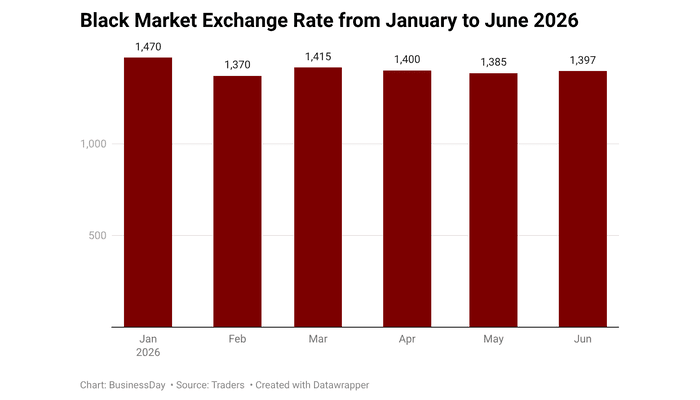
…Black market rate weakens to N1,425/$
Nigeria’s currency, the naira, is coming under renewed pressure in the parallel foreign exchange (FX) market as seasonal demand for dollars for summer travel, overseas school fees and business trips gathers momentum, widening the gap with the official exchange rate.
Data collated from currency dealers showed the naira, which strengthened to about N1,370/$ in February 2026, depreciated to N1,425/$ on Thursday, representing a loss of N55 or 3.86 percent. Consequently, the spread between the official and parallel market exchange rates has widened to about N46, from near-zero levels recorded four months ago.
The naira, however, remained largely stable in the official market. Data from the Nigerian Foreign Exchange Market (NFEM) showed the local currency closed at N1,378.43/$ on Thursday, a marginal 64 kobo appreciation from N1,379.07/$ on Wednesday. The highest bid rate during the trading session was N1,380/$.
Despite the pressure in the parallel market, Nigeria’s external reserves, which provide the Central Bank of Nigeria (CBN) with ammunition to support the currency, and meet external obligations, continued to rise. Gross reserves increased to $51.71 billion as of July 8, 2026, representing a 38.71 percent increase from $37.28 billion recorded in the corresponding period of 2025, according to data on the CBN website.
Commenting on the development, Ayokunle Olubunmi, head of Financial Institutions Ratings at Agusto & Co., attributed the renewed pressure primarily to seasonal demand.
“Definitely, it’s due to demand for summer travel and school fees,” he said, adding that the lingering impact of the Dangote IPO and political activities ahead of the elections are also contributing to increased demand for foreign exchange.
Uche Uwaleke, professor of Capital Market at Nasarawa State University and president of the Capital Market Academics of Nigeria, agreed that seasonal factors typically increase demand for foreign exchange and can widen the premium between the official and parallel markets.
According to him, however, such factors alone do not explain a significant divergence between the two exchange rates.
“A widening gap more often reflects a combination of factors: insufficient supply in the official market, expectations of further naira depreciation, portfolio outflows or delayed inflows, as well as speculative and precautionary dollar purchases,” Uwaleke said.
“So, school fees and summer travel can add pressure, but by themselves they are unlikely to fully explain a significant divergence between the official and parallel exchange rates.”
The CBN’s February 2026 monthly economic report showed that net foreign exchange inflow into the economy moderated to $6.92 billion, compared with $9.22 billion in January. Aggregate FX inflows declined to $9.43 billion from $12.23 billion, while aggregate outflows also fell to $2.50 billion from $3.01 billion during the same period.
The report also showed that demand for foreign exchange remained concentrated in the productive sectors. The industrial sector accounted for the largest share of visible import FX utilisation at 37.90 percent, followed by manufactured products with 25.04 percent and the oil sector with 19.63 percent, reflecting continued reliance on imported raw materials, machinery and petroleum products.
Food products accounted for 10.57 percent of total FX utilisation, while the transport sector represented 5.25 percent. The minerals and agricultural sectors accounted for 1.04 percent and 0.57 percent, respectively.
As part of efforts to improve access to foreign exchange while maintaining market stability, the CBN in May introduced a partial relaxation of its cashless policy on Personal Travel Allowance (PTA) and Business Travel Allowance (BTA) under the revised Foreign Exchange Manual, which took effect on June 1, 2026.
Under the new framework, 75 percent of PTA and BTA disbursements will continue to be processed electronically through debit or credit cards, while 25 percent may now be paid in cash dollars, partially reversing the apex bank’s 2024 directive that required all PTA and BTA transactions to be settled electronically.
The revised FX Manual also increased the allowable advance payment for imports from 15 percent to 30 percent, introduced free processing of Form NXP, expanded provisions for service exports, Pan-African Payment and Settlement System (PAPSS) transactions and non-resident investment accounts, and permits tuition fee payments of up to $25,000 per semester for undergraduate and postgraduate studies abroad.
Olayemi Cardoso, governor of the CBN, said the revised FX Manual aligns Nigeria’s foreign exchange administration with international best practices and is designed to improve transparency, operational efficiency and investor confidence while strengthening the country’s macroeconomic framework.

Join BusinessDay whatsapp Channel, to stay up to date
Open In Whatsapp


