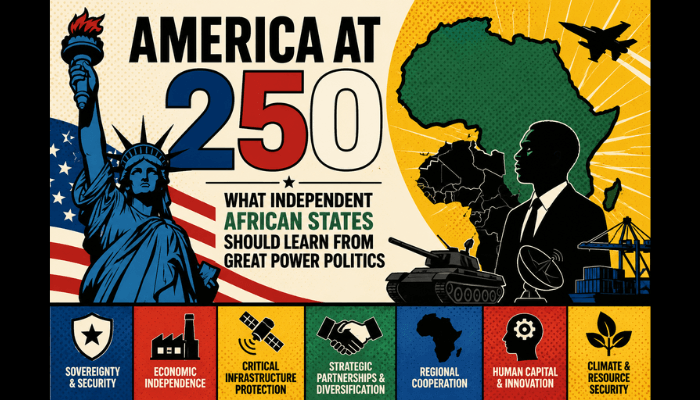
As the United States marks the 250th anniversary of its independence, African policymakers have an opportunity to look beyond the celebrations and ask a more strategic question: what lessons does the rise of a global superpower hold for a continent seeking greater sovereignty, security and economic resilience?
For Africa, the answer is not to emulate the United States wholesale, nor to reject its experience outright. Rather, it is to understand that powerful states pursue their national interests relentlessly. Every major power—whether the United States, China, Russia, India, Türkiye, the European Union or the Gulf states—ultimately acts according to its own strategic priorities. Independent African countries must therefore develop the capacity to define and defend their own.
“The continent should likewise strengthen regional security cooperation. The African Union and Regional Economic Communities have established mechanisms for peacekeeping, conflict prevention and intelligence sharing.”
The first lesson is that sovereignty The first lesson teaches us that capability sustains sovereignty. by capability. Political independence alone is insufficient if a country cannot secure its borders, protect its institutions or maintain internal stability. Across the Sahel, the Horn of Africa and parts of Central Africa, weak institutions have enabled terrorism, organised crime, insurgencies and external intervention. Security is not merely a military responsibility; it is the foundation upon which economic development, investment and social stability depend.
The second lesson concerns economic independence. Nations that depend overwhelmingly on imported food, energy, manufactured goods and technology remain strategically vulnerable. African governments should view industrialisation as a national security priority. Manufacturing, engineering, and technological innovation in the country make it less reliant on outside suppliers. They also create skilled jobs and make the economy more resilient.
This principle extends directly to the defence sector. Defence industries are not simply about producing weapons; they develop advanced manufacturing, electronics, communications, aerospace engineering and research capabilities that spill over into civilian industries. Countries such as South Africa, Egypt, Morocco and Nigeria have demonstrated the potential for indigenous defence production, but much greater regional cooperation is possible through joint ventures, technology transfer and common procurement programmes.
A third lesson is the importance of protecting critical infrastructure. Modern conflict increasingly targets ports, power stations, telecommunications, financial systems, satellites and undersea communications cables. Cybersecurity, resilient electricity grids, secure digital networks and reliable transport corridors are now strategic assets. A nation whose infrastructure can be disrupted remotely faces risks comparable to conventional military attack.
Africa should also recognise the strategic importance of its critical minerals. The continent possesses significant reserves of cobalt, lithium, manganese, graphite, uranium, platinum and rare earth elements essential for electric vehicles, renewable energy technologies and advanced defence systems. Yet much of this wealth continues to be exported in raw form. Independent African states should prioritise refining, processing and manufacturing at home, allowing more value to remain within African economies while strengthening industrial capability and creating highly skilled employment.
Another important lesson concerns strategic partnerships. African governments should avoid becoming overly dependent on any single external power. Diversified relationships strengthen bargaining power and reduce geopolitical vulnerability. Constructive engagement with Western partners, China, India, Türkiye, the Gulf states and other emerging economies should always be guided by national development objectives rather than ideological alignment. Strategic autonomy does not mean isolation; it means preserving independent decision-making.
The continent should likewise strengthen regional security cooperation. The African Union and Regional Economic Communities have established mechanisms for peacekeeping, conflict prevention and intelligence sharing. These frameworks require greater political commitment, sustainable financing and operational coordination. Terrorism, piracy, organised crime and illegal trafficking do not respect national borders, making collective security increasingly essential.
The maritime domain deserves particular attention. Africa controls some of the world’s most strategically important sea lanes, including access to the Gulf of Guinea, the Red Sea and the Mozambique Channel. Maritime insecurity threatens trade, fisheries, offshore energy infrastructure and commercial shipping. Investment in coast guards, naval forces, maritime surveillance and port security therefore produces both economic and security dividends.
Modern national security also depends upon food and energy resilience. Recent global crises have shown how disruptions to grain exports, fertiliser supplies and fuel markets can rapidly undermine domestic stability. Food insecurity often contributes to migration, communal conflict and political unrest. African governments should therefore regard agricultural productivity, strategic grain reserves, irrigation, fertiliser production and energy diversification as integral components of national defence planning rather than purely economic policies.
Equally important is the development of human capital. Future military and economic competition will increasingly Artificial intelligence, robotics, cyber operations, space technologies, biotechnology, and advanced communications will increasingly drive future military and economic competition. by artificial intelligence, robotics, cyber operations, space technologies, biotechnology and advanced communications. African universities, research institutions and military academies should expand programmes in engineering, computer science, cybersecurity, defence technology and applied research. Long-term competitiveness depends less upon imported equipment than upon the quality of domestic expertise.
The information domain has become another battlefield. Modern conflicts are increasingly fought through cyberattacks, disinformation campaigns, election interference and manipulation of public opinion. Independent African states require stronger cyber defence capabilities, professional intelligence services and resilient digital infrastructure while also promoting media literacy and protecting democratic institutions. Building resilience against information warfare is now as important as maintaining conventional military readiness.
Political stability and accountable governance remain fundamental. Investors seek predictable legal systems, transparent procurement, independent institutions and responsible fiscal management. Defence spending should therefore be accompanied by effective parliamentary oversight, professional procurement systems and robust anti-corruption measures to maximise operational effectiveness and maintain public confidence.
Climate security also deserves greater attention. Desertification, flooding, prolonged drought and environmental degradation increasingly contribute to displacement, food shortages and competition over natural resources. National security planning should incorporate disaster preparedness, environmental resilience and humanitarian response alongside traditional defence capabilities.
The African Continental Free Trade Area presents a historic opportunity to strengthen regional industrial cooperation. Integrated supply chains for pharmaceuticals, aerospace maintenance, electronics, vehicle production, defence manufacturing and mineral processing could significantly reduce import dependence while increasing intra-African trade. Greater industrial integration would also improve strategic resilience during global disruptions.
Perhaps the most enduring lesson from two and a half centuries of American state-building is that national power accumulates gradually. It is built through sustained investment in infrastructure, education, science, innovation, financial institutions and industrial capacity over generations. Military strength alone cannot secure prosperity, just as economic growth without security cannot guarantee national stability.
As the international system becomes increasingly multipolar, African governments possess greater strategic flexibility than at any point since independence. They should use this opportunity to negotiate from positions of confidence, strengthen domestic institutions, deepen regional integration and pursue policies designed around African priorities rather than external competition.
America’s 250th anniversary is ultimately less important for what it says about the United States than for what it reminds Africa about statecraft. Durable national power is neither accidental nor imported. It is built patiently through capable institutions, economic transformation, technological innovation, disciplined governance and strategic foresight.
For Africa’s independent states, the next twenty-five years may prove even more consequential than America’s last 250. If the continent can convert its youthful population, abundant natural resources, expanding markets and growing technological capacity into productive national strength, it will increasingly shape global affairs rather than simply respond to them. That is the enduring lesson of great-power politics: nations that invest consistently in their own capabilities are ultimately best positioned to determine their own future.

Join BusinessDay whatsapp Channel, to stay up to date
Open In Whatsapp