

…Insists controversy belongs to Presidency, says lawmakers won’t investigate without petition
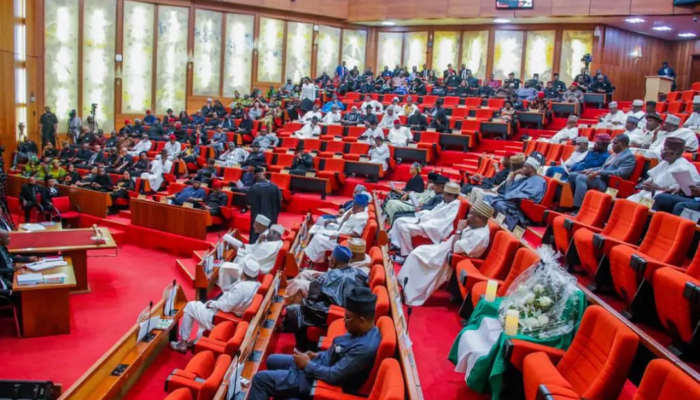
The Senate on Tuesday sought to distance the National Assembly from the deepening controversy surrounding the disputed Presidential Foreign Intervention Promotion Council (PFIPC), insisting that lawmakers neither created nor inserted the agency into the 2026 Appropriation Act despite its controversial appearance in the federal budget.
Instead, the upper chamber said responsibility for explaining how the agency found its way into the national budget rests squarely with the Executive, describing the matter as an internal dispute within the Presidency that falls outside the Senate’s immediate legislative remit.
The position marks the first official response by the National Assembly since the controversy erupted, with the Presidency and the council’s purported Director-General trading allegations over the existence of the agency and the circumstances surrounding its budgetary allocation.
Speaking with journalists after Tuesday’s plenary, Yemi Adaramodu, Senate spokesman, said the Senate would not be drawn into the controversy because no petition had been formally laid before it.
More significantly, however, he rejected insinuations that the legislature inserted the agency into the budget during the appropriation process.
“The budget line being referred to was not created or inserted by the National Assembly.
Read also: Gbajabiamila threatens N10bn suit against fake agency DG over bribery, murder allegations
“It is not the duty of the Senate or the House of Representatives to carry out security checks on those supposedly appointed to head the various MDAs,” Adaramodu said.
His remarks come as questions continue to mount over how an agency whose legal existence has been publicly disputed by the Presidency secured a budgetary allocation in the 2026 fiscal year.
The controversy has thrown fresh scrutiny on Nigeria’s budget preparation process and the checks undertaken before public funds are appropriated to ministries, departments and agencies.
The crisis began after Femi Gbajabiamila, the Chief of Staff to President Bola Tinubu, publicly disowned the Presidential Foreign Intervention Promotion Council and its purported Director-General, Adeniyi Adeyemi, describing both as unauthorised.
Adeyemi, however, fired back, insisting that the council was known to senior officials within the Presidency. He further alleged that Gbajabiamila collected N400 million from him in connection with his appointment and later demanded 48 per cent of the N1.3 billion appropriated to the council in the 2026 budget.
Those allegations have intensified public interest in the agency, particularly after reports indicated that the PFIPC appears as a beneficiary of federal appropriations despite questions surrounding its legal status.
Asked whether the Senate intended to launch its own investigation into the matter, Adaramodu said the upper chamber could not act based on media reports or allegations exchanged between feuding parties.
“The allegations and counter-allegations over the fake agency and fake Director-General are all within the Executive and should be sorted out there, specifically between the Office of the Chief of Staff and the alleged Director-General,” he said.
He maintained that the Senate’s constitutional responsibilities do not include verifying the authenticity of agencies or conducting background checks on presidential appointees who are not subject to legislative confirmation.
“If the alleged Director-General were one of the presidential appointees screened and confirmed by the Senate, the controversy might have been perceived to be linked to us. That is not the situation here.”
The Senate spokesman also disclosed that the matter has already assumed a legal dimension, making legislative intervention inappropriate at this stage.
“Being a matter already before the court, the Senate, in line with its rules, will not dabble into it.”
Nevertheless, he left the door open for future legislative scrutiny should the matter come before the Senate through established procedures.
“If a petition is sent to the Senate by any of the feuding parties or by any concerned Nigerian on the existence or non-existence of the agency or the Director-General, it will be legislatively looked into.”
The Senate’s response effectively shifts the burden of accountability back to the Executive, even as the controversy continues to raise broader questions about governance, transparency and fiscal oversight.
The dispute has also exposed potential gaps in the budget process, with analysts expected to question how agencies with disputed legal status are captured in federal spending plans and whether existing vetting mechanisms are sufficiently robust.

Join BusinessDay whatsapp Channel, to stay up to date
Open In Whatsapp


