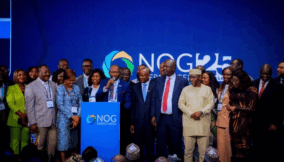
The Nigerian National Petroleum Company (NNPC) Limited said it saved a staggering $3.4 billion over the past year by aggressively restructuring and optimizing its joint venture and production sharing contracts.
Bayo Ojulari, Group chief executive officer disclosed this at the NOG conference in Abuja on Tuesday, stating that the company also recorded an average 98 percent recovery across its five crude oil export terminals between April 2025 and May 2026, compared with operational lows of about one per cent at the Bonny Oil and Gas Terminal in June 2022.
Ojulari also announced that Nigeria’s crude oil production has risen to 1.71 million barrels per day—the highest level in five years—while NNPC Exploration and Production Limited (NEPL) achieved a record production of 365,000 barrels per day.
He added that gas production reached 7.5 billion standard cubic feet per day, driven by the successful completion of the River Niger crossing on the Ajaokuta-Kaduna-Kano (AKK) Gas Pipeline and the commissioning of the ANOH Gas Processing Plant.
According to him, NNPC Ltd maintained 100 per cent compliance with all Joint Venture cash call obligations throughout 2025 and up to June 2026, while sustaining its drive toward achieving crude oil production of two million barrels per day.
Read also: FG admits oil demand from US, Europe, Middle East outstrips supply
Since the last NOG Energy Week, he said, the Company has signed landmark Gas Sale and Purchase Agreements (GSPAs) covering 1.29 billion standard cubic feet per day for long-term LNG feed gas and 750 million standard cubic feet per day for domestic industrial gas supply to DFL FZE and Dangote Refinery.
“These agreements represent more than US$20 billion in associated investments, with seven additional commercial transactions in the pipeline,” Ojulari said.
The GCEO further revealed that NNPC Ltd resumed full monthly remittances to the Federation Account in July 2025, reinstated monthly business performance reporting and hosted its first-ever earnings call in November 2025, reinforcing the Company’s commitment to transparency, accountability and investor confidence.
He urged stakeholders to move beyond transactional relationships to strategic partnerships, from isolated projects to integrated value chains, and from exporting raw resources to building competitive industrial economies.
“At NNPC Limited, we see ourselves not just as an energy producer but as an ecosystem builder—connecting capital, technology, policy, talent and markets to create lasting value for Nigeria and Africa.
“Across the continent, we still witness insufficient alignment between resource owners and operators; between investors and projects; between innovation and execution; between policy and capital; between research and commercialization.
“The energy industry is one of the most interconnected industries in the world. Its success depends not on the strength of a single organisation, but on the collective effectiveness of an entire ecosystem.
“A producing field requires world-class technical and operating partners capable of deploying technology, expertise and operational discipline. Projects require strong financial institutions willing to provide patient and competitive capital across volatile commodity cycles,” he said.
Describing the energy sector as one of the world’s most interconnected industries, Ojulari said no single organisation could unlock Africa’s energy potential alone.
Ojulari identified fragmented collaboration as one of the biggest barriers to Africa’s energy transformation, noting that weak linkages between resource owners and operators, investors and projects, innovation and execution, and policy and capital continue to constrain growth.
Despite holding about 17 per cent of global natural gas reserves alongside vast oil and renewable energy resources, he observed that Africa still attracts only a small share of global energy investment.
He urged governments, national oil companies, investors, regulators, financiers, academia and service providers to work together to position Africa as a global hub for energy investment, technology and value creation.
“The future of African energy will not be determined solely by the resources beneath our soil, but by the quality of the partnerships we forge above it. The opportunity before us is extraordinary. The responsibility is ours. And the time to act is now.”
Read also:Elektron expands solar capacity at Jabi Lake Mall
“The industry depends on capable service providers, both in the subsurface and surface domains, who convert geological potential into reliable production and transform infrastructure into commercial value. It requires regulators who provide clarity, consistency and predictability.
“It requires universities, research institutions and innovation centres that continuously develop the talent, technologies and solutions that will power future growth.
And perhaps most importantly, it requires governments, communities and industry leaders who recognise that long-term collaboration creates more value than short-term competition. When any one of these links is weak, investment slows, when several are weak, projects stall.
When all are disconnected, nations remain resource-rich but prosperity-poor,” he added.

Join BusinessDay whatsapp Channel, to stay up to date
Open In Whatsapp