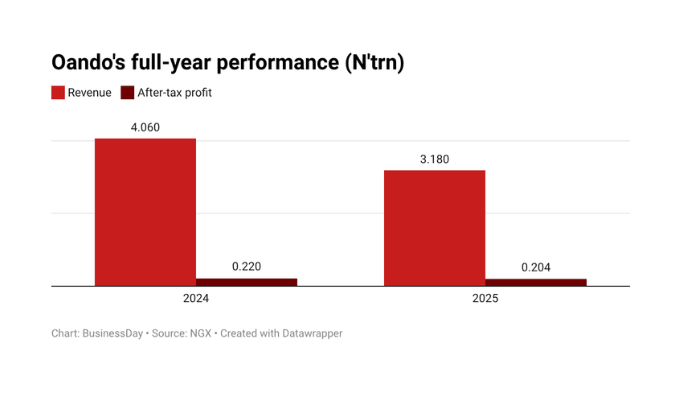
Oando Plc, in its audited financial statement for the period ended December 31st, 2025, reported an after-tax profit of N204.8 billion, even as revenue declined by more than 22 percent.
The Nigerian energy group’s audited full-year financial statements show profit after tax eased slightly from N220.1 billion in 2024 to N204.8 billion, while profit attributable to shareholders stood at N204 billion. Earnings per share rose to N23 from N18, supported by changes in the company’s share capital structure during the year.
Revenue declined to N3.18 trillion from N4.09 trillion in 2024, representing a 22.2 percent decrease, reflecting weaker trading activity following an exceptionally strong prior year.
The Group reported a gross loss of N2.8 billion in FY 2025, compared with a gross profit of N93.3 billion in FY 2024, reflecting margin pressure arising from a higher operating cost base associated with the expanded asset portfolio and transition to operatorship.
Although the cost of sales declined during the period, broadly in line with lower trading activity and associated input costs, gross margins were impacted by increases in staff costs, logistics, security expenses, regulatory levies, depreciation, and inventory valuation adjustments.
More importantly, other operating income almost doubled to N203.8 billion. At the same time, the group recognised a N441.5 billion reversal of impairment on financial assets, compared with an impairment charge of N76.2 billion a year earlier. These gains largely compensated for weaker sales.
The group recorded an operating profit of N240.9 billion in FY 2025 from N569.7 billion reported in 2024, representing a decline of 57.7 percent, which reflects normalised operating performance following the N784.8 billion non-recurring gain on bargain purchase recognised in FY 2024 on the NAOC acquisition. Excluding this one-off, underlying operating performance improved materially year-on-year.
Finance costs remained elevated at N394.7 billion, although finance income increased substantially to N288 billion, reducing net finance costs to N106.9 billion, significantly lower than the N188.6 billion recorded in 2024.
The most significant earnings support came from taxation. Rather than recording a tax expense, Oando recognised a tax credit of N69 billion, reversing the N163.7 billion tax expense booked in the previous year and lifting net earnings.
Balance sheet expands following NAOC acquisition
Oando’s balance sheet strengthened considerably during the year.
- Shippers Council assures exporters of timely cargo evacuation after BusinessDay story
- WORLD IN BRIEF: Charlie Kirk murder case heads to court, Microsoft cuts 4,800 jobs, Senegal's president plans new political party and other stories
- Meet Emmanuel Nnorom poised to take over from Elumelu as UBA Chair
Total assets increased by 15.7 percent to N7.45 trillion from N6.43 trillion, reflecting the continuing integration of Nigerian Agip Oil Company (NAOC) assets and increased liquidity. Cash and cash equivalents almost doubled to N439.9 billion from N221.8 billion, while short-term investments rose more than tenfold to N29.6 billion.
Trade receivables also climbed to N2.19 trillion from N750.3 billion, highlighting higher working capital tied to operations.
On the liability side, the company made measurable progress in reducing debt. Non-current borrowings declined to N616.5 billion from N1.46 trillion, although current borrowings increased to N2.08 trillion, indicating a greater concentration of short-term debt obligations. Total trade and other payables rose sharply to N4.08 trillion from N2.55 trillion, underscoring continued reliance on supplier and operating liabilities.
Decommissioning provisions fell significantly to N417.4 billion from N672.7 billion, following revisions to estimates.
Despite reporting another profitable year, Oando remained in a negative equity position, with total equity standing at negative N566.9 billion, although this improved from negative N361 billion in 2024. Retained losses narrowed substantially to N88.5 billion from N292.5 billion, reflecting accumulated profits during the year.
Cash flow turns positive
One of the strongest features of the 2025 results was the improvement in cash generation.
Net cash generated from operating activities reached N32.3 billion, reversing a N535.3 billion cash outflow recorded in 2024. This marked a significant turnaround in the group’s ability to generate cash from its core business despite lower revenue.
Investing activities also improved dramatically. Net cash generated from investing activities amounted to N97.6 billion, compared with a N869.3 billion outflow in 2024, largely because the previous year’s acquisition-related investments were not repeated.
Financing cash inflows, however, moderated considerably. Net cash generated from financing activities fell to N165.7 billion from N1.43 trillion, reflecting lower borrowings and continued debt repayments. During the year, the company borrowed N1.02 trillion while repaying N863.1 billion of existing loans.
Overall, cash and cash equivalents increased to N422.9 billion, almost tripling from N155.3 billion a year earlier.
Oando began the year with a share price of N40.20 and is currently trading at N41.45 at the end of closing on Monday, July 6, 2026, gaining 3.11 percent on that price valuation, ranking it 84th on the NGX in terms of year-to-date performance.

Join BusinessDay whatsapp Channel, to stay up to date
Open In Whatsapp