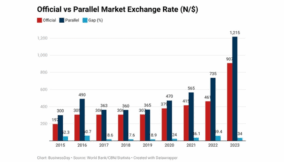
Recently, the International Monetary Fund (IMF) and some prominent Nigerians have called for further devaluation of the nation’s currency against the dollar chiefly on account of the country’s shrinking oil revenue. In November 2014, the Central Bank of Nigeria (CBN) had devalued the naira from N155/US$ to N168/US$ apparently in response to declining crude oil price and continuous pressure on the country’s external reserves. Barely three months after, another round of devaluation saw the naira plunging to N198/US$ following the closure of the Dutch auction window of the foreign exchange market by the central bank.
In theory, devaluation – a decision by a government to adjust the value of a currency downward relative to another currency – brings about an increase in exports and a decrease in imports as exports become cheaper and imports more expensive. The multiplier effect of this is seen in increased output, job creation and improved balance of payments. So, will devaluation of the naira, in our present circumstance, bring about improved macroeconomic performance? This article presents some arguments why theoretically positive effects from devaluation may prove elusive for Nigeria.
First, while net exporting countries such as China use devaluation to boost exports because the prices of local products become cheaper to foreign buyers, a mono-product economy like Nigeria may not reap the benefits of increased exports in the wake of currency devaluation due to the country’s shallow export base. Owing to structural peculiarities of the Nigerian economy, currency devaluation is not likely to support a better foreign trade balance. This is because as a net importing country, devaluation would result in more costly imports than any export revenue growth could compensate for.
Also, since most of the country’s basic goods are imported, devaluation of the naira against the dollar will lead to an increase in the cost of basic food items and a rise in headline inflation. In fact, currency devaluation will undermine the performance of Micro Small and Medium Enterprises (MSMEs) since the input of this sector is mostly imported. The high cost of living which comes with weaker naira will also reduce consumer demand with adverse consequences on industrial capacity utilisation and rate of employment. A study by Mahmoud and Ahmed (2013) on the impact of naira devaluation on the manufacturing sector of the Nigerian economy revealed a negative impact on capacity utilization as most of the sampled firms experienced reduced capacity utilization, declining productivity and high incidence of layoffs.
Similarly, currency devaluation erodes the value of wages and salaries. In view of the fact that the public sector is a major employer of labour in Nigeria, the reduction in purchasing power will most likely lead to pressure to increase wages. The experience of Malawi is instructive. Gumede (2015) reported that devaluation of Malawi’s currency pushed up public sector wages and the hardships caused by the devaluation led to popular protests that partly resulted in former Malawian President Joyce Banda losing the May 2014 elections.
Furthermore, devaluation will make interest payments on Nigeria’s external debt more expensive. This may not be much of an issue now considering the relatively small size of Nigeria’s external debt component but will certainly be reckoned with in future as more foreign debts are procured. In addition, the impact of naira devaluation on the stock market is likely to be negative since investors will shun the market if real returns are negative on account of rising inflation.
There is also a psychological angle to currency devaluation. According to Cooper (1991), a strong currency is commonly seen as a mark of prestige while devaluation is associated with weak governments.
Based on the foregoing, it is important therefore that the central bank does not succumb to calls to devalue the naira simply because the Nigerian economy is not yet diversified and until this is done, naira devaluation will prove to be a process without end that will ultimately lead to a completely worthless currency.
The way forward therefore is to diversify the economy by exploiting the opportunities in agriculture and solid minerals in particular. MSMEs in Nigeria should be incentivised to increase their output as well as improve competitiveness such that consumers do not consider locally-made goods inferior to foreign goods. Given its sheer size of aggregate demand, government patronage of these firms could make a significant impact. Currently before the National Assembly is the Local Industry Patronage Bill 2015 which seeks to compel government ministries, departments and agencies (MDAs) to patronize local manufacturers and indigenous companies in the procurement of goods and services (BusinessDay, November 17, 2015, pg 1). This is a welcome development that is expected to conserve foreign exchange and create the much-needed employment opportunities for the teeming youths.
Uchenna J. Uwaleke

Join BusinessDay whatsapp Channel, to stay up to date
Open In Whatsapp